Elements in Political Psychology - Böcker
Visar alla böcker i serien Elements in Political Psychology. Handla med fri frakt och snabb leverans.
8 produkter
8 produkter
In Defense of Ideology
Reexamining the Role of Ideology in the American Electorate
Häftad, Engelska, 2023
234 kr
Skickas inom 7-10 vardagar
Years of collective political science research has fueled the stereotype of the uninformed or illogical American voter who ardently supports parties or candidates but lacks any cohesive ideological reasons for doing so. Prior works, however, do not tell the whole story nor fully capture the nature of public opinion in today's increasingly polarized political environment. Thus, this Element makes the case for more careful and nuanced assessments of ideological thinking in the American electorate. Using a variety of more contemporary survey and experimental data, it shows that a substantial portion of Americans do hold coherent political beliefs and that these beliefs have important consequences for the American political system. Though partisanship still plays a powerful role, the electorate as this Element presents it is much more ideological than the literature too often assumes.
216 kr
Skickas
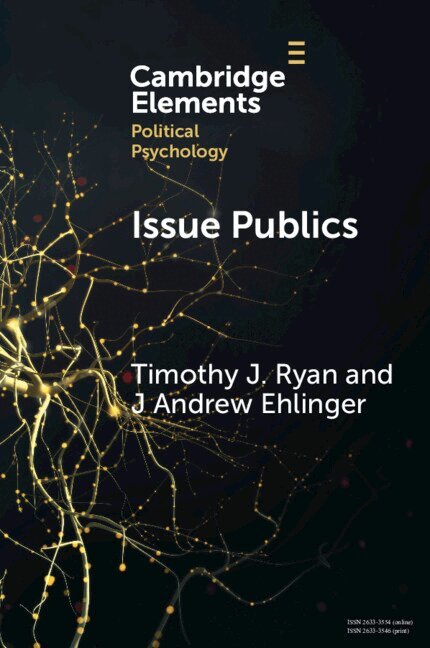
An often-forgotten passage of Philip Converse's classic essay on mass belief systems introduced the concept of an issue public - a segment of voters that has crystallized attitudes about a particular topic. Some people deeply care about particular topics, and they might be equipped to reach judgments on these topics. This simple idea could provide an important corrective to work that casts citizens' political competence in a negative light. But, previous attempts to evaluate the issue publics hypothesis have been unsatisfying. This Element proposes and tests a new measurement approach for identifying issue publics. The evidence gathered leads to the conclusion that issue publics exist, but are smaller and more particularistic than existing scholarship presumes them to be. As such, researchers underappreciate the significance of issue opinions in electoral politics.
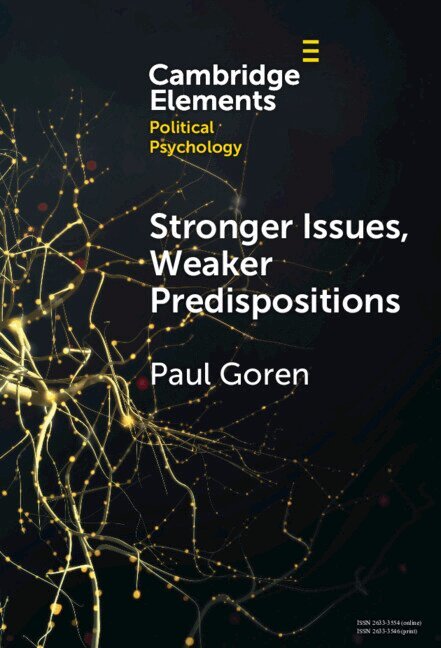
Stronger Issues, Weaker Predispositions
Abortion, Gay Rights, and Authoritarianism
Inbunden, Engelska, 2025
753 kr
Skickas inom 7-10 vardagar
Political psychologists have long theorized that authoritarianism structures the positions people take on cultural issues and their party ties. Authoritarianism is durable; it resists the influence of other political judgments; and it is very impactful-in a word, it is strong. By contrast, researchers characterize the attitudes most people hold on most issues as unstable and ineffectual-in a word, weak. But what is true of most issues is not true of the issues that have driven America's long running culture war-abortion and gay rights. This Element demonstrates that moral issue attitudes are stronger than authoritarianism. With data from multiple sources over the period 1992-2020, it shows that (1) moral issue attitudes endure longer than authoritarianism; (2) moral issues predict change in authoritarianism; (3) authoritarianism does not systematically predict change in moral issues; and (4) moral issues have always played a much greater role structuring party ties than authoritarianism.
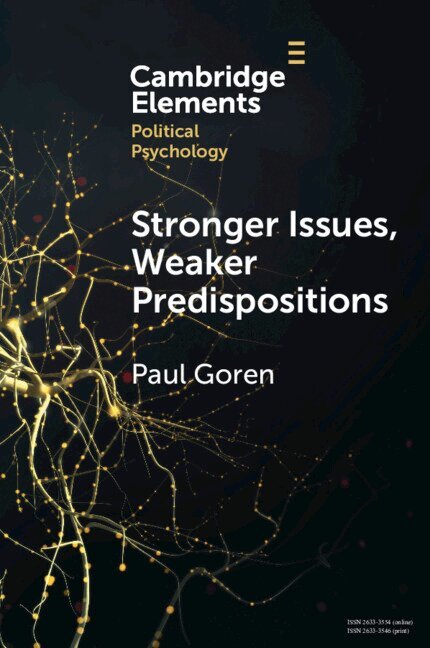
Stronger Issues, Weaker Predispositions
Abortion, Gay Rights, and Authoritarianism
Häftad, Engelska, 2025
234 kr
Skickas inom 7-10 vardagar
Political psychologists have long theorized that authoritarianism structures the positions people take on cultural issues and their party ties. Authoritarianism is durable; it resists the influence of other political judgments; and it is very impactful-in a word, it is strong. By contrast, researchers characterize the attitudes most people hold on most issues as unstable and ineffectual-in a word, weak. But what is true of most issues is not true of the issues that have driven America's long running culture war-abortion and gay rights. This Element demonstrates that moral issue attitudes are stronger than authoritarianism. With data from multiple sources over the period 1992-2020, it shows that (1) moral issue attitudes endure longer than authoritarianism; (2) moral issues predict change in authoritarianism; (3) authoritarianism does not systematically predict change in moral issues; and (4) moral issues have always played a much greater role structuring party ties than authoritarianism.
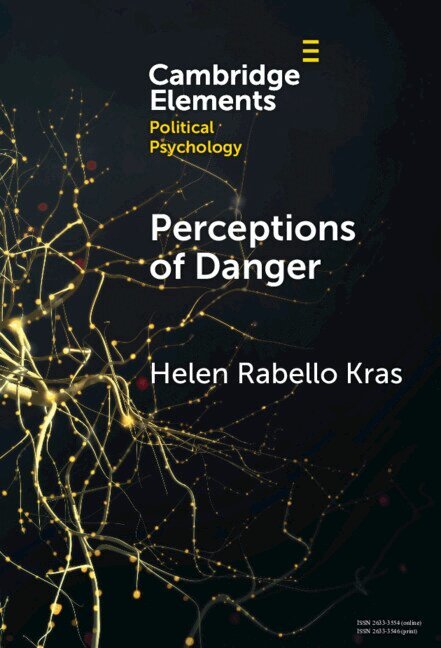
Perceptions of Danger
How Risk Assessments Underpin Attitudes on Crime and Intimate Partner Violence
Inbunden, Engelska, 2026
753 kr
Kommande
This Element explores how citizens understand general crime and violence against women, especially intimate partner violence (IPV). Drawing on interdisciplinary literature, this Element makes the case that cognitive heuristics and risk assessments, in particular, shape the way people see crime versus IPV. The central argument is that cognitive heuristics that generate risk perceptions help us understand why the public worries excessively about crime, with important political consequences, while downplaying IPV. This fosters distinct attitudes toward IPV and general crime. Accordingly, this Element sheds light on why victim-blaming is so prevalent in the context of IPV. Using original survey experiments from Brazil and Mexico, the study shows that respondents attribute more responsibility for prevention to the victim for IPV than for general crimes, display optimism bias with acquaintance victimization, and approve different types of policy remedies to deal with general crime and IPV.
Perceptions of Danger
How Risk Assessments Underpin Attitudes on Crime and Intimate Partner Violence
Häftad, Engelska, 2026
234 kr
Kommande
This Element explores how citizens understand general crime and violence against women, especially intimate partner violence (IPV). Drawing on interdisciplinary literature, this Element makes the case that cognitive heuristics and risk assessments, in particular, shape the way people see crime versus IPV. The central argument is that cognitive heuristics that generate risk perceptions help us understand why the public worries excessively about crime, with important political consequences, while downplaying IPV. This fosters distinct attitudes toward IPV and general crime. Accordingly, this Element sheds light on why victim-blaming is so prevalent in the context of IPV. Using original survey experiments from Brazil and Mexico, the study shows that respondents attribute more responsibility for prevention to the victim for IPV than for general crimes, display optimism bias with acquaintance victimization, and approve different types of policy remedies to deal with general crime and IPV.
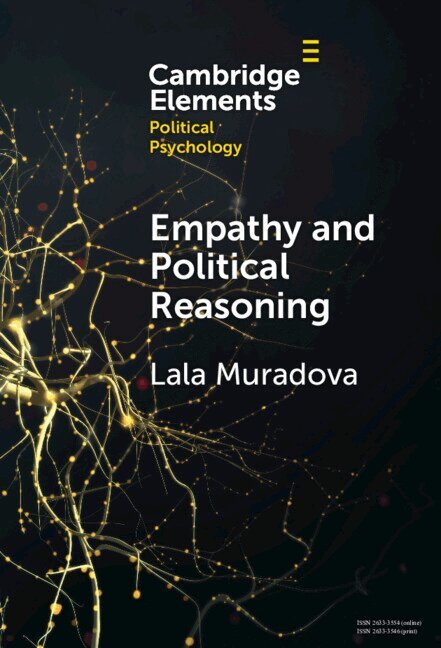
Empathy and Political Reasoning
How Empathy Promotes Reflection and Strengthens Democracy
Inbunden, Engelska, 2025
731 kr
Skickas inom 7-10 vardagar
How do individuals make up their mind about politics? This question has sparked a vigorous debate in the study of political behavior for the last few decades. Some scholars contend that citizens can and should engage in political reflection, while others highlight biases in human political reasoning that make reflection impossible. This Element is about the conditions under which citizens can be motivated to transcend their egocentric biases and engage in reflection. Rather than asking whether citizens are capable of reflection, it shifts focus to a more productive question: how to motivate reflection. Firstly, it argues that (situational) empathy for the other side can inspire citizens to think reflectively about politics. Secondly, the Element proposes that deliberative institutions have the potential to evoke empathy for the other side in individuals. Thirdly, it draws on experimental and qualitative data from Belgium, Chile, Ireland, and the UK to test the theoretical expectations.
Empathy and Political Reasoning
How Empathy Promotes Reflection and Strengthens Democracy
Häftad, Engelska, 2025
227 kr
Skickas inom 7-10 vardagar
How do individuals make up their mind about politics? This question has sparked a vigorous debate in the study of political behavior for the last few decades. Some scholars contend that citizens can and should engage in political reflection, while others highlight biases in human political reasoning that make reflection impossible. This Element is about the conditions under which citizens can be motivated to transcend their egocentric biases and engage in reflection. Rather than asking whether citizens are capable of reflection, it shifts focus to a more productive question: how to motivate reflection. Firstly, it argues that (situational) empathy for the other side can inspire citizens to think reflectively about politics. Secondly, the Element proposes that deliberative institutions have the potential to evoke empathy for the other side in individuals. Thirdly, it draws on experimental and qualitative data from Belgium, Chile, Ireland, and the UK to test the theoretical expectations.