Expression of Cognitive Categories [ECC] - Böcker
Visar alla böcker i serien Expression of Cognitive Categories [ECC]. Handla med fri frakt och snabb leverans.
11 produkter
11 produkter
2 783 kr
Skickas inom 5-8 vardagar
This book covers the essentials of modality and offers both foundational ideas and cutting edge advances. The book consists of what are essentially tutorials on modality and modal notions, covering definitions of modality, morphosyntactic form, conceptual and logical semantics, historical development, and acquisition. There are also specific chapters on modality in Zapotec and American Sign Language, which show the range of forms that modal notions can take. To assist its tutorial function, the book closes with a comprehensive conceptual outline of all the chapters.Key features: new series textbook covers the essentials of modality
392 kr
Skickas inom 5-8 vardagar
This book covers the essentials of modality and offers both foundational ideas and cutting edge advances. The book consists of what are essentially tutorials on modality and modal notions, covering definitions of modality, morphosyntactic form, conceptual and logical semantics, historical development, and acquisition. There are also specific chapters on modality in Zapotec and American Sign Language, which show the range of forms that modal notions can take. To assist its tutorial function, the book closes with a comprehensive conceptual outline of all the chapters.Key features:textbook covers the essentials of modality Well-known editor Cognitive categories are currently among the most important areas of research in linguistics and beyond (biology, psychology)
2 272 kr
Skickas inom 5-8 vardagar
This collection of nine original articles deals with the expression of possession at various levels of grammar, morphological, phrasal, and syntactic, and from a typologically diverse range of languages (including Germanic, Oceanic, Meso-American, and Australian Aboriginal). There are two main aims. The first is to reveal something of the range of constructions employed cross-linguistically in the expression of possession, and second, to present an understanding of the possessive relation itself as a cognitive and linguistic phenomenon. A guiding principle in the selection of contributors has been to invite linguists whose research, while not necessarily directly dealing with possession, touches on it, and indicates that they are likely to provide fresh perspectives on this well-trodden field.Key features: William McGregor is a well known expert in this fíeld of research Possession is a paradigm for studies on typology, ethnology etc., because a multitude of linguistic and cultural varieties are reflected in this field new series textbook
713 kr
Skickas inom 5-8 vardagar
Human thought and action is fundamentally shaped by a small set of cognitive categories, such as time, space, causality, or possession. It is not surprising, therefore, that all natural languages have developed many devices to express these categories. Temporality, for example, is reflected in the lexical meaning of verbs, in grammatical marking of tense and aspect, in time adverbials, in special particles, and in the application of discourse principles. Many of these devices have been the subject of intensive research across languages; but as a rule, this research focuses on particular aspects, it does not look at the expression of such a category as a whole, which is precisely the aim of the present series. The short volumes bring together what is known about the expression of a particular category in human language.
2 272 kr
Skickas inom 5-8 vardagar
Time is the most fundamental category of human cognition and action, and all human languages have developed many devices to express it. These include verbal categories, such as tense and aspect, but also adverbials, particles, and principles of discourse organisation. This book is intended as a tutorial for the study of how time is expressed in natural languages. Its chapters take the reader through a number of foundational issues, such as the various notions of time and the various means to express it; other chapters are devoted to more specific questions, such as the acquisition of time, its modelling in formal semantics and in computational linguistics, or how its expression can be empirically investigated.
392 kr
Skickas inom 5-8 vardagar
Time is the most fundamental category of human cognition and action, and all human languages have developed many devices to express it. These include verbal categories, such as tense and aspect, but also adverbials, particles, and principles of discourse organisation. This book is intended as a tutorial for the study of how time is expressed in natural languages. Its chapters take the reader through a number of foundational issues, such as the various notions of time and the various means to express it; other chapters are devoted to more specific questions, such as the acquisition of time, its modelling in formal semantics and in computational linguistics, or how its expression can be empirically investigated.
2 623 kr
Skickas inom 5-8 vardagar
Negation is a sine qua non of every human language but is absent from otherwise complex systems of animal communication. In many ways, it is negation that makes us human, imbuing us with the capacity to deny, to contradict, to misrepresent, to lie, and to convey irony. The apparent simplicity of logical negation as a one-place operator that toggles truth and falsity belies the intricate complexity of the expression of negation in natural language. Not only do we find negative adverbs, verbs, copulas, quantifiers, and affixes, but the interaction of negation with other operators (including multiple iterations of negation itself) can be exceedingly complex to describe, extending (as first detailed by Otto Jespersen) to negative concord, negative incorporation, and the widespread occurrence of negative polarity items whose distribution is subject to principles of syntax, semantics, and pragmatics. The chapters in this book survey the patterning of negative utterances in natural languages, spanning such foundational issues as how negative sentences are realized cross-linguistically and how that realization tends to change over time, how negation is acquired by children, how it is processed by adults, and how its expression changes over time. Specific chapters offer focused empirical studies of negative polarity, pleonastic negation, and negative/quantifier scope interaction, as well as detailed examinations of the form and function of sentential negation in modern Romance languages and Classical Japanese.
576 kr
Skickas inom 7-10 vardagar
Negation is a sine qua non of every human language but is absent from otherwise complex systems of animal communication. In many ways, it is negation that makes us human, imbuing us with the capacity to deny, to contradict, to misrepresent, to lie, and to convey irony. The apparent simplicity of logical negation as a one-place operator that toggles truth and falsity belies the intricate complexity of the expression of negation in natural language. Not only do we find negative adverbs, verbs, copulas, quantifiers, and affixes, but the interaction of negation with other operators (including multiple iterations of negation itself) can be exceedingly complex to describe, extending (as first detailed by Otto Jespersen) to negative concord, negative incorporation, and the widespread occurrence of negative polarity items whose distribution is subject to principles of syntax, semantics, and pragmatics. The chapters in this book survey the patterning of negative utterances in natural languages, spanning such foundational issues as how negative sentences are realized cross-linguistically and how that realization tends to change over time, how negation is acquired by children, how it is processed by adults, and how its expression changes over time. Specific chapters offer focused empirical studies of negative polarity, pleonastic negation, and negative/quantifier scope interaction, as well as detailed examinations of the form and function of sentential negation in modern Romance languages and Classical Japanese.
2 272 kr
Skickas inom 5-8 vardagar
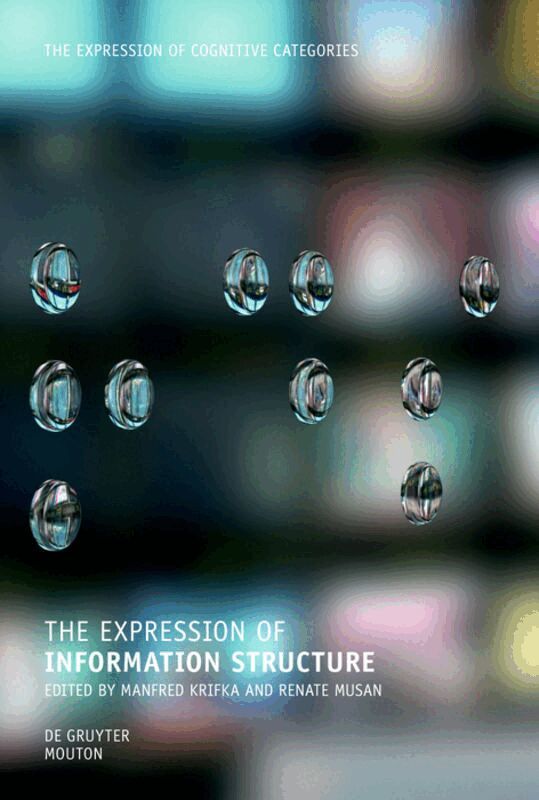
Information structure deals with the linguistic forms and techniques that support the integration of what is said into the current informational and attentional state of the addressee. This shows in categories like topic-comment structuring, focus to highlight expressions, marking of givenness and of presupposed information, and ways to indicate that the information provided is restricted. The book relates infor-mation structure to theoretical models of grammar, to computation and modelling and brings together what is known about the expression of information structure in human language with regard to its empirical investigation, its psycholinguistic aspects and the acquisition of information structure. Since the need to integrate what is said into the informational and attentional state of the addressee is central to all human communication, it is not surprising that all natural languages have developed devices to express information structural cate-gories. To illustrate this, the book also provides concrete and theory independent descriptions of the information structural encoding strategies of individual languages of different types . The book can be used as a textbook appropriate for advanced undergraduate and graduate courses; it also provides information for linguists that are not specialists in the field.
1 886 kr
Skickas inom 7-10 vardagar
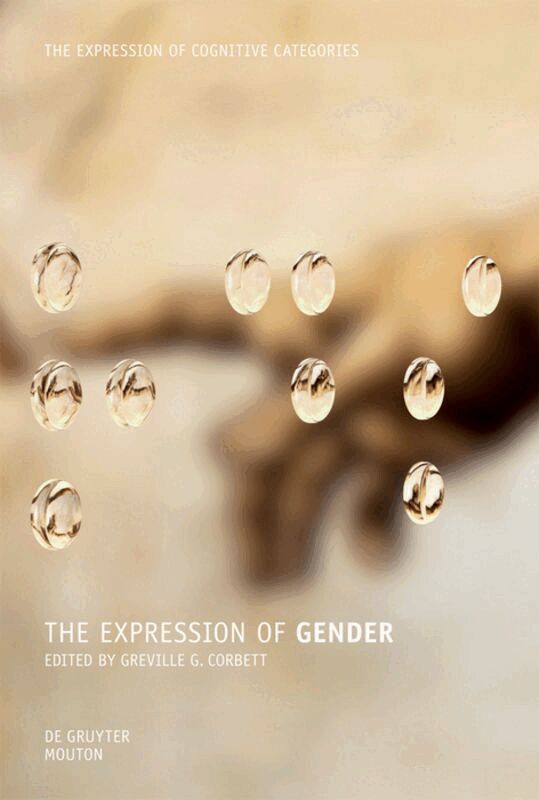
Gender is a fascinating category, which has grown steadily in importance across the humanities and social sciences. The book centres on the core of the category within language. Each of the seven contributions provides an independent account of a key part of the topic, ranging from gender and sex, gender and culture, to typology, dialect variation and psycholinguistics. The authors pay attention to a broad range of languages, including English, Chukchi, Konso and Mohawk.
490 kr
Skickas inom 5-8 vardagar
Gender is a fascinating category, which has grown steadily in importance across the humanities and social sciences. The book centres on the core of the category within language. Each of the seven contributions provides an independent account of a key part of the topic, ranging from gender and sex, gender and culture, to typology, dialect variation and psycholinguistics. The authors pay attention to a broad range of languages, including English, Chukchi, Konso and Mohawk.