Holocaust and Genocide Studies - Böcker
Visar alla böcker i serien Holocaust and Genocide Studies. Handla med fri frakt och snabb leverans.
5 produkter
5 produkter
1 043 kr
Skickas inom 5-8 vardagar
Adorno and the Concept of Genocide examines the legacy of Critical Theory’s foremost authority on life ‘after Auschwitz.’ As a leading member of the Frankfurt School and one of post-war Europe’s most important public intellectuals, Adorno’s reflections on genocide and its relation to contemporary society achieved a level of urgency and insight that remains unparalleled to this day.Assembled here for the first time in English is a wide-ranging collection of essays on the seminal significance of the concept of genocide for Adorno’s thought, as well as the enduring relevance of that thought for our own time. Contributors include: Babette Babich, Ryan Crawford, Tom Huhn, Osman Nemli, Ulrich Plass, Erik M. Vogt, James R. Watson, Markus Zöchmeister
Del 108 - Holocaust and Genocide Studies
Theoretical Interpretations of the Holocaust
Häftad, Engelska, 2001
1 074 kr
Skickas inom 5-8 vardagar
This book aims to show the many resources at our disposal for grappling with the Holocaust as the darkest occurrence of the twentieth century. These wide-ranging studies on philosophy, history, and literature address the way the Holocaust had led to the reconceptualization of the humanities. The scholarly approaches of Pierre Klossowski, Georges Bataille, and Maurice Blanchot are examined critically, and the volume explores such poignant topics as violence, evil, and monuments.
1 663 kr
Skickas inom 5-8 vardagar
If philosophy addresses concrete ethical challenges, then what shifts in basic concepts must be made to the discipline in the darkness of our genocidal world? What anti-genocidal strains are in Western philosophy? Are we “really” rejects and/ or “still of intrinsic worth” when we fail our excellence tests? How are we represented and how do we participate in representations? Are representational forms historical in origin and development? Is genocide indissolubly linked to our degradation and destruction of animals? Can one slaughter and eat one’s partners in a social bond? If so, what does this tell us about the socio-political world we have formed? Is there a deep center—metacide—in our culture from which genocide receives its impulse? These are some of the pivotal questions addressed in the thirteen thought-provoking essays of this volume.
Del 237 - Holocaust and Genocide Studies
Memory of Pain
Women’s Testimonies of the Holocaust
Häftad, Engelska, 2011
1 342 kr
Skickas inom 5-8 vardagar
In this book, Camila Loew analyzes four women’s testimonial literary writings on the Holocaust to examine and question some of the tenets of the fields of Holocaust studies, gender studies, and testimony. Through a close reading of the works of Charlotte Delbo, Margarete Buber-Neumann, Ruth Klüger, and Marguerite Duras, Loew foregrounds these authors’ search for a written form to engage with their experiences of the extreme. Although each chapter contains its individual focus and features, the book possesses a unity in intention, concerns, and consequences. In the theoretical introduction that unites the four chapters, Loew eschews essentialism and revises the emergence of the field of Women and Holocaust studies from the early 1980s on, and signals some of its shortcomings. In response, and in accordance with a recent turn in various disciplines of the Humanities, Loew highlights the ethical dimension of testimony and its responsible commitment to the other. In dealing with the texts as literary testimonies—a complex genre, between literature and history—, testimony is freed from the obligation to respond to the requirements of factual truth, and becomes a privileged form to voice the traumatic event, and to symbolically explore the role of excess.
783 kr
Skickas inom 5-8 vardagar
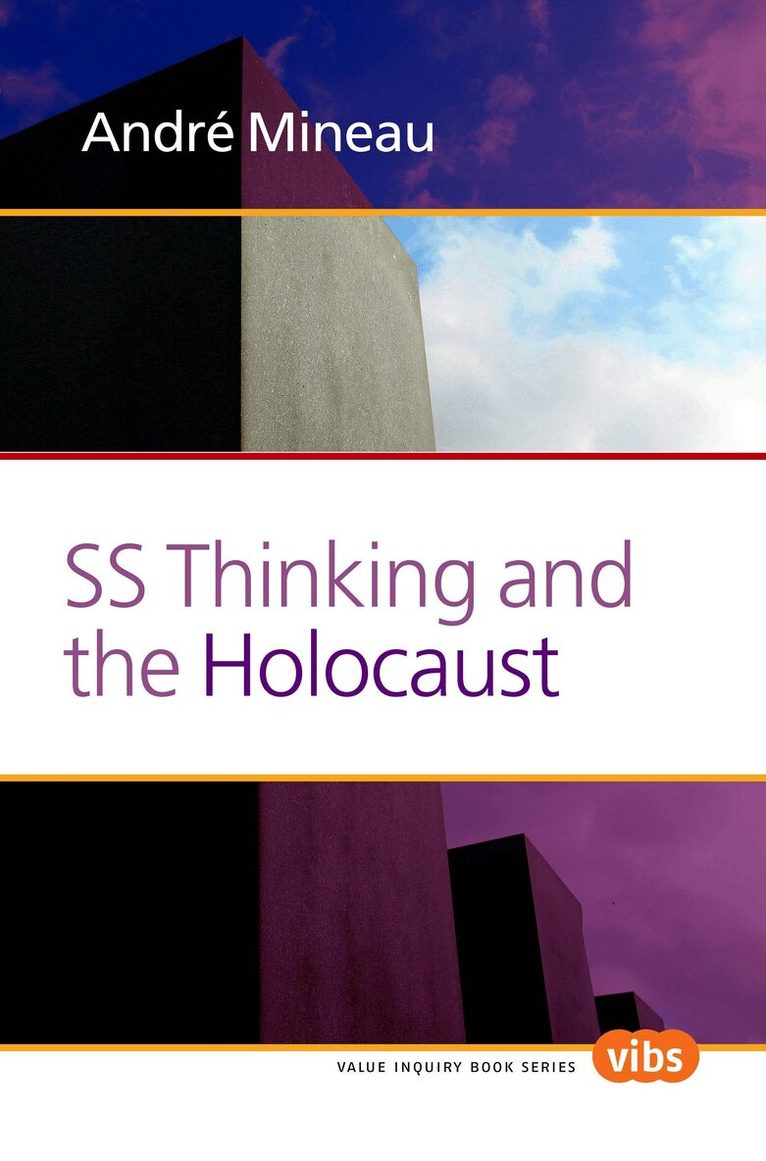
SS ideology was the expression of an apparently philosophical self-containing system of thought, articulated around a systematic body of knowledge claiming to integrate humanity inside a global vision of Being. Using ontology and anthropology as foundations, SS thinking developed essentially in the field of ethics. It portrayed itself as a global approach to society and civilization, based on eugenics and ethnic cleansing. It accomplished the fusion of the modern biological paradigm with the cultural shock brought about by World War I and promoted total war for the sake of total health. And since institutional philosophy largely ignores SS theory and praxis, Holocaust memorial institutions may represent an alternative for the development of understanding and reflection.Within the context of Nazism, SS thinking did much to work out the theory for which the Holocaust would be the ultimate accomplishment. It intended to provide the Holocaust with legitimacy, from the viewpoints of ontology, anthropology, politics, and ethics, whence the importance of studying the theoretical framework that gave sense to the most terrible form of SS praxis.