Humanistic Perspectives on International Relations – serie
Visar alla böcker i serien Humanistic Perspectives on International Relations. Handla med fri frakt och snabb leverans.
6 produkter
6 produkter
Inbunden, Engelska, 2004
840 kr
Skickas inom 10-15 vardagar
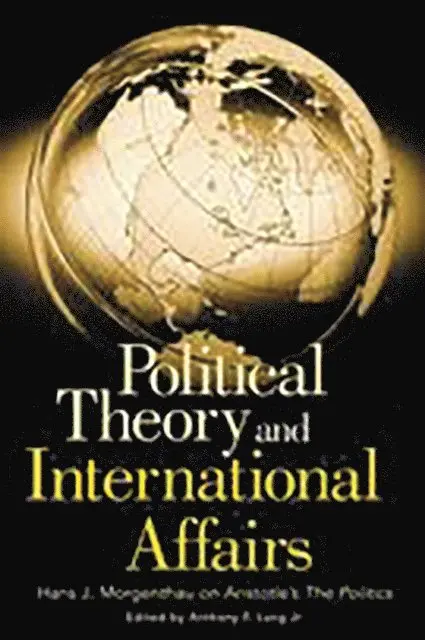
Hans J. Morgenthau is primarily considered a theorist of power politics, often associated with the six principles of realism and the national interest. Shedding new light on the theorist by digging into his archives to show his wide-ranging views on politics, these selected lectures demonstrate the broad set of political themes that were important to Morgenthau and his ability to engage classical political philosophy in a contemporary setting. This book reveals a scholar who drew on Aristotelian insights to understand the politics of the Mafia in New York City, regime change in Latin America, and the foreign policy of the United States.Based on Aristotle's The Politics, these lectures discuss a wide spectrum of history and theory in order to examine the realm of politics. This collection serves as the only published seminars from Morgenthau, revealing him as both a teacher and a thinker. Topics include: Equality to Freedom; Ethics and Politics; Justice and Revolution.
E-bok
PDF, Engelska, 20021 095 kr
Läs direkt efter köp
NATO's military interventions in the Balkans have transformed the alliance. As the alliance goes East, its members are compelled to rethink NATO's, and each member nation's, military and political roles. Providing a well-rounded study of continuing change in the contemporary North Atlantic Treaty Organization, this book is constructed around eight essays by European security experts analyzing challenges confronting the Atlantic Alliance as a military alliance and as a collective security organization dealing simultaneously with deterrence, enlargement, and regional crisis intervention. It is intended for senior undergraduate and graduate students in international relations, American foreign policy, European studies, security and strategic studies.The evidence is that NATO will undergo many more changes responding to actual and potential threats to Europe's peace. These range from a revival of the ethnic conflict in the former Yugoslavia to the proliferation and possible use of nuclear, biological, and chemical weapons. Also discussed is the matter of NATO's further enlargement and the question of whether this offers more or less security to the alliance membership, as are the emerging tensions between the EU and NATO security regimes.
E-bok
PDF, Engelska, 20021 169 kr
Läs direkt efter köp
At the dawn of the 21st century, it should be evident that the Cold War of 1945-1991 was but the first of its kind. Nichols urges the reader to consider previous resolutions before another such conflict arises. He asserts that the Cold War was essentially a clash of ideologies tempered by the ever-present threat of nuclear annihilation. Victory for the West came quietly, without the final and utterly destructive war often envisioned.Undoubtedly, the end of the Cold War was a signal victory for the West, and for the United States in particular. Yet Nichols reminds that enemies of the ideals of democracy, capitalism, and liberty abound and will lash out against western states that hold true to them. When this occurs, it will be imperative for the West to remember key lessons taken from the Cold War. Nichols argues that conflicts driven by dissonant ideologies differ from wars fought over resources and territory, and must therefore be fought differently.
E-bok
PDF, Engelska, 20031 095 kr
Läs direkt efter köp
From the end of the Cold War to the terrorist attacks on the United States in September 2001, the NATO Alliance has changed profoundly. This book explores the multifaceted consequences of NATO's adjustment to new international and domestic political and security realities. Internal Alliance politics and matters of relative power within the membership have strongly influenced recent NATO developments. Several major issues challenging the Alliance are examined, including how the impact of efforts to develop an enhanced common European security and defense policy have affected NATO: whether missile defense is driving the United States and its European allies closer or further apart; how the experience of NATO in the Balkans and elsewhere brought alliance members together or made MATO cohesion more difficult to maintain; and in what way the changing role of NATO has influenced American and Canadian participation in the Alliance. An important guidepost to pivotal changes and likely NATO developments, scholars and policymakers of Atlantic and international politics will find these meditations indispensable.A number of authors also speculate on the likely changes for the alliance that will ensue in the wake of the September 11 terrorist attacks, and the possibility that NATO will soon modify its mission and responsibilities in reaction to the threat of international terrorism. Indeed many of the same strategies and strains that affected NATO cohesion over the past decade are likely to complicate efforts to maintain Alliance unity as part of the anti-terrorist coalition.
E-bok
PDF, Engelska, 2004424 kr
Läs direkt efter köp
Hans J. Morgenthau is primarily considered a theorist of power politics, often associated with the six principles of realism and the national interest. Shedding new light on the theorist by digging into his archives to show his wide-ranging views on politics, these selected lectures demonstrate the broad set of political themes that were important to Morgenthau and his ability to engage classical political philosophy in a contemporary setting. This book reveals a scholar who drew on Aristotelian insights to understand the politics of the Mafia in New York City, regime change in Latin America, and the foreign policy of the United States.Based on Aristotle's The Politics, these lectures discuss a wide spectrum of history and theory in order to examine the realm of politics. This collection serves as the only published seminars from Morgenthau, revealing him as both a teacher and a thinker. Topics include: Equality to Freedom; Ethics and Politics; Justice and Revolution.
E-bok
PDF, Engelska, 20011 135 kr
Läs direkt efter köp
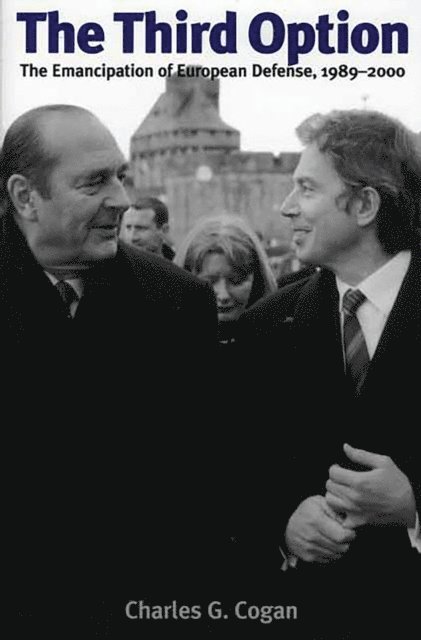
It was logical to expect that the European Economic and Monetary Union would lead ineluctably to an autonomous European defense; the very size of the European Union seems to demand it. The EU eventually will reach the point where its economic and demographic weight will far exceed that of the United States. Can it not be expected too that the EU will seek to make this weight felt internationally? Cogan tracks the halting creation of an independent European military structure, a third way between national armies and ATO, since the Iron Curtain's fall.With the Cold War's end and subsequent western engagements in Central and Eastern Europe, it is no longer a question of whether NATO and the EU compare; they now must relate. They have to coordinate their planning and force postures so as to avoid duplication of resources and efforts. Although NATO's integrated command structure theoretically was an anomaly with the end of the Cold War, it nevertheless turned out to be the case in Bosnia, and later Kosovo, that nothing was possible until the Americans intervened. The virtue of integrated command -- American participation and know-how -- was once again seen as crucially important, despite the increasingly anachronistic deficit of sovereignty for Western Europe in defense matters. In the long run, Europe's economic power must be balanced by its military and diplomatic might.