IAH - International Contributions to Hydrogeology – serie
Visar alla böcker i serien IAH - International Contributions to Hydrogeology. Handla med fri frakt och snabb leverans.
16 produkter
16 produkter
Häftad, Engelska, 2020
722 kr
Skickas inom 10-15 vardagar
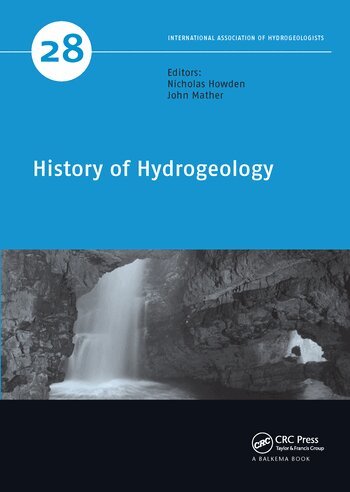
Lessons can be learnt from the past; from time to time it is useful for practitioners to look back over the historical developments of their science. Hydrogeology has developed from humble beginnings into the broad church of investigatory procedures which collectively form the modern-day hydrogeologist’s tool box. Hydrogeology remains a branch of the over-arching science of geology and today provides analysis of the sub-surface part of the water cycle within a holistic approach to problem solving.The History of Hydrogeology, is a first attempt to bring the story of the evolution of the science of hydrogeology together from a country- or region-specific viewpoint. It does not cover history to the present day, nor does it deal with all countries involved in groundwater studies, but rather takes the story for specific key countries up and until about the period 1975 to 1980. This is when hydrogeology was still evolving and developing, and in some areas doing so quite rapidly.The book has been written not only for practitioners of hydrogeology and hydrology but also for teachers and students to see the context of the evolution of the science around the globe. The History of Hydrogeology will also be of interest to science historians and all those interested in the role that individuals, institutes and nations have played over the years in defining modern day studies of groundwater.
Häftad, Engelska, 2020
722 kr
Skickas inom 10-15 vardagar
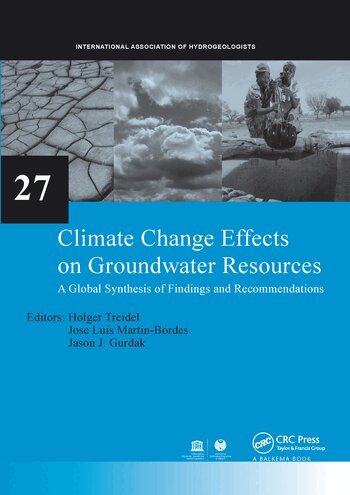
Climate change is expected to modify the hydrological cycle and affect freshwater resources. Groundwater is a critical source of fresh drinking water for almost half of the world’s population and it also supplies irrigated agriculture. Groundwater is also important in sustaining streams, lakes, wetlands, and associated ecosystems. But despite this, knowledge about the impact of climate change on groundwater quantity and quality is limited.Direct impacts of climate change on natural processes (groundwater recharge, discharge, storage, saltwater intrusion, biogeochemical reactions, chemical fate and transport) may be exacerbated by human activities (indirect impacts). Increased groundwater abstraction, for example, may be needed in areas with unsustainable or contaminated surface water resources caused by droughts and floods. Climate change effects on groundwater resources are, therefore, closely linked to other global change drivers, including population growth, urbanization and land-use change, coupled with other socio-economic and political trends. Groundwater response to global changes is a complex function that depends on climate change and variability, topography, aquifer characteristics, vegetation dynamics, and human activities. This volume contains case studies from diverse aquifer systems, scientific methods, and climatic settings that have been conducted globally under the framework of the UNESCO-IHP project Groundwater Resources Assessment under the Pressures of Humanity and Climate Change (GRAPHIC). This book presents a current and global synthesis of scientific findings and policy recommendations for scientists, water managers and policy makers towards adaptive management of groundwater sustainability under future climate change and variability.
Häftad, Engelska, 2020
777 kr
Skickas inom 10-15 vardagar
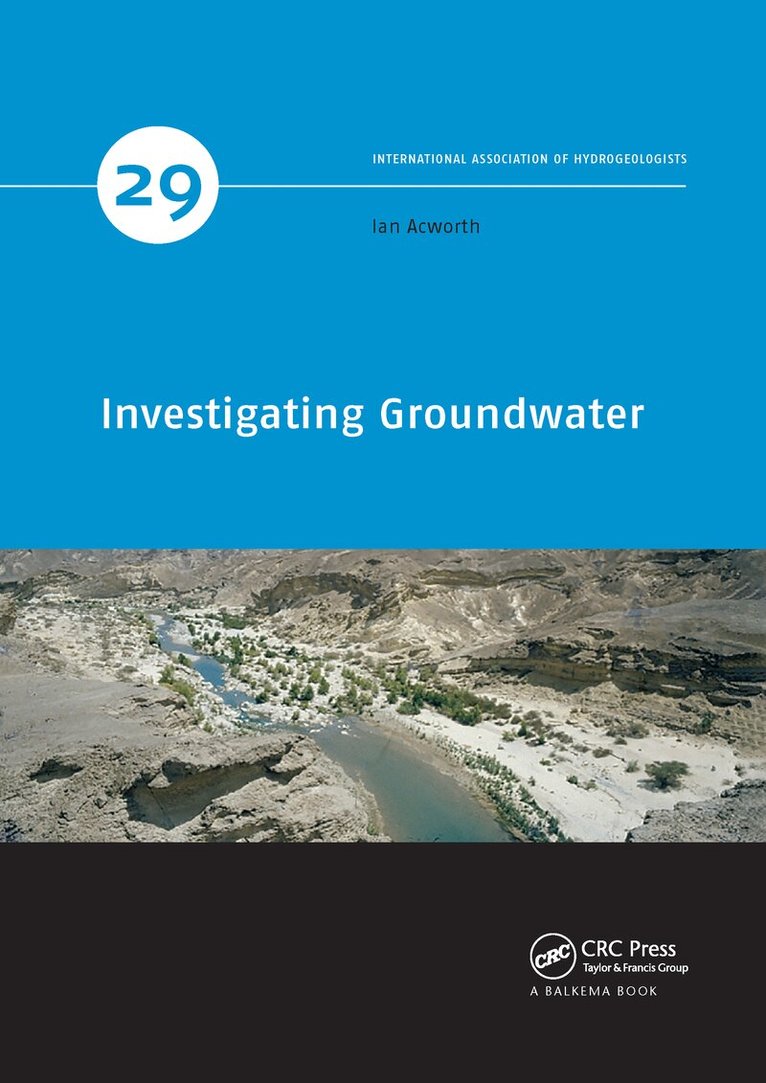
Investigating Groundwater provides an integrated approach to the challenges associated with locating groundwater. Uniquely, the book provides a review of the wide range of techniques that can be deployed to investigate this important resource. Many of the practical examples given are based upon Australian experience but the methods have worldwide applicability. The book is published in colour and includes many original diagrams and photographs. Particular effort has been made to provide consistent terminology and SI units are used throughout the textInvestigating Groundwater starts with an introduction to the historical significance of groundwater and gives an account of climate change. A description of the occurrence of groundwater in different rock types is then provided. A detailed account of surface water techniques is then followed by an account of the interconnections between surface water and groundwater. Four chapters describing groundwater hydraulics are then followed by four chapters describing the latest geophysical techniques. Once the best location of a borehole is determined using these techniques; chapters then describe appropriate drilling methods to use; provide a wide ranging review of geophysical logging, hydrochemical and isotopic techniques, before concluding with a detailed description of groundwater flow to a well.Written for a worldwide audience of degree level geology/engineering practitioners, academics and students involved in groundwater resource investigation methods; Investigating Groundwater is essential reading for those involved in groundwater research.Key Features: Presents the theoretical background and a detailed description of the techniques used in the investigation of groundwater. Describes the general occurrence of groundwater in different rock types; surface water hydrology and interconnected surface and groundwater systems. Provides detailed descriptions of geophysical techniques (seismic, electrical, gravity and heat) and an account of available geophysical logging methods. Reviews hydrochemical and isotope methods, followed by an account of drilling techniques. Gives a detailed account of radial flow to a well, including appropriate modelling and pump-testing techniques and a consideration of non-linear flow. Of interest to anyone involved in the development of groundwater resources, either for domestic supply, for agriculture or for mining.
Inbunden, Engelska, 2022
2 412 kr
Skickas inom 10-15 vardagar
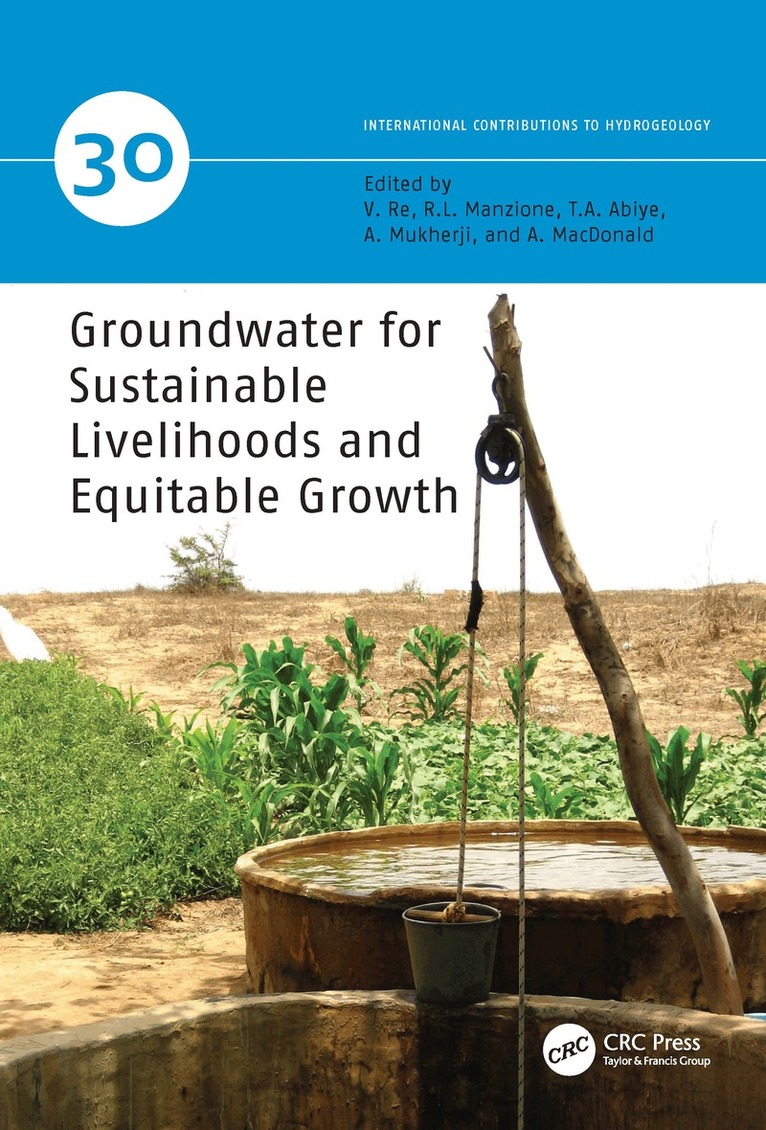
Groundwater for Sustainable Livelihoods and Equitable Growth explores how groundwater, often invisibly, improves peoples’ lives and livelihoods. This unique collection of 19 studies captures experiences of groundwater making a difference in 16 countries in Africa, South America and Asia. Such studies are rarely documented and this book provides a rich new collection of interdisciplinary analysis. The book is published in colour and includes many original diagrams and photographs.Spring water, wells or boreholes have provided safe drinking water and reliable water for irrigation or industry for millennia. However, the hidden nature of groundwater often means that it’s important role both historically and in the present is overlooked. This collection helps fill this knowledge gap, providing a diverse set of new studies encompassing different perspectives and geographies. Different interdisciplinary methodologies are described that can help understand linkages between groundwater, livelihoods and growth, and how these links can be threatened by over-use, contamination, and ignorance.Written for a worldwide audience of practitioners, academics and students with backgrounds in geology, engineering or environmental sciences; Groundwater for Sustainable Livelihoods and Equitable Growth is essential reading for those involved in groundwater and international development.
Inbunden, Engelska, 2012
2 343 kr
Skickas inom 10-15 vardagar
Lessons can be learnt from the past; from time to time it is useful for practitioners to look back over the historical developments of their science. Hydrogeology has developed from humble beginnings into the broad church of investigatory procedures which collectively form the modern-day hydrogeologist’s tool box. Hydrogeology remains a branch of the over-arching science of geology and today provides analysis of the sub-surface part of the water cycle within a holistic approach to problem solving.The History of Hydrogeology, is a first attempt to bring the story of the evolution of the science of hydrogeology together from a country- or region-specific viewpoint. It does not cover history to the present day, nor does it deal with all countries involved in groundwater studies, but rather takes the story for specific key countries up and until about the period 1975 to 1980. This is when hydrogeology was still evolving and developing, and in some areas doing so quite rapidly.The book has been written not only for practitioners of hydrogeology and hydrology but also for teachers and students to see the context of the evolution of the science around the globe. The History of Hydrogeology will also be of interest to science historians and all those interested in the role that individuals, institutes and nations have played over the years in defining modern day studies of groundwater.
Inbunden, Engelska, 2011
2 566 kr
Skickas inom 10-15 vardagar
Climate change is expected to modify the hydrological cycle and affect freshwater resources. Groundwater is a critical source of fresh drinking water for almost half of the world’s population and it also supplies irrigated agriculture. Groundwater is also important in sustaining streams, lakes, wetlands, and associated ecosystems. But despite this, knowledge about the impact of climate change on groundwater quantity and quality is limited.Direct impacts of climate change on natural processes (groundwater recharge, discharge, storage, saltwater intrusion, biogeochemical reactions, chemical fate and transport) may be exacerbated by human activities (indirect impacts). Increased groundwater abstraction, for example, may be needed in areas with unsustainable or contaminated surface water resources caused by droughts and floods. Climate change effects on groundwater resources are, therefore, closely linked to other global change drivers, including population growth, urbanization and land-use change, coupled with other socio-economic and political trends. Groundwater response to global changes is a complex function that depends on climate change and variability, topography, aquifer characteristics, vegetation dynamics, and human activities. This volume contains case studies from diverse aquifer systems, scientific methods, and climatic settings that have been conducted globally under the framework of the UNESCO-IHP project Groundwater Resources Assessment under the Pressures of Humanity and Climate Change (GRAPHIC). This book presents a current and global synthesis of scientific findings and policy recommendations for scientists, water managers and policy makers towards adaptive management of groundwater sustainability under future climate change and variability.
Inbunden, Engelska, 2017
1 847 kr
Skickas inom 10-15 vardagar
One quarter of the world's population lives in karst terrains, yet karsts are highly vulnerable to stresses caused by human activity. This book surveys human impact on karst water, showing that the increasing pollution of the environment has, to a great extent, spoiled sensitive karst ecosystems. This text examines such consequences and offers proposals for future solutions and strategies. Part One provides an overview of the functioning of karsts and of human interaction with karst environments over several millennia. Part Two consists of a systematic examination of the major areas of human activity affecting karst waters, such as agriculture, industry, mining and water exploitation. Finally, Part Three views the effects on karst groundwater within a broader societal and legislative perspective and considers possible changes of methodology and approach.
Inbunden, Engelska, 2019
2 687 kr
Skickas inom 10-15 vardagar
Investigating Groundwater provides an integrated approach to the challenges associated with locating groundwater. Uniquely, the book provides a review of the wide range of techniques that can be deployed to investigate this important resource. Many of the practical examples given are based upon Australian experience but the methods have worldwide applicability. The book is published in colour and includes many original diagrams and photographs. Particular effort has been made to provide consistent terminology and SI units are used throughout the textInvestigating Groundwater starts with an introduction to the historical significance of groundwater and gives an account of climate change. A description of the occurrence of groundwater in different rock types is then provided. A detailed account of surface water techniques is then followed by an account of the interconnections between surface water and groundwater. Four chapters describing groundwater hydraulics are then followed by four chapters describing the latest geophysical techniques. Once the best location of a borehole is determined using these techniques; chapters then describe appropriate drilling methods to use; provide a wide ranging review of geophysical logging, hydrochemical and isotopic techniques, before concluding with a detailed description of groundwater flow to a well.Written for a worldwide audience of degree level geology/engineering practitioners, academics and students involved in groundwater resource investigation methods; Investigating Groundwater is essential reading for those involved in groundwater research.Key Features: Presents the theoretical background and a detailed description of the techniques used in the investigation of groundwater. Describes the general occurrence of groundwater in different rock types; surface water hydrology and interconnected surface and groundwater systems. Provides detailed descriptions of geophysical techniques (seismic, electrical, gravity and heat) and an account of available geophysical logging methods. Reviews hydrochemical and isotope methods, followed by an account of drilling techniques. Gives a detailed account of radial flow to a well, including appropriate modelling and pump-testing techniques and a consideration of non-linear flow. Of interest to anyone involved in the development of groundwater resources, either for domestic supply, for agriculture or for mining.
Inbunden, Engelska, 1998
3 450 kr
Skickas inom 5-8 vardagar
Shallow groundwater systems are important as a source of water, for sustenance of stream baseflow, and for wetland and riparian ecosystems. They are also central to waterlogging, and dryland and irrigation salinity problems. Response time to hydrologic change and pollutant loadings is fast among shallow aquifiers, and it is important that hydrogeologists and natural resource managers understand the unsaturated zone processes which links human activity at the soil surface and the underlying groundwater, and vice versa. This volume of papers explores practical aspects of soil and surface water interactions with groundwater, including modelling of flow and contaminant transport in the unsaturated and saturated zones.
Häftad, Engelska, 1998
832 kr
Skickas inom 10-15 vardagar
Shallow groundwater systems are important as a source of water, for sustenance of stream baseflow, and for wetland and riparian ecosystems. They are also central to waterlogging, and dryland and irrigation salinity problems. Response time to hydrologic change and pollutant loadings is fast among shallow aquifiers, and it is important that hydrogeologists and natural resource managers understand the unsaturated zone processes which links human activity at the soil surface and the underlying groundwater, and vice versa. This volume of papers explores practical aspects of soil and surface water interactions with groundwater, including modelling of flow and contaminant transport in the unsaturated and saturated zones.
Häftad, Engelska, 1999
1 161 kr
Skickas inom 10-15 vardagar
One quarter of the world's population lives in karst terrains, yet karsts are highly vulnerable to stresses caused by human activity. This book surveys human impact on karst water, showing that the increasing pollution of the environment has, to a great extent, spoiled sensitive karst ecosystems. This text examines such consequences and offers proposals for future solutions and strategies. Part One provides an overview of the functioning of karsts and of human interaction with karst environments over several millennia. Part Two consists of a systematic examination of the major areas of human activity affecting karst waters, such as agriculture, industry, mining and water exploitation. Finally, Part Three views the effects on karst groundwater within a broader societal and legislative perspective and considers possible changes of methodology and approach.
Recharge of Phreatic Aquifers in (Semi-)Arid Areas
IAH International Contributions to Hydrogeology 19
Inbunden, Engelska, 1997
3 237 kr
Skickas inom 10-15 vardagar
Groundwater use is of fundamental importance to meet the rapidly expanding urban, industrial and agricultural water requirements in (semi) arid areas. Quantifying the current rate of groundwater recharge and define its variability in space and time are thus prerequesites for efficient groundwater resource managment in these regions, where such resources are often the key to economic development. Attention focuses on recharge of phreatic aquifers, often the most readily-available and affordable source of water in (semi) arid regions. These aquifers are also the most susceptible to contamination, with the recharge rate determining their level of vulnerability. (Semi) arid zone recharge can be highly variable, the greater the aridity, the smaller and potentially more variable the natural flux. Its determination is an iterative process, involving progressive data collection and resource evaluation; there is also a need to use more than one technique to verify results. Direct, localised and indirect recharge mechanisms from a spectrum of known sources are addressed in the framework of recharge from precipitation, intermittant flow and permanent water bodies. The approach taken for each of these reflects the nature and current understanding of the processes involved. The volume also reviews current recharge estimation challenges, outlines recent developments and offers guidance for potential solutions.
Inbunden, Engelska, 2002
1 024 kr
Skickas inom 10-15 vardagar
Effective management of a water well requires that the water well can meet a set of performance indicators. These can include criteria related to water quality, yield, economics and asset life. Water well deterioration due to fouling and corrosion impacts the ability of a well system to meet these criteria. Managing well deterioration processes involves understanding the nature of these processes and having in place water well maintenance strategies to deal with them. Managing water well deterioration fills a need within the literature for an academically based informative text that incorporates practical advice. The focus on a problem-oriented approach to diagnosing well deterioration makes the book a useful practical handbook. It integrates concepts from hydrogeology, hydrochemistry and microbiology to give a thorough understanding of water well deterioration processes. Scenarios have been developed to illustrate common causes of water well fouling. A feature of the book is the treatment of both corrossion and fouling issues in depth. Case studies selected from around the world are uses to illustrate approaches to the diagnosis and remediation of well deterioration. These scientifically orientated perspectives on water well deterioration are embedded within a management framework to provide a comprehensive approach to dealing with water well deterioration.
Inbunden, Engelska, 2003
3 374 kr
Skickas inom 10-15 vardagar
In order to provide water security in the twenty-first century, there is universal agreement that a continuation of current policies and extrapolation of trends is not an option. Also clear is that from both water supply and development perspectives, the world's arid and semi-arid regions are those currently and potentially experiencing the highest water stresses. One third of the world's land surface is classified as arid or semi-arid, and about half of all countries are directly affected in some way by problems of aridity. The hydrology of arid and semi-arid areas is also known to be substantially different from that in more humid regions. It is therefore essential that investigation methods appropriate to the former are developed and applied, and that strategies for arid and semi-arid region water resources development recognise the principal characteristics of in-situ hydrological processes.
Inbunden, Engelska, 2003
2 618 kr
Skickas inom 10-15 vardagar
More than 50% of the world's population already live in cities, and the proportion is rising extremely rapidly towards developed country levels of more than 90%. Groundwater from wells is the major source of water supply for many of these cities, however, groundwater is polluted by the cities that overlie it and sewerage systems are often absent, or leak. Industrial landuse implies the use of large quantities of chemicals, and it is the poor disposal and accidental spillage of these chemicals which results in the contamination of virtually every industrial site in the world. Much of this pollution migrates deeper to damage groundwater. Groundwater has slow turnover time, often measured in decades and centuries, reducing the self-cleansing capacity. Urban aquifers are therefore vitally important but very fragile, easily damaged and slow to repair. Urban groundwater problems and solutions vary greatly around the world. Mature cities
1 629 kr
Tillfälligt slut
Presents, in a simple, but scientifically rigorous manner, the consequences of natural processes to stable isotope concentrations and radioactivities, but also containing indications of possible applications without the pretension of a cookbook.