Institute of Social Studies Series on Development of Societies – serie
Visar alla böcker i serien Institute of Social Studies Series on Development of Societies. Handla med fri frakt och snabb leverans.
13 produkter
13 produkter
Inbunden, Engelska, 1980
1 659 kr
Skickas inom 10-15 vardagar
The authors of a recent textbook on the Economics of Development (P. A. Yotopoulos and J . B. Nugent, 1976) chose as the title of their first chapter 'The Record of Economic Development and Disillusionment with Development Economics'. It is striking that dissatisfaction with this young branch of the tree of economics has become so strong that a textbook treatment of the subject matter takes Disillusionment as its point of departure. True, the Disillusion ment chapter is followed by many other chapters - there is, after all, some thing to be said on development economics that is worth saying - but the wording has changed, and frequently the focus as well, in comparison to the development economics of the 1950s and 'sixties. Dissatisfaction and disillusionment may be interpreted optimistically as an inevitable stage in the coming-of-age process of development economics. Others may say that the search for a new paradigm is the core of the problem. At any rate, there is no room for complacency. It cannot be denied that at least part of the 'early' development theory came into being as a justification ex post of policy measures that, for a variety of reasons, were judged desirable or essen tial.
Inbunden, Engelska, 1980
1 659 kr
Skickas inom 10-15 vardagar
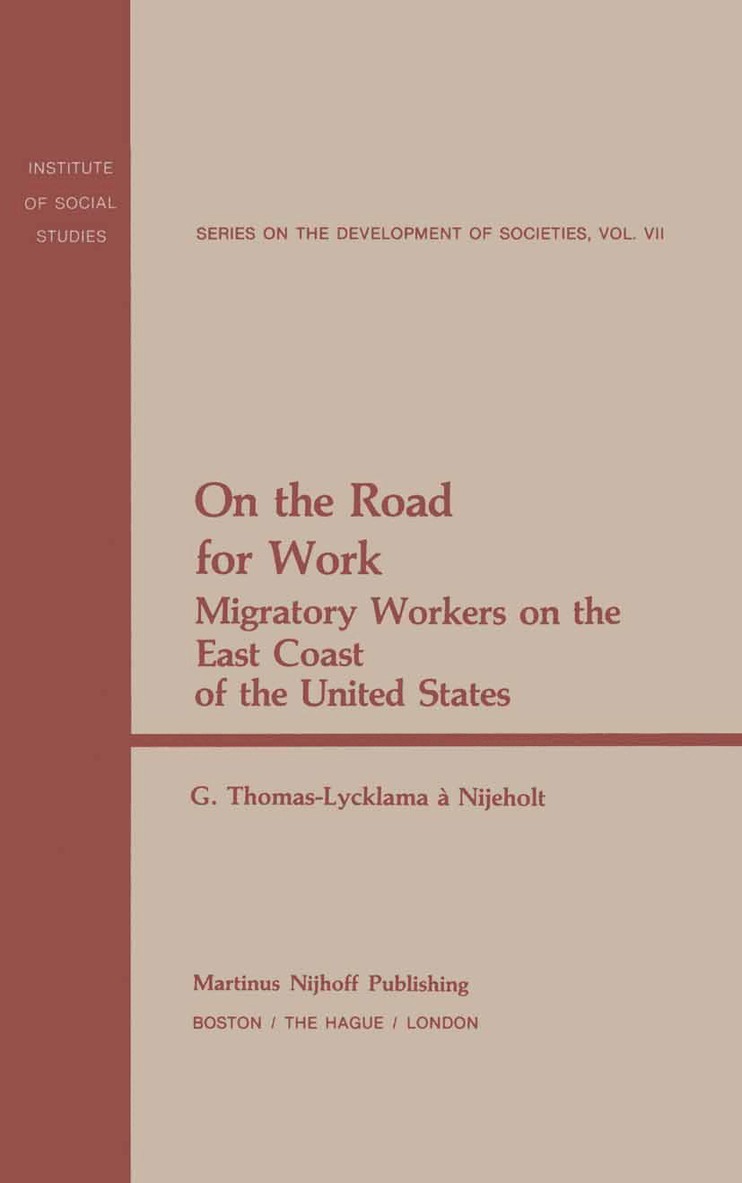
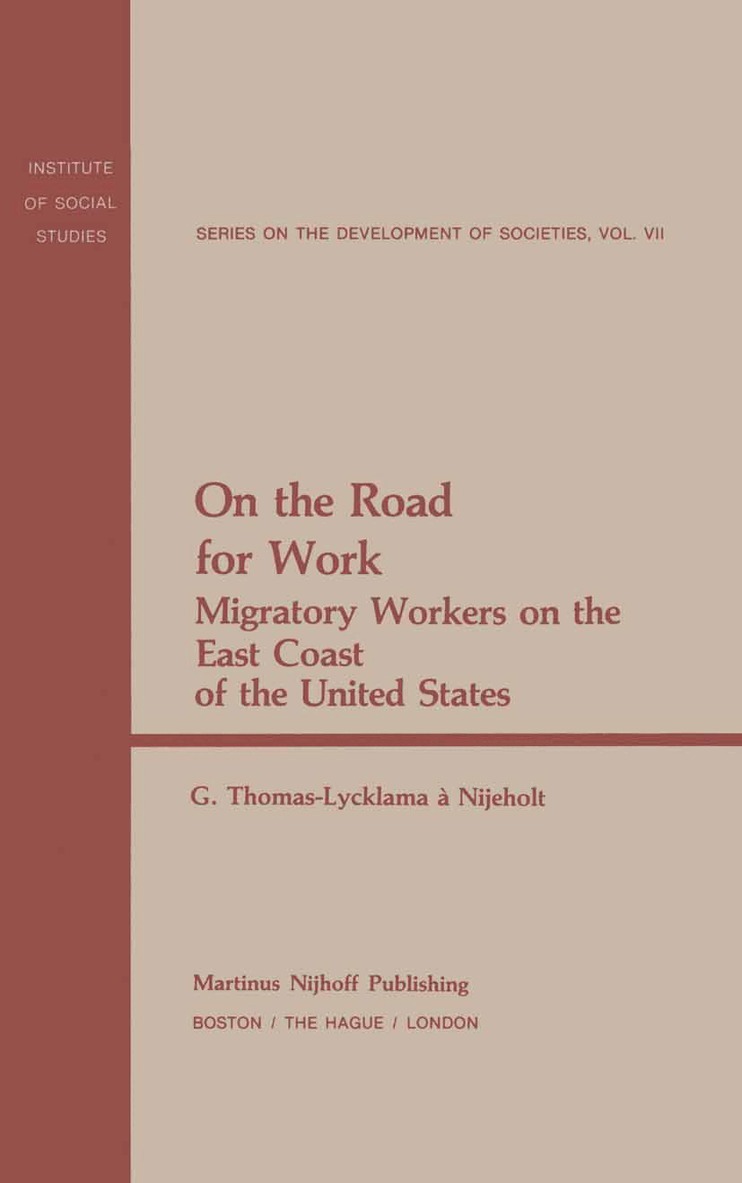
Migratory farm workers provide the extra hands that are so badly needed during the planting and harvest season in the United States. Although these workers have been essential to the American agricultural system for more than a hundred years, our knowledge of them is limited and quite fragmentary; it can be divided roughly into two types of information. On the one hand, we have the statistical data collected by various censuses and the data gathered by agricultural econ omists to study the supply of and demand for farm labor. The economic aspects of farm labor generally predominate in such material. On the other, we have the scientific studies and journalistic descriptions that report on migratory farm by using a qualitative approach. The social scientists and journalists who workers have compiled these reports lived in the labor camps and have vividly described the dismal and oppressive conditions these workers must endure. The drawback of the first type of data is that its orientation to economic problems makes it too superficial and one-sided. It fails to interrelate the diverse economic factors affecting the lives and work of all farm workers, and conse quently presents a distorted and incomplete picture of migratory farm worker life. Also, because the migratory farm workers are quite elusive and usually keep a low profIle, they are often underrepresented in such data. The data gathered by using qualitative methods have the major disadvantage of being quite limited in scope.
Häftad, Engelska, 2011
2 223 kr
Skickas inom 10-15 vardagar
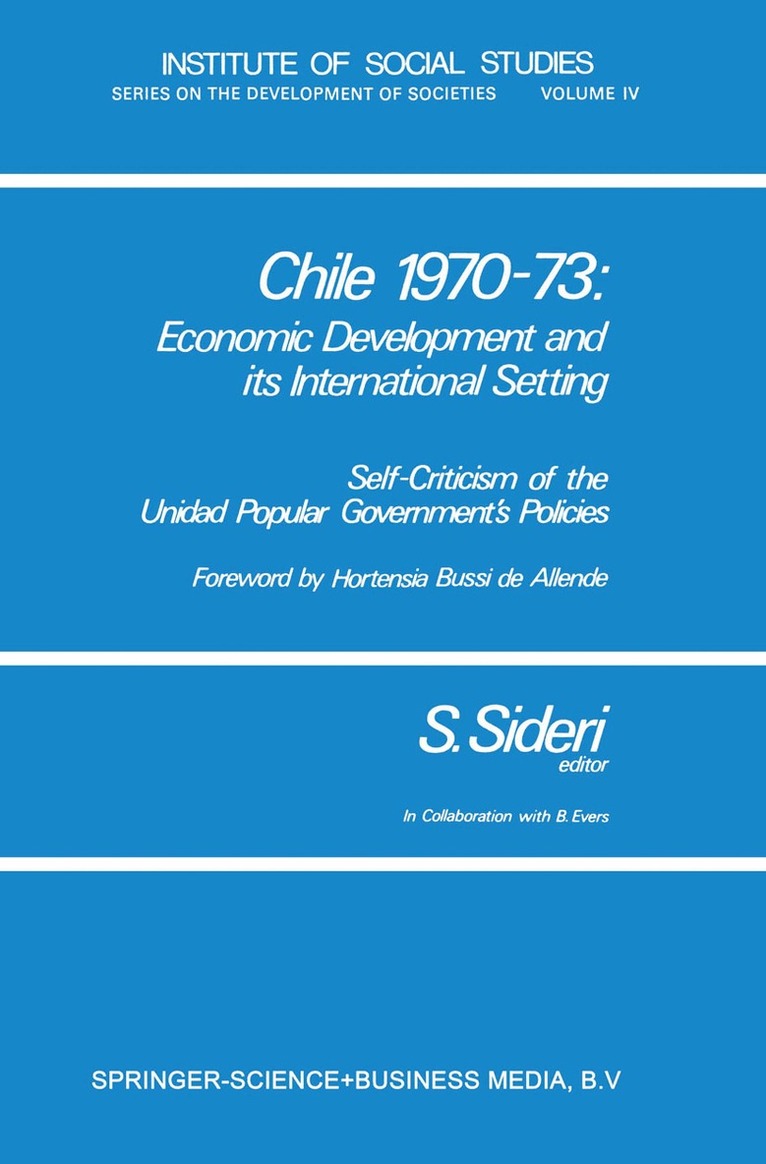
One of the main objectives of the Unidad Popular ('Popular Unity') Govern ment was to attain Chile's evolution towards more advanced forms of social organization within the framework of strictly respected democracy. This objective, which is deeply inherent in every human being and conse quently present under alI conditions and in alI parts of the world, is not weakened by temporary defeats or transient retreats. History proves this, and current events in many parts ofthe world fully confirm it. One of the areas in which this struggle for progress takes place most in tensively is economics. Here, c1ashes take place between the forces which work towards social progress, and those which oppose it and aim to maintain a sys tem of intolerable priveleges. The ideological and material resources available to the forces which attempt to re strain social progress are not small, and under given circumstances they overcome the forces by which the majority tries to realize a better future. This is expressed very c1early in the relationships which link the internal dynamics of social development with the great economic and political forces operating at the internationallevel. Consequently, analysis of the social trans formation process in such countries as Chile, in the context of the political and economic reactions these processes unleach at the internationallevel, is of key importance.
Häftad, Engelska, 2013
1 083 kr
Skickas inom 10-15 vardagar
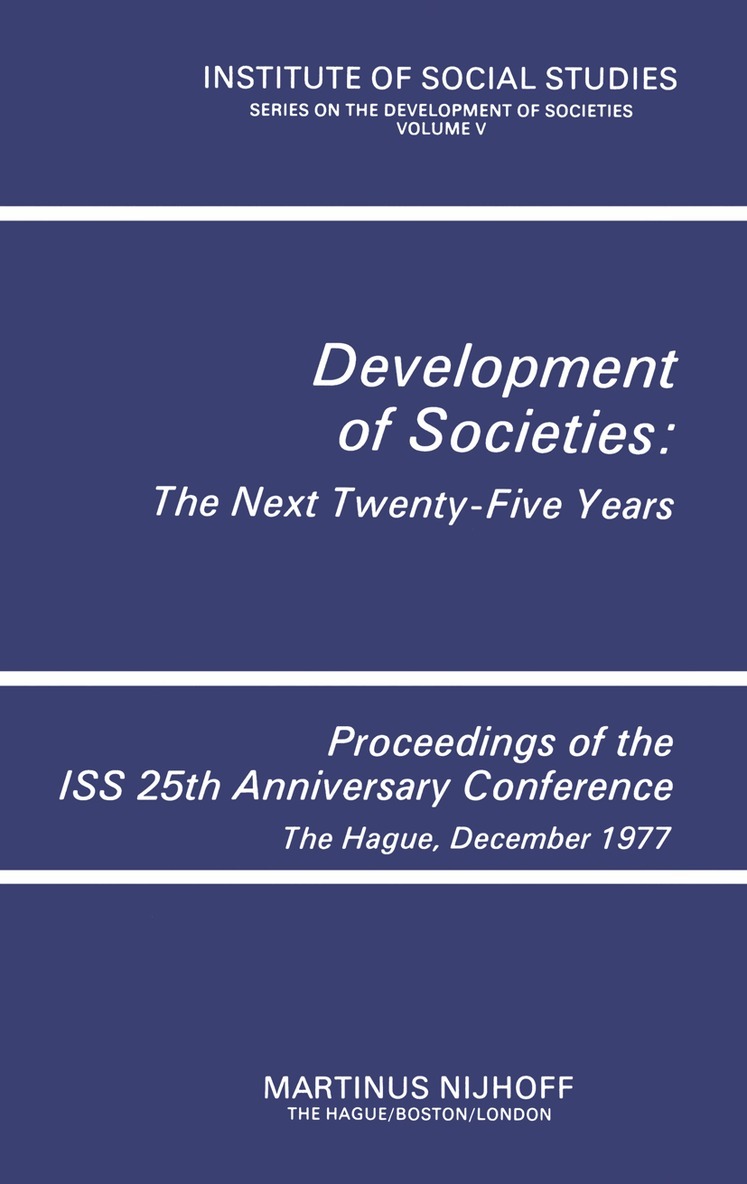
This volume is the product of a conference on the theme 'Development - the Next Twenty-five Years' which the Institute of Social Studies held in Decem ber 1977 to mark its own twenty-fifth anniversaryas a centre of development studies. We felt it appropriate at that point in time to caU together specialists from all over the world in an attempt to assess the 'state of play' in our field as we move into the last quarter of the twentieth century. 1 For several days, therefore, the Institute's new building house d a remarkable concentration of knowledge and experience concerning the problems of the so-calle d less developed countries, drawn from all over the world. Although it was inevitable that the participants should represent the past (and it was several times re marked that, in that sense, there were too few women present), the earnest and sometimes heated discussions looked to the future as much as to what had happened in the last twenty-five years. As the discussions proceeded, three things became apparent. Firstly , although the papers submitted did not fully reveal it, the ongoing debate between radicals and moderates, those who saw possibilities of change only basically through a direct break with existing structures and those who felt change possibIe within them, is by no means at an end.
Häftad, Engelska, 2011
1 083 kr
Skickas inom 10-15 vardagar
Häftad, Engelska, 1976
2 145 kr
Skickas inom 10-15 vardagar
Häftad, Engelska, 1977
542 kr
Skickas inom 10-15 vardagar
The gestation period of this collection has been lengthy even by academic stan dards. Some of our long-suffering contributors prepared their original drafts for a workshop held in Nairobi in 1967, and although they have all up-dated their contributions they are still essentially reporting on research conducted in the late 1960s. However, we feel that their various findings and analyses of the issues they respectively treat have a continuing validity in our comprehension of the problem of rural development. Other contributions reporting on more recent work have been incorporated at different times since, most of them not commissioned especially for this symposium but all adding something to our understanding of the problem. The slow accumulation of material which makes up this fmal collection parallels an evolution in our own collective thinking, if indeed not that of most students of 'development' over the past decade. The progression has not been towards fmal clarification of the complex and changing East African realities, nor towards formulation of an accepted model for their analysis; rather, it has been marked by the questioning of the initial, somewhat simplistic assumptions with which some of us started out and a continuing debate and widening polar ization of views about the significance of that process of government 'pene tration' of the rural areas which is our focus, about the positive or negative value of 'development' policies in East Africa and, indeed, about the appropri ate theoretical approaches to the study of 'development' in general.
Inbunden, Engelska, 1978
1 076 kr
Skickas inom 10-15 vardagar
Del 4 - Institute of Social Studies Series on Development of Societies
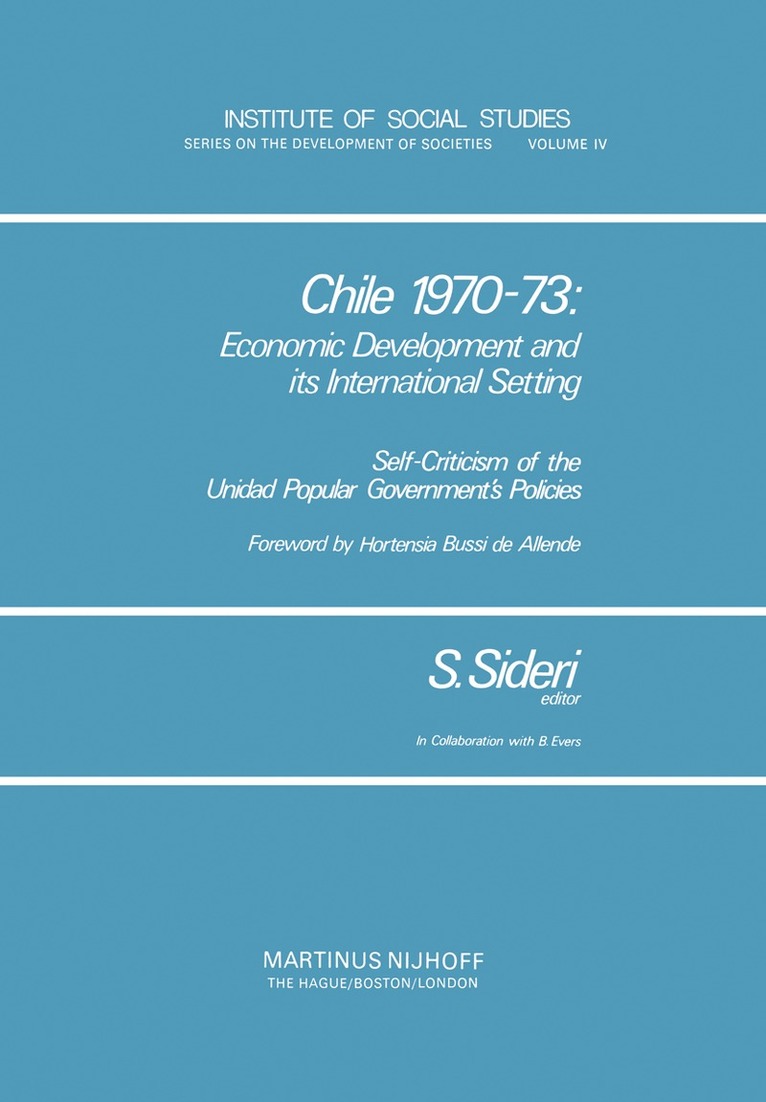
Chile 1970–73: Economic Development and Its International Setting
Self Criticism of the Unidad Popular Government’s Policies
Inbunden, Engelska, 1979
2 210 kr
Skickas inom 10-15 vardagar
One of the main objectives of the Unidad Popular ('Popular Unity') Govern ment was to attain Chile's evolution towards more advanced forms of social organization within the framework of strictly respected democracy. This objective, which is deeply inherent in every human being and conse quently present under alI conditions and in alI parts of the world, is not weakened by temporary defeats or transient retreats. History proves this, and current events in many parts ofthe world fully confirm it. One of the areas in which this struggle for progress takes place most in tensively is economics. Here, c1ashes take place between the forces which work towards social progress, and those which oppose it and aim to maintain a sys tem of intolerable priveleges. The ideological and material resources available to the forces which attempt to re strain social progress are not small, and under given circumstances they overcome the forces by which the majority tries to realize a better future. This is expressed very c1early in the relationships which link the internal dynamics of social development with the great economic and political forces operating at the internationallevel. Consequently, analysis of the social trans formation process in such countries as Chile, in the context of the political and economic reactions these processes unleach at the internationallevel, is of key importance.
Inbunden, Engelska, 1979
1 076 kr
Skickas inom 10-15 vardagar
This volume is the product of a conference on the theme 'Development - the Next Twenty-five Years' which the Institute of Social Studies held in Decem ber 1977 to mark its own twenty-fifth anniversaryas a centre of development studies. We felt it appropriate at that point in time to caU together specialists from all over the world in an attempt to assess the 'state of play' in our field as we move into the last quarter of the twentieth century. 1 For several days, therefore, the Institute's new building house d a remarkable concentration of knowledge and experience concerning the problems of the so-calle d less developed countries, drawn from all over the world. Although it was inevitable that the participants should represent the past (and it was several times re marked that, in that sense, there were too few women present), the earnest and sometimes heated discussions looked to the future as much as to what had happened in the last twenty-five years. As the discussions proceeded, three things became apparent. Firstly , although the papers submitted did not fully reveal it, the ongoing debate between radicals and moderates, those who saw possibilities of change only basically through a direct break with existing structures and those who felt change possibIe within them, is by no means at an end.
Häftad, Engelska, 2011
1 659 kr
Skickas inom 10-15 vardagar
The authors of a recent textbook on the Economics of Development (P. A. Yotopoulos and J . B. Nugent, 1976) chose as the title of their first chapter 'The Record of Economic Development and Disillusionment with Development Economics'. It is striking that dissatisfaction with this young branch of the tree of economics has become so strong that a textbook treatment of the subject matter takes Disillusionment as its point of departure. True, the Disillusion ment chapter is followed by many other chapters - there is, after all, some thing to be said on development economics that is worth saying - but the wording has changed, and frequently the focus as well, in comparison to the development economics of the 1950s and 'sixties. Dissatisfaction and disillusionment may be interpreted optimistically as an inevitable stage in the coming-of-age process of development economics. Others may say that the search for a new paradigm is the core of the problem. At any rate, there is no room for complacency. It cannot be denied that at least part of the 'early' development theory came into being as a justification ex post of policy measures that, for a variety of reasons, were judged desirable or essen tial.
Häftad, Engelska, 2011
1 659 kr
Skickas inom 10-15 vardagar
Migratory farm workers provide the extra hands that are so badly needed during the planting and harvest season in the United States. Although these workers have been essential to the American agricultural system for more than a hundred years, our knowledge of them is limited and quite fragmentary; it can be divided roughly into two types of information. On the one hand, we have the statistical data collected by various censuses and the data gathered by agricultural econ omists to study the supply of and demand for farm labor. The economic aspects of farm labor generally predominate in such material. On the other, we have the scientific studies and journalistic descriptions that report on migratory farm by using a qualitative approach. The social scientists and journalists who workers have compiled these reports lived in the labor camps and have vividly described the dismal and oppressive conditions these workers must endure. The drawback of the first type of data is that its orientation to economic problems makes it too superficial and one-sided. It fails to interrelate the diverse economic factors affecting the lives and work of all farm workers, and conse quently presents a distorted and incomplete picture of migratory farm worker life. Also, because the migratory farm workers are quite elusive and usually keep a low profIle, they are often underrepresented in such data. The data gathered by using qualitative methods have the major disadvantage of being quite limited in scope.
Del 4 - Institute of Social Studies Series on Development of Societies
Chile 1970–73: Economic Development and its International Setting
Self-criticism of the Unidad Popular Government’s Policies
Häftad, Engelska, 1979
542 kr
Skickas inom 10-15 vardagar
One of the main objectives of the Unidad Popular ('Popular Unity') Govern ment was to attain Chile's evolution towards more advanced forms of social organization within the framework of strictly respected democracy. This objective, which is deeply inherent in every human being and conse quently present under all conditions and in all parts of the world, is not weakened by temporary defeats or transient retreats. History proves this, and current events in many parts of the world fully confirm it. One of the areas in which this struggle for progress takes place most in tensively is economics. Here, clashes take place between the forces which work towards social progress, and those which oppose it and aim to maintain a sys tem of intolerable priveleges. The ideological and material resources available to the forces which attempt to restrain social progress are not small, and under given circumstances they overcome the forces by which the majority tries to realize a better future. This is expressed very clearly in the relationships which link the internal dynamics of social development with the great economic and political forces operating at the international level. Consequently, analysis of the social trans formation process in such countries as Chile, in the context of the political and economic reactions these processes unleach at the international level, is of key importance.