Investigations in Geophysics - Böcker
Visar alla böcker i serien Investigations in Geophysics. Handla med fri frakt och snabb leverans.
8 produkter
8 produkter
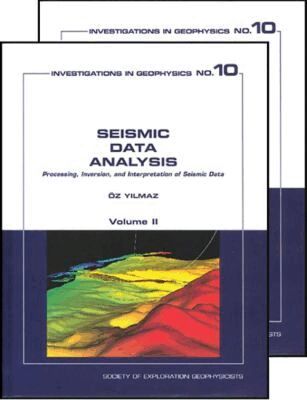
Seismic Data Analysis
Processing, Inversion, and Interpretation of Seismic Data (2 Volumes)
Inbunden, Engelska, 2001
1 880 kr
Skickas inom 7-10 vardagar
Öz Yilmaz has expanded his original volume on processing to include inversion and interpretation of seismic data. In addition to the developments in all aspects of conventional processing, this two- volume set represents a comprehensive and complete coverage of the modern trends in the seismic industry — from time to depth, from 3D to 4D, from 4D to 4C, and from isotropy to anisotropy.
1 663 kr
Skickas inom 11-20 vardagar
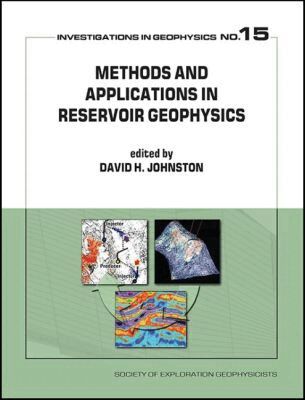
Methods and Applications in Reservoir Geophysics (SEG Investigations in Geophysics No. 15) not only demonstrates the value of geophysics in reservoir management but also shows how to apply geophysical technologies more effectively in reservoir studies. The chapter editors have selected more than 40 papers from SEG and other journals and have added 13 new contributions. In the reservoir-engineering tutorial, geophysicists will discover a rich source of information on issues and data that are critically important to the engineer. In the geophysics tutorial, the engineer and the geophysicist will find explanations of the tools and data discussed in the book’s case studies. Each chapter then focuses on a different phase of field life: exploration appraisal, development planning, and production optimization. Geophysics is used in each of those stages to help address the critical technical issues and business decisions that the reservoir-management team faces. The case studies demonstrate the processes, methods, and techniques used in reservoir geophysics, not simply the results. The last chapter explores the road ahead and emerging technologies that define the future of reservoir geophysics. This book will be valuable for geophysicists, engineers, and all members of the reservoir-management team who want to ensure that the correct data are used to maximize reserves, optimize recovery, and contain costs.
2 519 kr
Skickas inom 11-20 vardagar
AVO (SEG Investigations in Geophysics No. 16) by Satinder Chopra and John Castagna begins with a brief discussion on the basics of seismic-wave propagation as it relates to AVO, followed by a discussion of the rock-physics foundation for AVO analysis including the use of Gassmann’s equations and fluid substitution. Then, the early seismic observations and how they led to the birth of AVO analysis are presented. The various approximations for the Zoeppritz equations are examined, and the assumptions and limitations of each approximation are clearly identified. A section on the factors that affect seismic amplitudes and a discussion of the processing considerations important for AVO analysis are included. A subsequent section explores the various techniques used in AVO interpretation. Finally, topics including the influence of anisotropy in AVO analysis, the use of AVO inversion, estimation of uncertainty in AVO analysis, converted-wave AVO, and the future of the AVO method are discussed. Equally helpful to new entrants into the field as well as to seasoned workers, AVO will provide readers with the most up-to-date knowledge on amplitude variation with offset.
2 456 kr
Skickas inom 7-10 vardagar
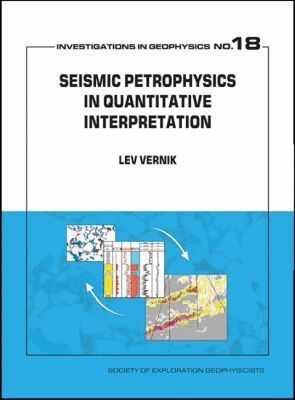
Exploration and characterization of conventional and unconventional reservoirs using seismic technologies are among the main activities of upstream technology groups and business units of oil and gas operators. However, these activities frequently encounter difficulties in quantitative seismic interpretation due to remaining confusion and new challenges in the fast developing field of seismic petrophysics. Seismic Petrophysics in Quantitative Interpretation shows how seismic interpretation can be made simple and robust by integration of the rock physics principles with seismic and petrophysical attributes bearing on the properties of both conventional (thickness, net/ gross, lithology, porosity, permeability, and saturation) and unconventional (thickness, lithology, organic richness, thermal maturity) reservoirs. Practical solutions to existing interpretation problems in rock physics-based amplitude versus offset (AVO) analysis and inversion are addressed in the book to streamline the workflows in subsurface characterization. Although the book is aimed at oil and gas industry professionals and academics concerned with utilization of seismic data in petroleum exploration and production, it could also prove helpful for geotechnical and completion engineers and drillers seeking to better understand how seismic and sonic data can be more thoroughly utilized.
3 019 kr
Skickas inom 7-10 vardagar
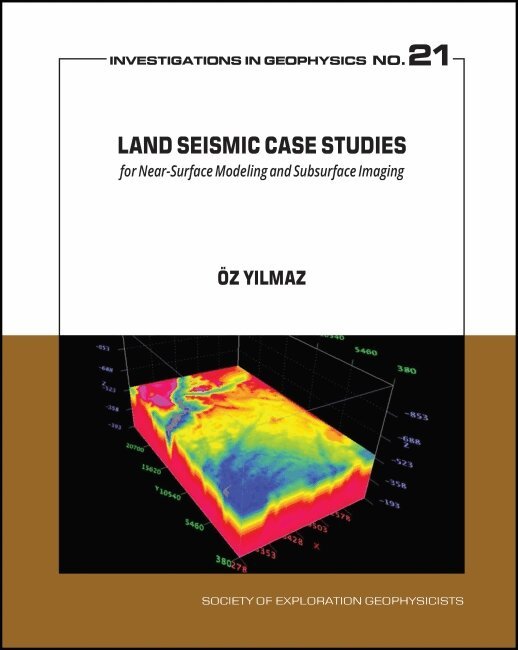
The scope of engineering seismology includes geotechnical site investigations for buildings and engineering infrastructures, such as dams, levees, bridges, and tunnels, landslide and active- fault investigations, seismic microzonation, and geophysical investigations of historic buildings. These projects require multidisciplinary participation by the geologist, geophysicist, and geotechnical and earthquake engineers. A key objective of this book (SEG Investigations in Geophysics Series No. 17) by Öz Yilmaz is to encourage the specialists from these disciplines to apply the seismic method to solve the many challenging engineering problems they face. The broader scope of engineering seismology also includes exploration of earth resources, including groundwater exploration, coal and mineral exploration, and geothermal exploration. While focusing on the application of the seismic method to geotechnical site investigations, this book includes many case studies in all of the applications of engineering seismology.
3 144 kr
Skickas inom 11-20 vardagar
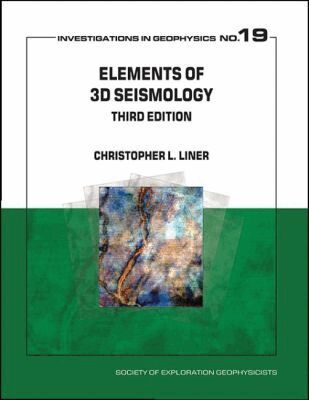
Elements of 3D Seismology, Third Edition is a thorough introduction to the acquisition, processing, and interpretation of 3D seismic data. This third edition is a major update of the second edition. Sections dealing with interpretation have been greatly revised in accordance with improved understanding and availability of data and software. Practice exercises have been added, as well as a 3D seismic survey predesign exercise. Discussions include: conceptual and historical foundations of modern reflection seismology; an overview of seismic wave phenomena in acoustic, elastic, and porous media; acquisition principles for land and marine seismic surveys; methods used to create 2D and 3D seismic images from field data; concepts of dip moveout, prestack migration, and depth migration; concepts and limitations of 3D seismic interpretation for structure, stratigraphy, and rock property estimation; and the interpretation role of attributes, impedance estimation, and AVO. This book is intended as a general text on reflection seismology, including wave propagation, data acquisition, processing, and interpretation, and it will be of interest to entry-level geophysicists, experts in related fields (geology, petroleum engineering), and experienced geophysicists in one subfield wishing to learn about another (e.g., interpreters wanting to learn about seismic waves or data acquisition).
2 640 kr
Skickas inom 7-10 vardagar
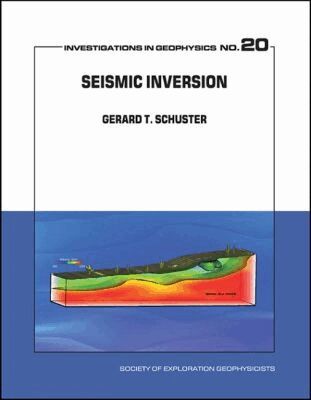
This book describes the theory and practice of inverting seismic data for the subsurface rock properties of the earth. The primary application is for inverting reflection and/or transmission data from engineering or exploration surveys, but the methods described can also be used for earthquake studies. Seismic Inversion will be of benefit to scientists and advanced students in engineering, earth sciences, and physics. It is desirable that the reader has some familiarity with certain aspects of numerical computation, such as finite-difference solutions to partial differential equations, numerical linear algebra, and the basic physics of wave propagation. For those not familiar with the terminology and methods of seismic exploration, a brief introduction is provided. To truly understand the nuances of seismic inversion, we have to actively practice what we preach (or teach). Therefore, computational labs are provided for most of the chapters, and some field data labs are given as well.
3 986 kr
Skickas inom 11-20 vardagar
Introduction to Petroleum Seismology, second edition (SEG Investigations in Geophysics Series No. 12) provides the theoretical and practical foundation for tackling present and future challenges of petroleum seismology especially those related to seismic survey designs, seismic data acquisition, seismic and EM modeling, seismic imaging, microseismicity, and reservoir characterization and monitoring. All of the chapters from the first edition have been improved and/or expanded. In addition, twelve new chapters have been added. These new chapters expand topics which were only alluded to in the first edition: sparsity representation, sparsity and nonlinear optimization, near-simultaneous multiple-shooting acquisition and processing, nonuniform wavefield sampling, automated modeling, elastic-electromagnetic mathematical equivalences, and microseismicity in the context of hydraulic fracturing. Another major modification in this edition is that each chapter contains analytical problems as well as computational problems. These problems include MatLab codes, which may help readers improve their understanding of and intuition about these materials. The comprehensiveness of this book makes it a suitable text for undergraduate and graduate courses that target geophysicists and engineers as well as a guide and reference work for researchers and professionals in academia and in the petroleum industry.