Jenny Stanford Series on the High‐Tech of Biotechnology – serie
Visar alla böcker i serien Jenny Stanford Series on the High‐Tech of Biotechnology. Handla med fri frakt och snabb leverans.
3 produkter
3 produkter
1 569 kr
Skickas inom 10-15 vardagar
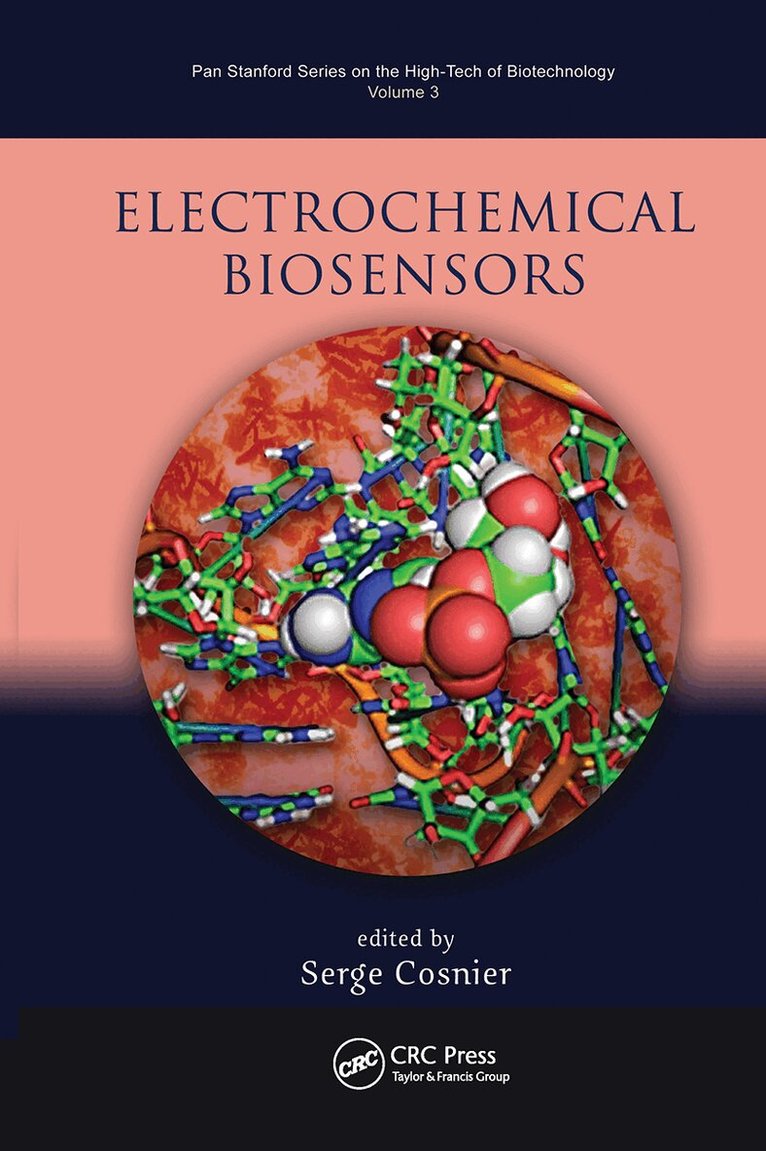
Since four decades, rapid detection and monitoring in clinical and food diagnostics and in environmental and biodefense have paved the way for the elaboration of electrochemical biosensors. Thanks to their adaptability, ease of use in relatively complex samples, and their portability, electrochemical biosensors now are one of the mainstays of analytical chemistry. In particular, electrochemistry has played a pivotal role in the development of transduction methods for biological processes and biosensors. In parallel, the explosion of activity in nanoscience and nanotechnology and their huge success have profoundly affected biosensor technology, opening new avenues of research for electrode materials and transduction.This book provides an overview of biosensors based on amperometry, conductimetry, potentiometry, square-wave voltammetry, impedance, and electrochemiluminescence and describes the use of ultramicroelectrodes for the real-time monitoring and understanding of exocytosis. Areas of particular interest are the use of silver and gold nanoparticles for signal amplification, photocurrent transduction, and aptamer design. Moreover, advanced insights in the innovative concept of self-powered biosensors derived from biofuel cells are also discussed.
Nanomaterials for Water Management
Signal Amplification for Biosensing from Nanostructures
Inbunden, Engelska, 2015
1 569 kr
Skickas inom 10-15 vardagar
The interest in finding reliable and highly sensitive sensors for water quality control has grown recently empowered by the explosion of cutting-edge technologies such as nanotechnologies, optoelectronics, and computing on one hand and by the increasing need for more secure control of water quality on the other hand. This book highlights a number of modern topics in the field of biosensing particularly for water sensing in which the signal is enhanced, starting from surface enhanced spectroscopies using plasmonic structures such as Raman scattering (SERS), infrared enhanced absorption (SEIRA), and surface enhanced fluorescence (SEF). The SPR enhanced detection is highlighted in two chapters and addressed using signal processing and the use of color of solutions as a result of modification of the LSPR properties of nanoparticles. Porous materials are another field of research where the enhancement is achieved due to the increasing the area- to-volume ratio. Good examples are the two emerging fields of porous Si and sculptured thin films prepared by the oblique deposition technique. One of the long standing problems is bacteria detection in water which is addressed thoroughly with emphasis on the problems usually encountered in detecting large bioentities.
1 562 kr
Skickas inom 7-10 vardagar
This book describes the design and the use of bioluminescent biosensors. It introduces beginners and experienced researchers starting in the microbiological biosensor domain to the practical aspects of building a luminescent microbial biosensor. It is also a source of information about other applications that use microbial cells. Each chapter focuses as far as possible on the technological conception of the presented biosensor with a clear demonstration of the issues in the design and how to reach the proof of concept. The book is divided into three practical sections facilitating the reader to easily access the information.