KIAS Springer Series in Mathematics - Böcker
Visar alla böcker i serien KIAS Springer Series in Mathematics. Handla med fri frakt och snabb leverans.
9 produkter
9 produkter
534 kr
Skickas inom 10-15 vardagar
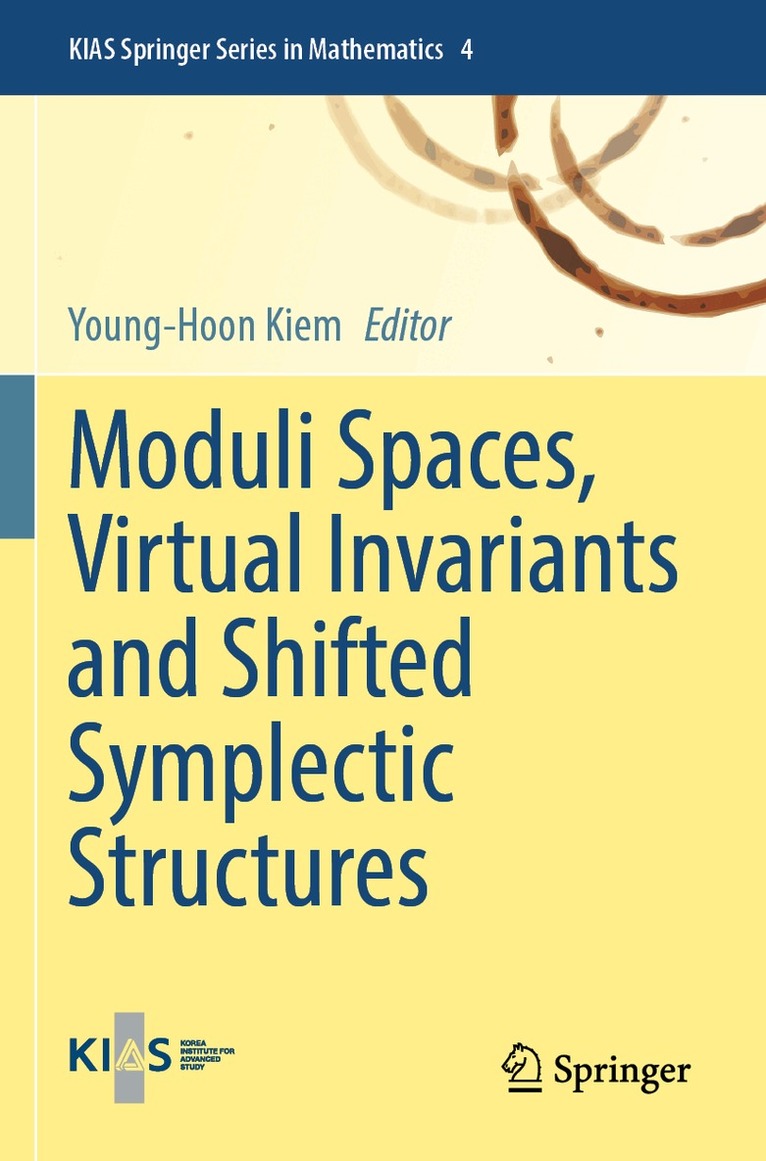
Young-Hoon Kiem discusses classical enumerative geometry before string theory and improvements after string theory as well as some recent advances in quantum singularity theory, Donaldson–Thomas theory for Calabi–Yau 4-folds, and Vafa–Witten invariants.
534 kr
Skickas inom 10-15 vardagar
This book consists of five chapters presenting problems of current research in mathematics, with its history and development, current state, and possible future direction. Four of the chapters are expository in nature while one is based more directly on research. All deal with important areas of mathematics, however, such as algebraic geometry, topology, partial differential equations, Riemannian geometry, and harmonic analysis. This book is addressed to researchers who are interested in those subject areas. Young-Hoon Kiem discusses classical enumerative geometry before string theory and improvements after string theory as well as some recent advances in quantum singularity theory, Donaldson–Thomas theory for Calabi–Yau 4-folds, and Vafa–Witten invariants. Dongho Chae discusses the finite-time singularity problem for three-dimensional incompressible Euler equations. He presents Kato's classicallocal well-posedness results, Beale–Kato–Majda's blow-up criterion, and recent studies on the singularity problem for the 2D Boussinesq equations. Simon Brendle discusses recent developments that have led to a complete classification of all the singularity models in a three-dimensional Riemannian manifold. He gives an alternative proof of the classification of noncollapsed steady gradient Ricci solitons in dimension 3. Hyeonbae Kang reviews some of the developments in the Neumann–Poincare operator (NPO). His topics include visibility and invisibility via polarization tensors, the decay rate of eigenvalues and surface localization of plasmon, singular geometry and the essential spectrum, analysis of stress, and the structure of the elastic NPO.Danny Calegari provides an explicit description of the shift locus as a complex of spaces over a contractible building. He describes the pieces in terms of dynamically extended laminations and of certain explicit “discriminant-like” affine algebraic varieties.
Categorical and Enumerative Aspects of Mirror Symmetry
A Tribute to the Life and Work of Professor Bumsig Kim
Inbunden, Engelska, 2026
591 kr
Kommande
This open access book is a tribute to the profound contributions of Professor Bumsig Kim in the field of mathematics, particularly in the realm of mirror symmetry.
Del 2 - KIAS Springer Series in Mathematics
Lagrangian Floer Theory and Its Deformations
An Introduction to Filtered Fukaya Category
Inbunden, Engelska, 2024
903 kr
Skickas inom 7-10 vardagar
A-infinity structure was introduced by Stasheff in the 1960s in his homotopy characterization of based loop space, which was the culmination of earlier works of Sugawara's homotopy characterization of H-spaces and loop spaces. At the beginning of the 1990s, a similar structure was introduced by Fukaya in his categorification of Floer homology in symplectic topology. This structure plays a fundamental role in the celebrated homological mirror symmetry proposal by Kontsevich and in more recent developments of symplectic topology.A detailed construction of A-infinity algebra structure attached to a closed Lagrangian submanifold is given in Fukaya, Oh, Ohta, and Ono's two-volume monograph Lagrangian Intersection Floer Theory (AMS-IP series 46 I & II), using the theory of Kuranishi structures—a theory that has been regarded as being not easily accessible to researchers in general. The present lecture note is provided by one of the main contributors to the Lagrangian Floer theory and is intended to provide a quick, reader-friendly explanation of the geometric part of the construction. Discussion of the Kuranishi structures is minimized, with more focus on the calculations and applications emphasizing the relevant homological algebra in the filtered context.The book starts with a quick explanation of Stasheff polytopes and their two realizations—one by the rooted metric ribbon trees and the other by the genus-zero moduli space of open Riemann surfaces—and an explanation of the A-infinity structure on the motivating example of the based loop space. It then provides a description of the moduli space of genus-zero bordered stable maps and continues with the construction of the (curved) A-infinity structure and its canonical models. Included in the explanation are the (Landau–Ginzburg) potential functions associated with compact Lagrangian submanifolds constructed by Fukaya, Oh, Ohta, and Ono. The book explains calculations of potential functions for toric fibers in detail and reviews several explicit calculations in the literature of potential functions with bulk as well as their applications to problems in symplectic topology via the critical point theory thereof. In the Appendix, the book also provides rapid summaries of various background materials such as the stable map topology, Kuranishi structures, and orbifold Lagrangian Floer theory.
Del 2 - KIAS Springer Series in Mathematics
Lagrangian Floer Theory and Its Deformations
An Introduction to Filtered Fukaya Category
Häftad, Engelska, 2025
639 kr
Skickas inom 10-15 vardagar
Del 3 - KIAS Springer Series in Mathematics
Progress on the Study of the Ginibre Ensembles
Inbunden, Engelska, 2024
534 kr
Skickas inom 7-10 vardagar
There is a distinction between the Ginibre ensemble with complex entries (GinUE) and those with real or quaternion entries (GinOE and GinSE, respectively). First, the eigenvalues of GinUE form a determinantal point process, while those of GinOE and GinSE have the more complicated structure of a Pfaffian point process.
Del 3 - KIAS Springer Series in Mathematics
Progress on the Study of the Ginibre Ensembles
Häftad, Engelska, 2025
429 kr
Skickas inom 10-15 vardagar
This open access book focuses on the Ginibre ensembles that are non-Hermitian random matrices proposed by Ginibre in 1965. Since that time, they have enjoyed prominence within random matrix theory, featuring, for example, the first book on the subject written by Mehta in 1967. Their status has been consolidated and extended over the following years, as more applications have come to light, and the theory has developed to greater depths. This book sets about detailing much of this progress. Themes covered include eigenvalue PDFs and correlation functions, fluctuation formulas, sum rules and asymptotic behaviors, normal matrix models, and applications to quantum many-body problems and quantum chaos. There is a distinction between the Ginibre ensemble with complex entries (GinUE) and those with real or quaternion entries (GinOE and GinSE, respectively).First, the eigenvalues of GinUE form a determinantal point process, while those of GinOE and GinSE have the more complicated structure of a Pfaffian point process. Eigenvalues on the real line in the case of GinOE also provide another distinction. On the other hand, the increased complexity provides new opportunities for research. This is demonstrated in our presentation, which details several applications and contains not previously published theoretical advances. The areas of application are diverse, with examples being diffusion processes and persistence in statistical physics and equilibria counting for a system of random nonlinear differential equations in the study of the stability of complex systems.
Del 4 - KIAS Springer Series in Mathematics
Moduli Spaces, Virtual Invariants and Shifted Symplectic Structures
Inbunden, Engelska, 2025
1 588 kr
Skickas inom 10-15 vardagar
Enumerative geometry is a core area of algebraic geometry that dates back to Apollonius in the second century BCE.
Del 4 - KIAS Springer Series in Mathematics
Moduli Spaces, Virtual Invariants and Shifted Symplectic Structures
Häftad, Engelska, 2026
1 588 kr
Skickas inom 10-15 vardagar
Enumerative geometry is a core area of algebraic geometry that dates back to Apollonius in the second century BCE. It asks for the number of geometric figures with desired properties and has many applications from classical geometry to modern physics. Typically, an enumerative geometry problem is solved by first constructing the space of all geometric figures of fixed type, called the moduli space, and then finding the subspace of objects satisfying the desired properties. Unfortunately, many moduli spaces from nature are highly singular, and an intersection theory is difficult to make sense of. However, they come with deeper structures, such as perfect obstruction theories, which enable us to define nice subsets, called virtual fundamental classes. Now, enumerative numbers, called virtual invariants, are defined as integrals against the virtual fundamental classes.Derived algebraic geometry is a relatively new area of algebraic geometry that is a natural generalization of Serre’s intersection theory in the 1950s and Grothendieck’s scheme theory in the 1960s. Many moduli spaces in enumerative geometry admit natural derived structures as well as shifted symplectic structures.The book covers foundations on derived algebraic and symplectic geometry. Then, it covers foundations on virtual fundamental classes and moduli spaces from a classical algebraic geometry point of view. Finally, it fuses derived algebraic geometry with enumerative geometry and covers the cutting-edge research topics about Donaldson–Thomas invariants in dimensions three and four.