Language and Language Behavior - Böcker
Visar alla böcker i serien Language and Language Behavior. Handla med fri frakt och snabb leverans.
5 produkter
5 produkter
Del 4 - Language and Language Behavior
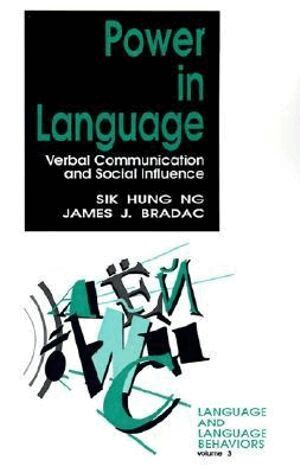
Power in Language
Verbal Communication and Social Influence
Häftad, Engelska, 1993
2 271 kr
Skickas inom 3-6 vardagar
The literature review provided by Sik Hung Ng and James J. Bradac is particularly thorough and informative. --Canadian Journal of Communication "This volume, the third in the Language and Language Behaviors Series, fits nicely with the series' aim to reveal ways language behaviors create and revise everyday life. The book provides extremely broad coverage of a vast amount of literature that adopts quite a diversity of positions with regard to how language and power are connected. It is written in a style accessible to students in social psychology, as well as verbal communication, and at the same time tackles questions that should be at the forefront of discussions of researchers in these fields as well." --Nancy Budwig in Journal of Language and
Del 1 - Language and Language Behavior
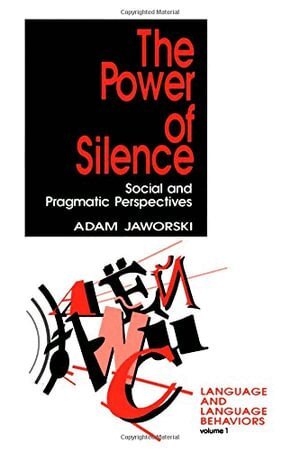
The Power of Silence
Social and Pragmatic Perspectives
Häftad, Engelska, 1993
2 160 kr
Skickas inom 3-6 vardagar
Adam Jaworski tells his reader in the preface to The Power of Silence that he wants 'to show silence as a rich and powerful tool of communication and to provide some clues as to how it works in different areas of human communication and how it can be accounted for by various theories.' Jaworski does this, and more, in this very extensive exploration of silence as a means of communication. . . The gems of Jaworski's discussion come through his examples, which are woven together from his own Polish background and an astute coverage of cross-cultural (Polish, Amish, Apache), feminist and mass media research on silence. The book covers a broad scope of orientations: linguistic, psycholinguistic, paralinguistic, ethnographic, pragmatic, literary, and artistic. As such, The Power of Silence has broad appeal to anyone who deals even marginally with communication issues, especially teachers, who will appreciate his coverage of silence in the classroom. . . Jaworski's book serves the necessary function of bringing together various types of research on silence into one volume. . . . He has accomplished his task. It would not be a mistake to recommend the book to students as an introduction to silence and communication. Jaworski's full bibliography, and the book overall, is an invaluable resource for scholars of linguistics, communication theory, discourse analysis, political communication, literature, the rhetoric of art, intercultural communication, women and language, and mass media. --Discourse & Society Is silence the antithesis of communication? Or is it simply another way in which humans exchange information? In this theoretical yet accessible account of a variety of different aspects of silence, Jaworski contends that silence is an extremely powerful communicative tool. This innovative volume includes a research overview that shows the influence of related work in the fields of media studies, politics, gender studies, aesthetics, and literature. For example, one section of the book illustrates the power of silencing in politics; another chapter emphasizes the importance of silence beyond linguistics and politics in terms of artistic expression. By incorporating the work of a wide array of theorists--such as Brown and Levinson (politeness), Leach (taboo), Rosch (prototypes), and Sperber and Wilson (relevance)--Jaworski keeps his approach intentionally broad and eclectic in order to explore the concept of silence as a rich and evocative aspect of communication. The author argues that, in theoretically pragmatic terms, silence can be accounted for by the same principles as those of speech. He then investigates new ways of studying socially-motivated language, particularly emphasizing silence and the silenced. By applying several frameworks of analyses to both linguistic and non-linguistic dimensions of silence, Jaworski contributes to the integrative study of culture, of which language is an integral part. Researchers, professors, and advanced students throughout communication studies and sociolinguistics will find this volume to be an innovative and essential resource.
3 127 kr
Skickas inom 3-6 vardagar
Who tells lies? Where, when, and how? Why do people tell lies, and when are they deemed acceptable? Deceit, Delusion, and Detection is a remarkable book that examines these questions across a variety of institutional and interpersonal contexts. Author W. Peter Robinson explores ways in which people develop their skills of deception and discusses the feasibility and art of lie detection. This volume reveals the cultural biases inherent in varying modes and interpretations of lying, paying special attention to the Western world and its values. Looking at lying from a social psychological perspective, Robinson analyzes it in terms of language and language usage. This book is accessible enough for the general public yet scholarly enough for academia. Deceit, Delusion, and Detection is particularly geared toward advanced students in communication studies and cognate areas such as social psychology, linguistics, or media studies. "Deceit, Delusion, and Detection is appropriate for graduate and postgraduate researchers in social psychology, sociology, and political science. . . . Several of the chapters . . . stand on their own as reviews of the research literature on the development of deception, on lying in face-to-face interaction, and on the history and effectiveness of the polygraph. . . . I have learned much from studying the collage W. Peter Robinson creates in Deceit, Delusion, and Detection." --Marsha D. Walton in Journal of Language and Social Psychology
2 271 kr
Skickas inom 3-6 vardagar
Who tells lies? Where, when, and how? Why do people tell lies, and when are they deemed acceptable? Deceit, Delusion, and Detection is a remarkable book that examines these questions across a variety of institutional and interpersonal contexts. Author W. Peter Robinson explores ways in which people develop their skills of deception and discusses the feasibility and art of lie detection. This volume reveals the cultural biases inherent in varying modes and interpretations of lying, paying special attention to the Western world and its values. Looking at lying from a social psychological perspective, Robinson analyzes it in terms of language and language usage. This book is accessible enough for the general public yet scholarly enough for academia. Deceit, Delusion, and Detection is particularly geared toward advanced students in communication studies and cognate areas such as social psychology, linguistics, or media studies. "Deceit, Delusion, and Detection is appropriate for graduate and postgraduate researchers in social psychology, sociology, and political science. . . . Several of the chapters . . . stand on their own as reviews of the research literature on the development of deception, on lying in face-to-face interaction, and on the history and effectiveness of the polygraph. . . . I have learned much from studying the collage W. Peter Robinson creates in Deceit, Delusion, and Detection." --Marsha D. Walton in Journal of Language and Social Psychology
Del 5 - Language and Language Behavior
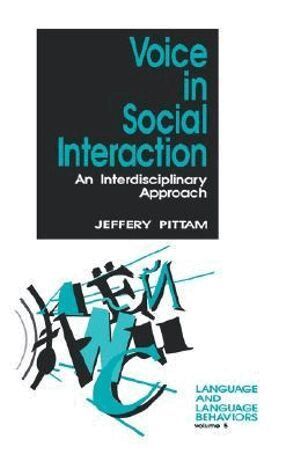
Voice in Social Interaction
An Interdisciplinary Approach
Inbunden, Engelska, 1994
3 127 kr
Skickas inom 3-6 vardagar
The complexity and full extent of the way voice functions communicatively in social interactions has remained unclear, although the link between voice and social and personal identity remains undeveloped--until now. The first comprehensive study of voice, Voice in Social Interaction, provides us with important insights into human social interaction. This volume brings together the many interdisciplinary perspectives on voice--from acoustic phonetics to voice pathology, from the history of vocal function to social interaction. The author concludes the book by developing a theoretical taxonomy that explains vocal function based upon a number of functional models of nonverbal communication, social psychology, linguistics, and communication studies. A unique volume, Voice in Social Interaction will be an essential supplement to graduate and/or upper-level courses in speech/voice, social psychology of language, communication of emotion, public speaking, sociolinguistics, and intergroup or interpersonal relations.