Lecture Notes in Applied Mathematics and Mechanics – Serie
Visar alla böcker i serien Lecture Notes in Applied Mathematics and Mechanics. Handla med fri frakt och snabb leverans.
3 produkter
3 produkter
Del 3 - Lecture Notes in Applied Mathematics and Mechanics
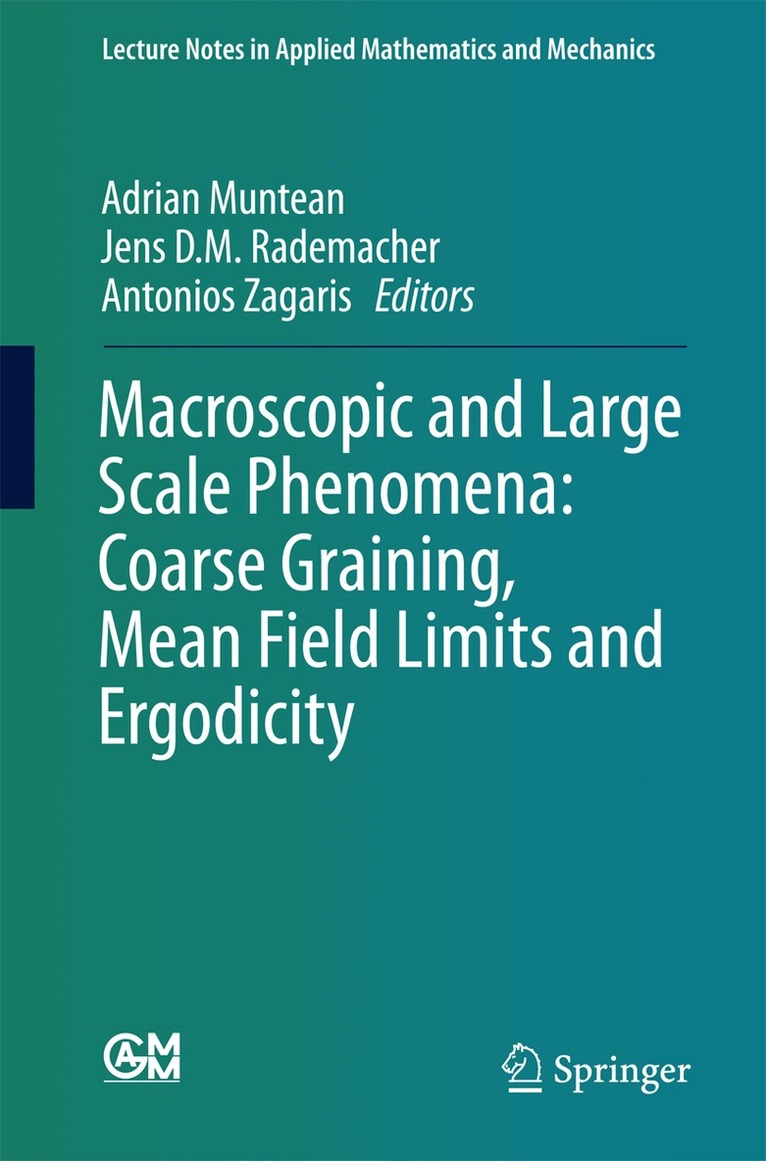
Macroscopic and Large Scale Phenomena: Coarse Graining, Mean Field Limits and Ergodicity
Häftad, Engelska, 2016
1 091 kr
Skickas inom 10-15 vardagar
This book is the offspring of a summer school school “Macroscopic andlarge scalephenomena: coarse graining, mean field limits and ergodicity”, which washeld in 2012 at the University of Twente, the Netherlands. The focus lies onmathematically rigorous methods for multiscale problems of physical origins.Each of the four book chapters is based on a set of lectures deliveredat the school, yet all authors have expanded and refined their contributions. Francois Golsedelivers a chapter on the dynamics of large particle systems in the mean fieldlimit and surveys the most significant tools and methods to establish suchlimits with mathematical rigor. Golse discusses in depth a variety of examples,including Vlasov--Poisson and Vlasov--Maxwell systems. Lucia Scardia focuseson the rigorous derivation of macroscopic models using $\Gamma$-convergence, amore recent variational method, which has proved very powerful for problems inmaterial science. Scardia illustrates this by various basic examples and a moreadvanced case study from dislocation theory.Alexander Mielke'scontribution focuses on the multiscale modeling and rigorous analysis ofgeneralized gradient systems through the new concept of evolutionary$\Gamma$-convergence. Numerous evocative examples are given, e.g., relating toperiodic homogenization and the passage from viscous to dry friction.Martin Göll and EvgenyVerbitskiy conclude this volume, taking a dynamical systems and ergodic theoryviewpoint. They review recent developments in the study of homoclinic pointsfor certain discrete dynamical systems, relating to particle systems viaergodic properties of lattices configurations.
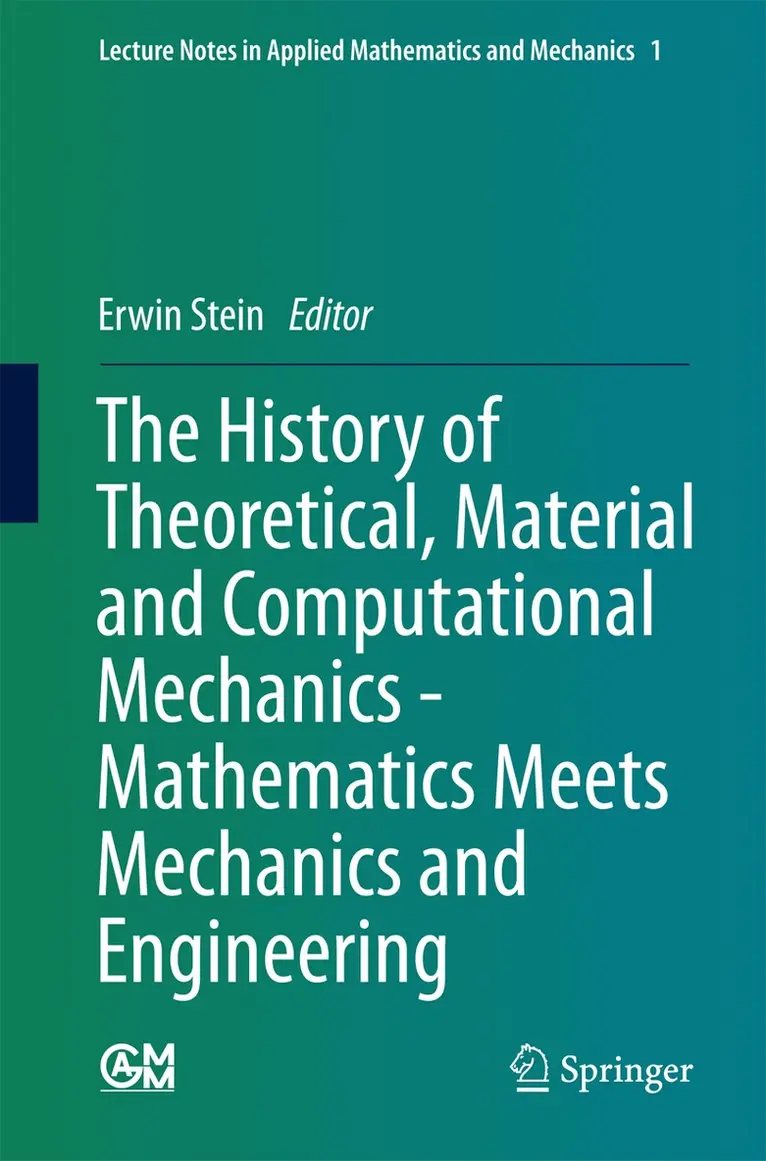
History of Theoretical, Material and Computational Mechanics - Mathematics Meets Mechanics and Engineering
Häftad, Engelska, 2013
1 387 kr
Skickas inom 10-15 vardagar
This collection of 23 articles is the output of lectures in special sessions on “The History of Theoretical, Material and Computational Mechanics” within the yearly conferences of the GAMM in the years 2010 in Karlsruhe, Germany, 2011 in Graz, Austria, and in 2012 in Darmstadt, Germany; GAMM is the “Association for Applied Mathematics and Mechanics”, founded in 1922 by Ludwig Prandtl and Richard von Mises. The contributions in this volume discuss different aspects of mechanics. They are related to solid and fluid mechanics in general and to specific problems in these areas including the development of numerical solution techniques. In the first part the origins and developments of conservation principles in mechanics and related variational methods are treated together with challenging applications from the 17th to the 20th century. Part II treats general and more specific aspects of material theories of deforming solid continua and porous soils. and Part III presents important theoretical and engineering developments in fluid mechanics, beginning with remarkable inventions in old Egypt, the still dominating role of the Navier-Stokes PDEs for fluid flows and their complex solutions for a wide field of parameters as well as the invention of pumps and turbines in the 19th and 20th century. The last part gives a survey on the development of direct variational methods – the Finite Element Method – in the 20th century with many extensions and generalizations.
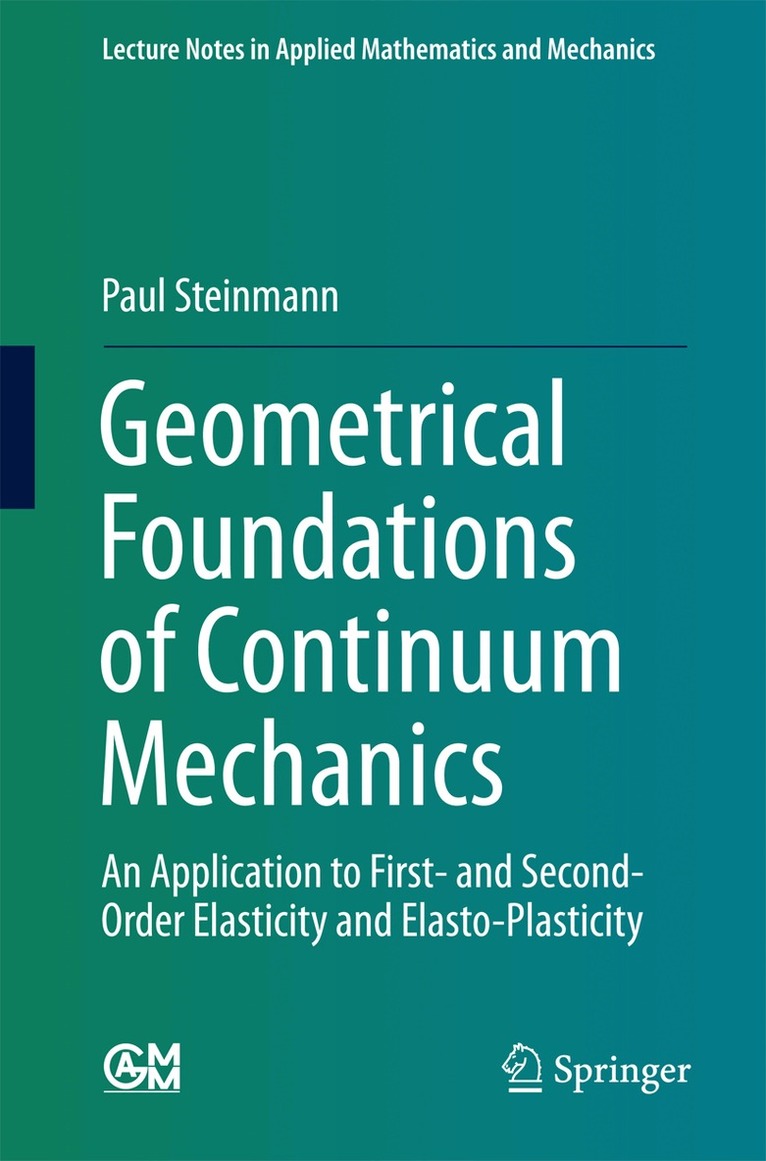
Geometrical Foundations of Continuum Mechanics
An Application to First- and Second-Order Elasticity and Elasto-Plasticity
Häftad, Engelska, 2015
1 584 kr
Skickas inom 10-15 vardagar
This book illustrates the deep roots of the geometrically nonlinear kinematics ofgeneralized continuum mechanics in differential geometry. Besides applications to first-order elasticity and elasto-plasticity an appreciation thereof is particularly illuminatingfor generalized models of continuum mechanics such as second-order (gradient-type)elasticity and elasto-plasticity. After a motivation that arises from considering geometrically linear first- and second-order crystal plasticity in Part I several concepts from differential geometry, relevantfor what follows, such as connection, parallel transport, torsion, curvature, and metricfor holonomic and anholonomic coordinate transformations are reiterated in Part II.Then, in Part III, the kinematics of geometrically nonlinear continuum mechanicsare considered. There various concepts of differential geometry, in particular aspectsrelated to compatibility, are generically applied to the kinematics of first- and second-order geometrically nonlinear continuum mechanics. Together with the discussion onthe integrability conditions for the distortions and double-distortions, the conceptsof dislocation, disclination and point-defect density tensors are introduced. Forconcreteness, after touching on nonlinear first- and second-order elasticity, a detaileddiscussion of the kinematics of (multiplicative) first- and second-order elasto-plasticityis given. The discussion naturally culminates in a comprehensive set of different typesof dislocation, disclination and point-defect density tensors. It is argued, that thesecan potentially be used to model densities of geometrically necessary defects and theaccompanying hardening in crystalline materials. Eventually Part IV summarizes theabove findings on integrability whereby distinction is made between the straightforwardconditions for the distortion and the double-distortion being integrable and the moreinvolved conditions for the strain (metric) and the double-strain (connection) beingintegrable. The book addresses readers with an interest in continuum modelling of solids fromengineering and the sciences alike, whereby a sound knowledge of tensor calculus andcontinuum mechanics is required as a prerequisite.