Linacre Lectures - Böcker
Visar alla böcker i serien Linacre Lectures. Handla med fri frakt och snabb leverans.
6 produkter
6 produkter
2 662 kr
Skickas inom 5-8 vardagar
The environment we inhabit is inseparable from culture. The contributors to this volume move through time and space - from prehistoric Europe to the Enlightenment, and from Aboriginal Australia to the industrial heart of Britain - to compare the ways in which the environment is constructed in different ways across cultures. The book transcends disciplinary boundaries, bringing together leading anthropologists, archaeologists, geographers, historians, and literary scholars to provide challenging perspectives on the ways in which culture influences human conceptions of landscape and the environment. The essays explore the interrelationship between values and emotions associated with 'landscape', and the economic practices that help to shape the physical and social environments in which people live. The book provides powerful evidence of the role of culture in shaping our understanding of the material world.
1 722 kr
Skickas inom 7-10 vardagar
Present anxieties about global warming and threats to biodiversity leave no doubts that environmental changes impact upon humans. Perceptions of the environment change as people try to define and shape 'nature' in different ways. The book explores the relationship between environmental change and society from the last Ice Age to the present. The book examines the environmental impact of fluctuations in climate and the demand for energy, and the patters which human societies have imposed on their surroundings, from boundaries to the cultural projections of legends and film. Together they show how insights from the disciplines of geography and geography, history and anthropology, can throw fresh light on the long-term attachment of people to place. The chapters in this book were originally delivered as Linacre Lectures at Linacre College, Oxford University
2 759 kr
Skickas inom 7-10 vardagar
This volume reviews the way in which, over the centuries, the evolving human presence in Britain has shaped the British landscape and how, in turn, the British landscape has moulded the development of British communities. From the beginnings of human settlement Britain has represented a final frontier for successive waves of colonists, each bringing its own set of cultural adaptations and its own ethos into the landscape. Over time both landscape and culture have matured from raw frontier to settled centre, moulded by the advent of agriculture, towns, and industry, and by streams of migration both within Britain and from outside. The chapters in this book - by archaeologists, historians, and geographers - present an interdisciplinary and accessible account of that long process. Together they trace the various phases of the story, showing how much of it has only recently been unearthed, and how much remains to be discovered.
2 280 kr
Skickas inom 5-8 vardagar
Although it is now widely recognized throughout societies around the world that humankind is straining the capacity of our planet, the responses of the many parties who need to come together to solve the myriad challenges have in general been sectoral in their approach. Yet the dangers presented by drawing successively on Earth's natural resources and exacerbating drought, water scarcity, hunger, health - indeed the viability of whol ecommunities and countries - coupled with the economic and social aspirations of the developed and developing world, clearly call for holistic vision leading to coordinated action.In this book, eight highly experienced authors from acaemia, intergovernmental negotiation, and diplomacy each present their own perspective and assess prospects for progress. the necessity for interdisciplinarity of approach, and for partnership and altruism on an unprecedented scale for solution, and for new negotiation and arbitration frameworks, emerge as inevitalbe conclusions.
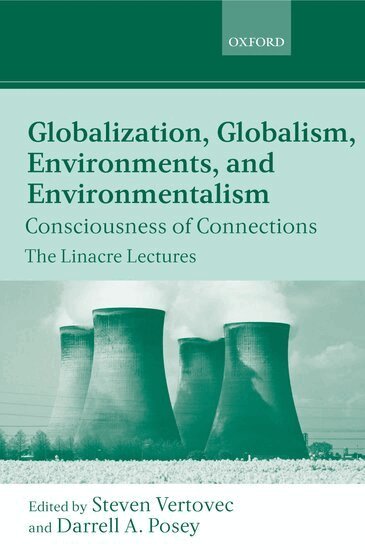
Globalization, Globalism, Environments, and Environmentalism
Consciousness of Connections
Inbunden, Engelska, 2004
1 150 kr
Skickas inom 3-6 vardagar
Over the past two decades there has been a growing attention to environmental matters in both scientific research and public interest. Global concerns have arisen particularly surrounding global warming, the emission of toxic chemicals, threats to biodiversity, radioactivity and the depletion of the world's resources such as fisheries and forest cover. The expansion of environmental interests is evident in numerous ways. These include the rise in the number of environment-focused grass-root and non-government organizations, the proliferation of official environmental agencies at national levels, and the growth of 'green' consumerism. These examples demonstrate a set of ways in which a global 'consciousness of connections' is taking form. Scientists, policy-makers, and the general public have become increasingly aware of the connections between environmental domains, and how damage or depletion in one affects numerous others. Yet another kind of developing 'consciousness of connections' involves the evolving links between individuals, groups and organizations concerned with environmental issues around the world. They are ever more conscious of each other, are creating coalitions for effective public campaigns, and are increasingly gaining the ear of national and international policy-makers.This volume presents the views of a number of leading figures concerning the nature of environmental consciousness and the emergence of connections linking globalization (processes of intensifying social, political and economic networks), globalism (our sense of the world as a whole), specific environments (such as rainforests or cities), and environmentalism (expressed in the activities of social movement organizations).
1 058 kr
Skickas inom 3-6 vardagar
A multi-disciplinary analysis of the evolution of water politics and policy by an international team of distinguished experts. Water management in the Middle Ages in Europe, its evolution in the USA, the elaboration of the European Water Framework Directive, the British experience of water management, the over-exploitation of African aquifers, and the evolution of the water situation in Southern Africa are all examined.This volume underlines the fact that only an integrative and interdisciplinary understanding can lead to genuinely improved water management practices that will not benefit some social groups at the expense of others.