Mechanics of Structural Systems – Serie
Visar alla böcker i serien Mechanics of Structural Systems. Handla med fri frakt och snabb leverans.
8 produkter
8 produkter
Del 5 - Mechanics of Structural Systems
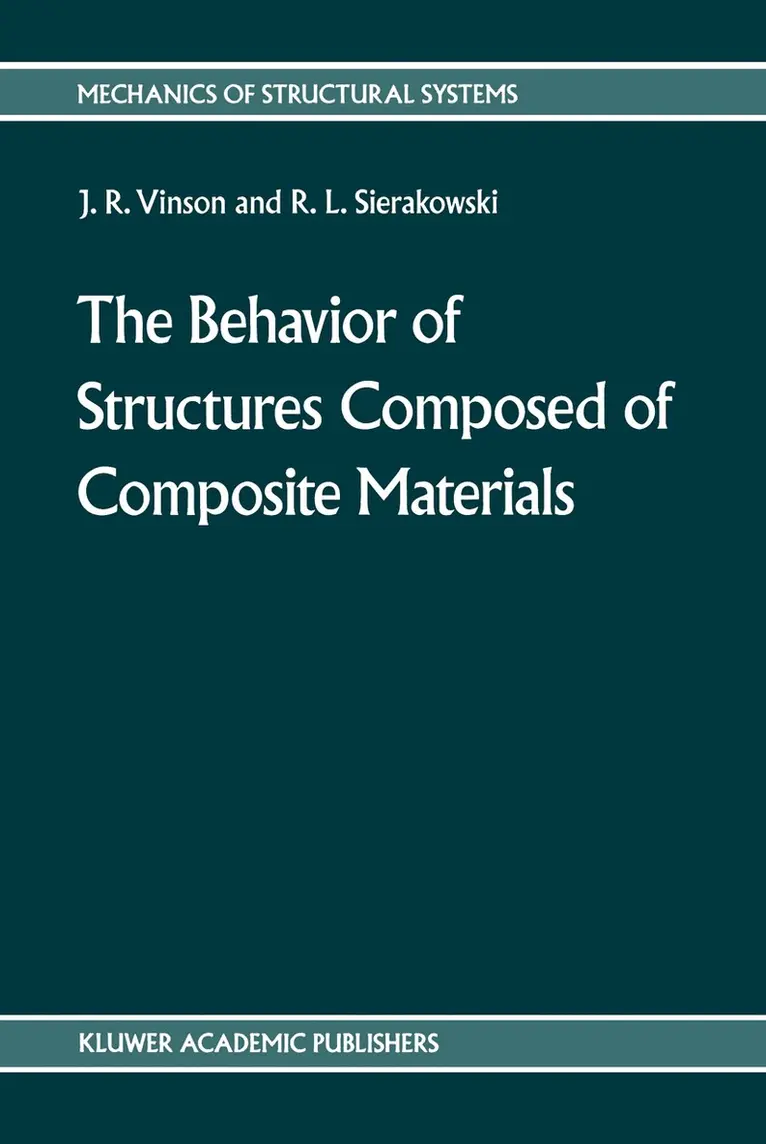
behavior of structures composed of composite materials
Häftad, Engelska, 1987
534 kr
Skickas inom 10-15 vardagar
While currently available texts dealing with the subject of high perfor mance composite materials touch upon a spectra of topics such as mechanical metallurgy, physical metallurgy, micromechanics and macro mechanics of such systems, it is the specific purpose of this text to examine elements of the mechanics of structural components composed of composite materials. This text is intended for use in training engineers in this new technology and rational thought processes necessary to develop a better understanding of the behavior of such material systems for use as structural components. The concepts are further exploited in terms of the structural format and development to which the book is dedicated. To this end the development progresses systematically by first introducing the notion and concepts of what these new material classes are, the fabrication processes involved and their unique features relative to conventional monolithic materials. Such introductory remarks, while far too short in texts of this type, appear necessary as a precursor for engineers to develop a better understanding for design purposes of both the threshold limits to which the properties of such systems can be pushed as well as the practical limitations on their manufacture. Following these introductory remarks, an in-depth discussion of the important differences between composites and conventional monolithic material types is discussed in terms of developing the concepts associated with directional material properties.
1 062 kr
Skickas inom 10-15 vardagar
1 589 kr
Skickas inom 10-15 vardagar
1 062 kr
Skickas inom 10-15 vardagar
1 589 kr
Skickas inom 10-15 vardagar
534 kr
Skickas inom 10-15 vardagar
The aim of this book is to provide a unified presentation of modern mechanics of structures in a form which is suitable for graduate students as well as for engineers and scientists working in the field of applied mechanics. Traditionally, students at technical universities have been taught subjects such as continuum mechanics, elasticity, plates and shells, frames or finite element techniques in an entirely separate manner. The authors' teaching experience clearly suggests that this situation frequently tends to create in students' minds an incomplete and inconsistent picture of the contemporary structural mechanics. Thus, it is very common that the fundamental laws of physics appear to students hardly related to simplified equations of different "technical" theories of structures, numerical solution techniques are studied independently of the essence of mechanical models they describe, and so on. The book is intended to combine in a reasonably connected and unified manner all these problems starting with the very fundamental postulates of nonlinear continuum mechanics via different structural models of "engineer ing" accuracy to numerical solution methods which can effectively be used for solving boundary-value problems of technological importance. The authors have tried to restrict the mathematical background required to that which is normally familiar to a mathematically minded engineering graduate.
630 kr
Skickas inom 10-15 vardagar
The basic partial differential equations for the stresses and displacements in clas sical three dimensional elasticity theory can be set up in three ways: (1) to solve for the displacements first and then the stresses; (2) to solve for the stresses first and then the displacements; and (3) to solve for both stresses and displacements simultaneously. These three methods are identified in the literature as (1) the displacement method, (2) the stress or force method, and (3) the combined or mixed method. Closed form solutions of the partial differential equations with their complicated boundary conditions for any of these three methods have been obtained only in special cases. In order to obtain solutions, various special methods have been developed to determine the stresses and displacements in structures. The equations have been reduced to two and one dimensional forms for plates, beams, and trusses. By neglecting the local effects at the edges and ends, satisfactory solutions can be obtained for many case~. The procedures for reducing the three dimensional equations to two and one dimensional equations are described in Chapter 1, Volume 1, where the various approximations are pointed out.
1 062 kr
Skickas inom 10-15 vardagar
Transport engineering structures are subjected to loads that vary in both time and space. In general mechanics parlance such loads are called moving loads. It is the aim of the book to analyze the effects of this type of load on various elements, components, structures and media of engineering me chanics. In recent years all branches of transport have experienced great advances characterized by increasingly higher speeds and weights of vehicles. As a result, structures and media over or in which the vehicles move have been subjected to vibrations and dynamic stresses far larger than ever before. The author has studied vibrations of elastic and inelastic bodies and structures under the action of moving loads for many years. In the course of his career he has published a number of papers dealing with various aspects of the problem. On the strength of his studies he has arrived at the conclusion that the topic has so grown in scope and importance as to merit a comprehensive treatment. The book is the outcome of his attempt to do so in a single monograph.