Middle Range Series – serie
Visar alla böcker i serien Middle Range Series. Handla med fri frakt och snabb leverans.
15 produkter
15 produkter
Inbunden, Engelska, 2016
393 kr
Skickas
A fast-growing social media marketing company, TechCo encourages all of its employees to speak up. By promoting open dialogue across the corporate hierarchy, the firm has fostered a uniquely engaged workforce and an enviable capacity for change. Yet the path hasn't always been easy. TechCo has confronted a number of challenges, and its experience reveals the essential elements of bureaucracy that remain even when a firm sets out to discard them. Through it all, TechCo serves as a powerful new model for how firms can navigate today's rapidly changing technological and cultural climate. Catherine J. Turco was embedded within TechCo for ten months. The Conversational Firm is her ethnographic analysis of what worked at the company and what didn't. She offers multiple lessons for anyone curious about the effect of social media on the corporate environment and adds depth to debates over the new generation of employees reared on social media: Millennials who carry their technological habits and expectations into the workplace.Marshaling insights from cultural and economic sociology, organizational theory, economics, technology studies, and anthropology, The Conversational Firm offers a nuanced analysis of corporate communication, control, and culture in the social media age.
Häftad, Engelska, 2018
330 kr
Skickas inom 5-8 vardagar
A fast-growing social media marketing company, TechCo encourages all of its employees to speak up. By promoting open dialogue across the corporate hierarchy, the firm has fostered a uniquely engaged workforce and an enviable capacity for change. Yet the path hasn't always been easy. TechCo has confronted a number of challenges, and its experience reveals the essential elements of bureaucracy that remain even when a firm sets out to discard them. Through it all, TechCo serves as a powerful new model for how firms can navigate today's rapidly changing technological and cultural climate.Catherine J. Turco was embedded within TechCo for ten months. The Conversational Firm is her ethnographic analysis of what worked at the company and what didn't. She offers multiple lessons for anyone curious about the effect of social media on the corporate environment and adds depth to debates over the new generation of employees reared on social media: Millennials who carry their technological habits and expectations into the workplace. Marshaling insights from cultural and economic sociology, organizational theory, economics, technology studies, and anthropology, The Conversational Firm offers a nuanced analysis of corporate communication, control, and culture in the social media age.
Inbunden, Engelska, 2019
1 192 kr
Skickas inom 5-8 vardagar
From the Spanish Inquisition to Nazi Germany to the United States today, ordinary people have often chosen to turn in their neighbors to the authorities. What motivates citizens to inform on the people next door? In Judge Thy Neighbor, Patrick Bergemann provides a theoretical framework for understanding the motives for denunciations in terms of institutional structures and incentives.In case studies of societies in which denunciations were widespread, Bergemann merges historical and quantitative analysis to explore individual reasons for participation. He sheds light on Jewish converts’ shifting motives during the Spanish Inquisition; when and why seventeenth-century Romanov subjects fulfilled their obligation to report insults to the tsar’s honor; and the widespread petty and false complaints filed by German citizens under the Third Reich, as well as present-day plea bargains, whistleblowing, and crime reporting. Bergemann finds that when authorities use coercion or positive incentives to elicit information, individuals denounce out of self-preservation or to gain rewards. However, in the absence of these incentives, denunciations are often motivated by personal resentments and grudges. In both cases, denunciations facilitate social control not because of citizen loyalty or moral outrage but through the local interests of ordinary participants. Offering an empirically and theoretically rich account of the dynamics of denunciation as well as vivid descriptions of the denounced, Judge Thy Neighbor is a timely and compelling analysis of the reasons people turn in their acquaintances, with relevance beyond conventionally repressive regimes.
Häftad, Engelska, 2021
304 kr
Skickas inom 5-8 vardagar
From the Spanish Inquisition to Nazi Germany to the United States today, ordinary people have often chosen to turn in their neighbors to the authorities. What motivates citizens to inform on the people next door? In Judge Thy Neighbor, Patrick Bergemann provides a theoretical framework for understanding the motives for denunciations in terms of institutional structures and incentives.In case studies of societies in which denunciations were widespread, Bergemann merges historical and quantitative analysis to explore individual reasons for participation. He sheds light on Jewish converts’ shifting motives during the Spanish Inquisition; when and why seventeenth-century Romanov subjects fulfilled their obligation to report insults to the tsar’s honor; and the widespread petty and false complaints filed by German citizens under the Third Reich, as well as present-day plea bargains, whistleblowing, and crime reporting. Bergemann finds that when authorities use coercion or positive incentives to elicit information, individuals denounce out of self-preservation or to gain rewards. However, in the absence of these incentives, denunciations are often motivated by personal resentments and grudges. In both cases, denunciations facilitate social control not because of citizen loyalty or moral outrage but through the local interests of ordinary participants. Offering an empirically and theoretically rich account of the dynamics of denunciation as well as vivid descriptions of the denounced, Judge Thy Neighbor is a timely and compelling analysis of the reasons people turn in their acquaintances, with relevance beyond conventionally repressive regimes.
Inbunden, Engelska, 2021
1 158 kr
Skickas inom 5-8 vardagar
Western Europe rose in global power during the early modern period as overseas expansion opened new trade routes. At the same time, intense rivalries pitted European states against one another in recurrent wars. Henning Hillmann examines the merchant community of Saint-Malo, Brittany, a key port in the French Atlantic economy, to shed light on the local networks that linked commerce and conflict in early modern Europe.Hillmann traces the development of Saint-Malo and the social structure of its merchant elite from the 1680s through the onset of the French Revolution. He pinpoints the role of privateering, showing how it enabled local merchant communities to secure their hold on established trades, seize new opportunities, and withstand the threats of armed conflict. In wartime, rulers commissioned ship-owning traders to fit out vessels as corsairs to raid enemy shipping. Within a mercantilist worldview, this state-sanctioned private war at sea aligned the interests of local elites and the royal government. Locally, within Saint-Malo, the partnerships that merchant elites formed in their privateering ventures gave rise to a cohesive network that held their community together amid outside conflicts. Combining rich descriptions of privateering campaigns with quantitative network analysis of partnership ties over more than a century, The Corsairs of Saint-Malo offers a new understanding of the local organizational foundations of early modern capitalist development.
Häftad, Engelska, 2021
295 kr
Skickas inom 5-8 vardagar
Western Europe rose in global power during the early modern period as overseas expansion opened new trade routes. At the same time, intense rivalries pitted European states against one another in recurrent wars. Henning Hillmann examines the merchant community of Saint-Malo, Brittany, a key port in the French Atlantic economy, to shed light on the local networks that linked commerce and conflict in early modern Europe.Hillmann traces the development of Saint-Malo and the social structure of its merchant elite from the 1680s through the onset of the French Revolution. He pinpoints the role of privateering, showing how it enabled local merchant communities to secure their hold on established trades, seize new opportunities, and withstand the threats of armed conflict. In wartime, rulers commissioned ship-owning traders to fit out vessels as corsairs to raid enemy shipping. Within a mercantilist worldview, this state-sanctioned private war at sea aligned the interests of local elites and the royal government. Locally, within Saint-Malo, the partnerships that merchant elites formed in their privateering ventures gave rise to a cohesive network that held their community together amid outside conflicts. Combining rich descriptions of privateering campaigns with quantitative network analysis of partnership ties over more than a century, The Corsairs of Saint-Malo offers a new understanding of the local organizational foundations of early modern capitalist development.
Inbunden, Engelska, 2021
1 158 kr
Skickas inom 5-8 vardagar
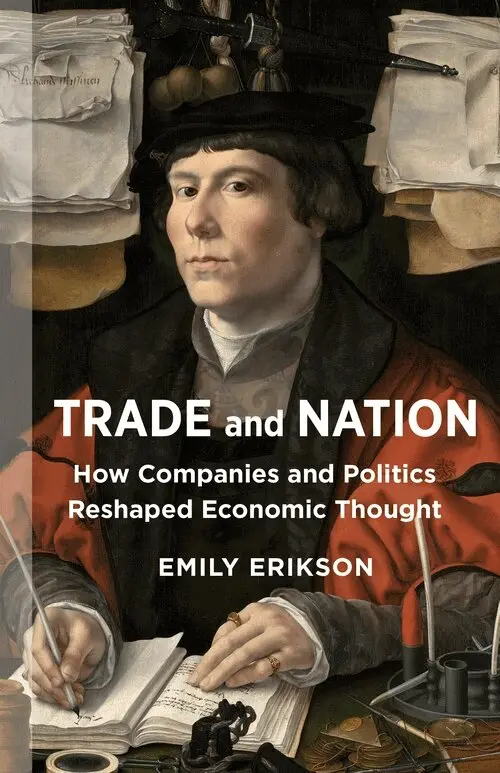
In the seventeenth century, English economic theorists lost interest in the moral status of exchange and became increasingly concerned with the roots of national prosperity. This shift marked the origins of classical political economy and provided the foundation for the contemporary discipline of economics. The seventeenth-century revolution in economic thought fundamentally reshaped the way economic processes have been interpreted and understood. In Trade and Nation, Emily Erikson brings together historical, comparative, and computational methods to explain the institutional forces that brought about this transformation.Erikson pinpoints how the rise of the company form in confluence with the political marginalization of English merchants created an opening for public argumentation over economic matters. Independent merchants, who were excluded from state institutions and vast areas of trade, confronted the power and influence of crown-endorsed chartered companies. Their distance from the halls of government drove them to take their case to the public sphere. The number of merchant-authored economic texts rose as members of this class sought to show that their preferred policies would contribute to the benefit of the state and commonwealth. In doing so, they created and disseminated a new moral framework of growth, prosperity, and wealth for evaluating economic behavior. By using computational methods to document these processes, Trade and Nation provides both compelling evidence and a prototype for how methodological innovations can help to provide new insights into large-scale social processes.
Häftad, Engelska, 2021
295 kr
Skickas inom 5-8 vardagar
In the seventeenth century, English economic theorists lost interest in the moral status of exchange and became increasingly concerned with the roots of national prosperity. This shift marked the origins of classical political economy and provided the foundation for the contemporary discipline of economics. The seventeenth-century revolution in economic thought fundamentally reshaped the way economic processes have been interpreted and understood. In Trade and Nation, Emily Erikson brings together historical, comparative, and computational methods to explain the institutional forces that brought about this transformation.Erikson pinpoints how the rise of the company form in confluence with the political marginalization of English merchants created an opening for public argumentation over economic matters. Independent merchants, who were excluded from state institutions and vast areas of trade, confronted the power and influence of crown-endorsed chartered companies. Their distance from the halls of government drove them to take their case to the public sphere. The number of merchant-authored economic texts rose as members of this class sought to show that their preferred policies would contribute to the benefit of the state and commonwealth. In doing so, they created and disseminated a new moral framework of growth, prosperity, and wealth for evaluating economic behavior. By using computational methods to document these processes, Trade and Nation provides both compelling evidence and a prototype for how methodological innovations can help to provide new insights into large-scale social processes.
Inbunden, Engelska, 2018
993 kr
Skickas inom 5-8 vardagar
Walmart is the largest employer in the world. It encompasses nearly 1 percent of the entire American workforce—young adults, parents, formerly incarcerated people, retirees. Walmart also presents one possible future of work—Walmartism—in which the arbitrary authority of managers mixes with a hyperrationalized, centrally controlled bureaucracy in ways that curtail workers’ ability to control their working conditions and their lives.In Working for Respect, Adam Reich and Peter Bearman examine how workers make sense of their jobs at places like Walmart in order to consider the nature of contemporary low-wage work, as well as the obstacles and opportunities such workplaces present as sites of struggle for social and economic justice. They describe the life experiences that lead workers to Walmart and analyze the dynamics of the shop floor. As a part of the project, Reich and Bearman matched student activists with a nascent association of current and former Walmart associates: the Organization United for Respect at Walmart (OUR Walmart). They follow the efforts of this new partnership, considering the formation of collective identity and the relationship between social ties and social change. They show why traditional unions have been unable to organize service-sector workers in places like Walmart and offer provocative suggestions for new strategies and directions. Drawing on a wide array of methods, including participant-observation, oral history, big data, and the analysis of social networks, Working for Respect is a sophisticated reconsideration of the modern workplace that makes important contributions to debates on labor and inequality and the centrality of the experience of work in a fair economy.
Häftad, Engelska, 2020
254 kr
Skickas inom 5-8 vardagar
Walmart is the largest employer in the world. It encompasses nearly 1 percent of the entire American workforce—young adults, parents, formerly incarcerated people, retirees. Walmart also presents one possible future of work—Walmartism—in which the arbitrary authority of managers mixes with a hyperrationalized, centrally controlled bureaucracy in ways that curtail workers’ ability to control their working conditions and their lives.In Working for Respect, Adam Reich and Peter Bearman examine how workers make sense of their jobs at places like Walmart in order to consider the nature of contemporary low-wage work, as well as the obstacles and opportunities such workplaces present as sites of struggle for social and economic justice. They describe the life experiences that lead workers to Walmart and analyze the dynamics of the shop floor. As a part of the project, Reich and Bearman matched student activists with a nascent association of current and former Walmart associates: the Organization United for Respect at Walmart (OUR Walmart). They follow the efforts of this new partnership, considering the formation of collective identity and the relationship between social ties and social change. They show why traditional unions have been unable to organize service-sector workers in places like Walmart and offer provocative suggestions for new strategies and directions. Drawing on a wide array of methods, including participant-observation, oral history, big data, and the analysis of social networks, Working for Respect is a sophisticated reconsideration of the modern workplace that makes important contributions to debates on labor and inequality and the centrality of the experience of work in a fair economy.
Inbunden, Engelska, 2019
295 kr
Skickas inom 5-8 vardagar
Why do people like books, music, or movies that adhere consistently to genre conventions? Why is it hard for politicians to take positions that cross ideological boundaries? Why do we have dramatically different expectations of companies that are categorized as social media platforms as opposed to news media sites? The answers to these questions require an understanding of how people use basic concepts in their everyday lives to give meaning to objects, other people, and social situations and actions.In this book, a team of sociologists presents a groundbreaking model of concepts and categorization that can guide sociological and cultural analysis of a wide variety of social situations. Drawing on research in various fields, including cognitive science, computational linguistics, and psychology, the book develops an innovative view of concepts. It argues that concepts have meanings that are probabilistic rather than sharp, occupying fuzzy, overlapping positions in a “conceptual space.” Measurements of distances in this space reveal our mental representations of categories. Using this model, important yet commonplace phenomena such as our routine buying decisions can be quantified in terms of the cognitive distance between concepts. Concepts and Categories provides an essential set of formal theoretical tools and illustrates their application using an eclectic set of methodologies, from micro-level controlled experiments to macro-level language processing. It illuminates how explicit attention to concepts and categories can give us a new understanding of everyday situations and interactions.
Inbunden, Engelska, 2024
1 192 kr
Skickas inom 5-8 vardagar
Winner, 2025 Sociology of Development Book Award, Sociology of Development Section, American Sociological AssociationWinner, 2025 Choice Outstanding Academic TitleShortlisted, 2026 Alice Amsden Best Book Award, Society for the Advancement of Socio-EconomicsChina’s breathtaking economic development has been driven by bureaucrats. Even as the country transitioned away from socialist planning toward a market economy, the economic bureaucracy retained a striking degree of influence and control over crafting and implementing policy. Yet bureaucrats are often dismissed as faceless and inconsequential, their role neglected in favor of party leaders’ top-down rule or bottom-up initiatives.Markets with Bureaucratic Characteristics offers a new account of economic policy making in China over the past four decades that reveals how bureaucrats have spurred large-scale transformations from within. Yingyao Wang demonstrates how competition among bureaucrats motivated by careerism has led to the emergence of new policy approaches. Second-tier economic bureaucrats instituted distinctive—and often conflicting—“policy paradigms” aimed at securing their standing and rewriting China’s long-term development plans for their own benefit. Emerging from the middle levels of the bureaucracy, these policy paradigms ultimately reorganized the Chinese economy and reshaped state-market relations. Drawing on fine-grained biographical and interview data, Wang traces how officials coalesced around shared career trajectories, generational experiences, and social networks to create new alliances and rivalries. Shedding new light on the making and trajectory of China’s ambitious economic reforms, this book also provides keen sociological insight into the relations among bureaucracy, states, and markets.
Häftad, Engelska, 2024
304 kr
Skickas inom 5-8 vardagar
Winner, 2025 Sociology of Development Book Award, Sociology of Development Section, American Sociological AssociationWinner, 2025 Choice Outstanding Academic TitleShortlisted, 2026 Alice Amsden Best Book Award, Society for the Advancement of Socio-EconomicsChina’s breathtaking economic development has been driven by bureaucrats. Even as the country transitioned away from socialist planning toward a market economy, the economic bureaucracy retained a striking degree of influence and control over crafting and implementing policy. Yet bureaucrats are often dismissed as faceless and inconsequential, their role neglected in favor of party leaders’ top-down rule or bottom-up initiatives.Markets with Bureaucratic Characteristics offers a new account of economic policy making in China over the past four decades that reveals how bureaucrats have spurred large-scale transformations from within. Yingyao Wang demonstrates how competition among bureaucrats motivated by careerism has led to the emergence of new policy approaches. Second-tier economic bureaucrats instituted distinctive—and often conflicting—“policy paradigms” aimed at securing their standing and rewriting China’s long-term development plans for their own benefit. Emerging from the middle levels of the bureaucracy, these policy paradigms ultimately reorganized the Chinese economy and reshaped state-market relations. Drawing on fine-grained biographical and interview data, Wang traces how officials coalesced around shared career trajectories, generational experiences, and social networks to create new alliances and rivalries. Shedding new light on the making and trajectory of China’s ambitious economic reforms, this book also provides keen sociological insight into the relations among bureaucracy, states, and markets.
Inbunden, Engelska, 2025
1 199 kr
Skickas inom 5-8 vardagar
Winner, 2026 Harrison C. White Outstanding Book Award, Decision-Making, Social Networks, and Society Section, American Sociological AssociationWinner, 2026 Outstanding Book Award, Altruism, Morality, and Social Solidarity Section, American Sociological AssociationThe concept of privacy is central to public life in the United States. It is the fulcrum of countless conflicts over reproductive rights and consumer protection, the power of tech companies and the reach of state surveillance. How did privacy come to take on such import, and what have the consequences been for American institutions and society?Martin Eiermann traces the transformation of privacy from a set of informal cultural norms into a potent political issue. Around the turn of the twentieth century, in a nation that was searching for order amid rapid change and frequent moral panics about the ills of modern life, privacy spoke to emerging social problems and new technological realities. During this tumultuous period, political mobilization and judicial contestation shaped a legal, institutional, and administrative privacy architecture that has partly endured into the twenty-first century. Eiermann rebuts the claim that technological change renders privacy obsolete, demonstrating that the concept became increasingly capacious when it was applied to the social problems and political disputes of the information age. And he shows that it is often the selectivity—not the ubiquity—of governmental and corporate data collection that should elicit our concerns.Drawing on rich archival materials and computational research methods, The Limiting Principle provides a deeply original sociological account of the history, social significance, and limitations of privacy in the modern United States.
Häftad, Engelska, 2025
311 kr
Skickas inom 5-8 vardagar
Winner, 2026 Harrison C. White Outstanding Book Award, Decision-Making, Social Networks, and Society Section, American Sociological AssociationWinner, 2026 Outstanding Book Award, Altruism, Morality, and Social Solidarity Section, American Sociological AssociationThe concept of privacy is central to public life in the United States. It is the fulcrum of countless conflicts over reproductive rights and consumer protection, the power of tech companies and the reach of state surveillance. How did privacy come to take on such import, and what have the consequences been for American institutions and society?Martin Eiermann traces the transformation of privacy from a set of informal cultural norms into a potent political issue. Around the turn of the twentieth century, in a nation that was searching for order amid rapid change and frequent moral panics about the ills of modern life, privacy spoke to emerging social problems and new technological realities. During this tumultuous period, political mobilization and judicial contestation shaped a legal, institutional, and administrative privacy architecture that has partly endured into the twenty-first century. Eiermann rebuts the claim that technological change renders privacy obsolete, demonstrating that the concept became increasingly capacious when it was applied to the social problems and political disputes of the information age. And he shows that it is often the selectivity—not the ubiquity—of governmental and corporate data collection that should elicit our concerns.Drawing on rich archival materials and computational research methods, The Limiting Principle provides a deeply original sociological account of the history, social significance, and limitations of privacy in the modern United States.