Modern Perspectives in Energy - Böcker
Visar alla böcker i serien Modern Perspectives in Energy. Handla med fri frakt och snabb leverans.
8 produkter
8 produkter
1 064 kr
Skickas inom 10-15 vardagar
536 kr
Skickas inom 10-15 vardagar
In contrast to the great diversity of other crime and delinquency research measures, those drawn from the CPI and the MMPI have much in common. They are taken from standardized instruments administered under controlled conditions, with known stimulus properties and validity indicators. The CPI and MMPI measures will frequently be instruments of choice in research on personality and psychodynamics of offenders. CHAPTER 6 Law Enforcement and Police This chapter encompasses a variety of scales that refer to law enforcement or police agencies. Unfortunately, in the case of many scales, these terms are used simply with the assumption that the respondents understand the concepts and use them in the same way as researchers. In other cases, however, specific policing functions are identified and described. As noted in Chapter 3, a standard order of scale presentation is followed. First the attitudes scales are presented, followed by the behavior ratings, per sonality measures, milieu ratings, prediction measures and finally the very broad category of description. After the reviews are completed within each subcategory, other scales in that category are listed. (See Chapter 2 for a description of the criteria that were used in deciding upon whether a scale would be reviewed or simply listed. ) Listed scales are presented by title and bibliographic reference, followed by a very brief description.
536 kr
Skickas inom 10-15 vardagar
We try in this book to provide a detailed but readable, technical but accessible monograph on energy in the United States. We treat energy as a multidisciplinary challenge and apply the standard tools of economists, physicists, engineers, policy analysts, and, some might claim, fortune tellers. We hope that it will be used in classrooms of various types, and read by the general reader as well. That increased energy efficiency should be the first priority of energy policymakers is a conclusion, not an assumption, of our analysis. Many analysts have arrived at this conclusion while working separately on energy supply problems. The magnitude and scope of supply problems, primarily problems of high prices and environmental costs, lead one inexorably back to reducing demand growth as the first, most important step in any plausible energy future. We examine, in some depth, why much of the past literature on energy still points, fallaciously in our opinion, to high energy c- v Preface vi sumption futures. This is in Part I (called "A Short History of the Future"). We devote one-third of the book (Part II) to energy resources, their internal and external costs, and the quantities of energy to be derived from these resources. This analysis provides a context within which the economic and social value of energy conservation options can be assessed.
1 276 kr
Skickas inom 10-15 vardagar
ica, I considered myself an old hand: when I started to study the environment of the North Bohemian region in 1963, the ecosystemic changes and health effects result ing from extremely high concentrations and deposition of sulfurous and nitrogenous air pollutants and particulate matter could not be ignored. When I returned to the area in 1966 to work there for nearly three years as a consultant in energy and environmental affairs, I came to realize the difficulties of efficiently controlling the problem. Hiking on the crest of the Ore Mountains overlooking the valley, I saw much destruction and degradation of coniferous plantings-but I was also repeatedly surprised by the contrast of the withering tops and stunted dried-out growth of spruces and firs with the magnificent beech trees and the healthy understory of shrubs and wild flowers. I recall this impressive lesson of ecosystemic vulnerability and resistance every time I read sweeping generalizations about the environmental effects of acid deposition. At the same time, in the second half of the 1960s, I was introduced by a friend, an engineer working in analytical chemistry and biochemistry, to some of the mysteries of enzymes; this led me to nitrogenase, one of the most incredible sub stances on this planet, and to an interest in various aspects of the nitrogen cycle, which was further strengthened by my later work on the energy cost of crop production, involving inevitable comparisons between natural nitrogen fixation and Haber-Bosch ammonia synthesis.
1 064 kr
Skickas inom 10-15 vardagar
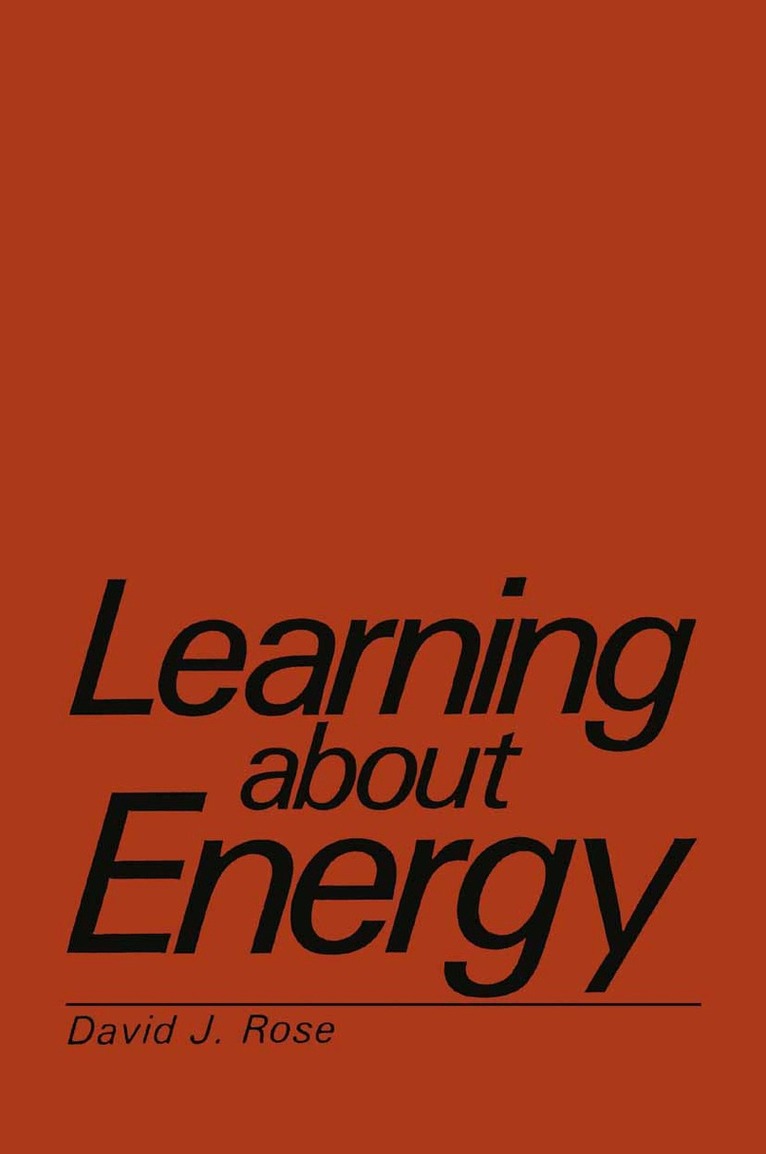
The vast eruption of books about energy that has appeared in the past decade has yielded few that could properly be called learning or. alternatively. teaching texts. This one is based principally on ten years of course offerings to senior undergraduates and graduate students at the Massachusetts Institute of Tech nology. and to middle-level and senior executives who attended accelerated study programs there. Teaching and learning are different; the first is an external act meant to stimulate the second. which is a very internal one. They are surely related. but it does not automatically follow that because I teach. the listener learns. This book. Learning about Energy. attempts to bridge that gap by putting in the hands of teachers. students. and independent readers a broad overview of the energy field. at a level that permits them to enter the more specialized topics with substantial perspective about the whole of it. The material is used for a one-semester course at M.I.T.. but could be one or two semesters there or elsewhere. according to how a thoughtful instructor might abridge some parts. or extend others via the numerous references. the problems at the ends of chapters. and current topics. Learning about Energy deals with energy as more than technology or eco nomics or any other specific parts. It deals with energy as part of the fabric of civilization. This requires some elaboration. As people and societies need food.
550 kr
Skickas inom 10-15 vardagar
1 064 kr
Skickas inom 10-15 vardagar
Es ist nicht abzusehen, wozu Husserl-Studien dienen sollen, wenn nicht von der Phanomenologie im Sinne Husserls eine Hilfe zu erwarten ist, einen Einblick zu gewinnen in das, was ist. Ein Ver- such, Einblick zu gewinnen in das, was ist: so jedenfalls wird die erste berechtigte Antwort auf die Frage "Was ist Phanomenolo- gie?" lauten mussen, wenn die Beschaftigung mit Phanomenolo- gie und insbesondere mit Husserl-Studien nicht eben eine blosse Beschaftigung sein soll. Ist die Phanomenologie nun ein Versuch, Einblick zu gewinnen in das, was ist, so heisst das: ein Versuch neben anderen mehr, unter diesen ein eigenartiger, gegenuber diesen ein neuer. Was ist das Eigentumliche dieses neuen Versuchs, des Versuchs, Einblick zu gewinnen in das, was ist, auf dem Wege einer Phanomenologie? Was ware der neue und eigentumliche Gesichtspunkt, von dem aus diese einen Einblick in das, was ist, zu gewinnen sucht?Husserl gibt die klare Auskunft: "Der Gesichtspunkt der Funktion ist der zentrale der Phanomenologie, die von ihm ausstrahlenden Untersuchungen umspannen so ziemlich die ganze phanomeno- logische Sphare, und schliesslich treten alle phanomenologischen Analysen irgendwie in ihren Dienst als Bestandstucke oder Unter- stufen";1 denn "die allergrossten Probleme sind die funktionellen Probleme, bzw. die der 'Konstitution der Bewusstseinsgegenstand- lichkeiten. '" 2 Der zentrale Gesichtspunkt der Phanomenologie, welcher ihr eigentumlich ist, ist derjenige, der die Probleme der Konstitution der Bewusstseinsgegenstandlichkeiten sichtbar macht. Was sind das fur Probleme? 1 Ideen zu einer reinen Phanomenologie und phanomenologischen Philosophie, I, 1913, s. 176. 2 Ebenda.
1 064 kr
Skickas inom 10-15 vardagar
Es ist nicht abzusehen, wozu Husserl-Studien dienen sollen, wenn nicht von der Phanomenologie im Sinne Husserls eine Hilfe zu erwarten ist, einen Einblick zu gewinnen in das, was ist. Ein Ver- such, Einblick zu gewinnen in das, was ist: so jedenfalls wird die erste berechtigte Antwort auf die Frage "Was ist Phanomenolo- gie?" lauten mussen, wenn die Beschaftigung mit Phanomenolo- gie und insbesondere mit Husserl-Studien nicht eben eine blosse Beschaftigung sein soll. Ist die Phanomenologie nun ein Versuch, Einblick zu gewinnen in das, was ist, so heisst das: ein Versuch neben anderen mehr, unter diesen ein eigenartiger, gegenuber diesen ein neuer. Was ist das Eigentumliche dieses neuen Versuchs, des Versuchs, Einblick zu gewinnen in das, was ist, auf dem Wege einer Phanomenologie? Was ware der neue und eigentumliche Gesichtspunkt, von dem aus diese einen Einblick in das, was ist, zu gewinnen sucht?Husserl gibt die klare Auskunft: "Der Gesichtspunkt der Funktion ist der zentrale der Phanomenologie, die von ihm ausstrahlenden Untersuchungen umspannen so ziemlich die ganze phanomeno- logische Sphare, und schliesslich treten alle phanomenologischen Analysen irgendwie in ihren Dienst als Bestandstucke oder Unter- stufen";1 denn "die allergrossten Probleme sind die funktionellen Probleme, bzw. die der 'Konstitution der Bewusstseinsgegenstand- lichkeiten. '" 2 Der zentrale Gesichtspunkt der Phanomenologie, welcher ihr eigentumlich ist, ist derjenige, der die Probleme der Konstitution der Bewusstseinsgegenstandlichkeiten sichtbar macht. Was sind das fur Probleme? 1 Ideen zu einer reinen Phanomenologie und phanomenologischen Philosophie, I, 1913, s. 176. 2 Ebenda.