New Directions in Jonathan Edwards Studies - Böcker
Visar alla böcker i serien New Directions in Jonathan Edwards Studies. Handla med fri frakt och snabb leverans.
4 produkter
4 produkter
Jonathan Edwards's Turn from the Classic-Reformed Tradition of Freedom of the Will
Inbunden, Engelska, 2017
1 677 kr
Skickas inom 11-20 vardagar
1 111 kr
Skickas inom 11-20 vardagar
Edwards Amasa Park (1808-1900) of Andover championed Edwardsean Calvinism in the United States from the Jacksonian era until the very close of the nineteenth century by employing rhetorical strategies that lent his New England theology fresh apologetic usefulness. The thesis demonstrates that Park has been incorrectly identified as a Taylorite but, extending the argument of Joseph Conforti, ought to be viewed as re-casting his inherited Hopkinsian exercise scheme into a fresh historical synthesis influenced by contemporary patterns of thought. Park's own training at Andover in the irenic divinity of Moses Stuart and Leonard Woods, his application as rhetorician of the work of Hugh Blair and George Campbell and his exposure in Germany to the Vermittlungstheologie of Friedrich Tholuck and Julius Müller gave specific definition to his own theological project. Additionally, the thesis argues that Park ought not to be viewed as a romantic idealist in the line of Horace Bushnell or as a proto-liberal in advance of the Andover liberals who succeeded him. Park retained a life-long commitment to a commingled epistemology and methodology derived from Lockean empiricism, Baconian induction, natural theology and Scottish common sense realism. As a formidable apologist for his revivalist inheritance identified with Jonathan Edwards and Samuel Hopkins, Edwards Amasa Park conserved the substance and prolonged the influence of his beloved New England theology by securing for it modes of expression well fitted to his nineteenth-century audience.
1 808 kr
Skickas inom 11-20 vardagar
The founders and forerunners of the Southern Baptist Convention were fundamentally shaped by the thought of Puritan theologian Jonathan Edwards and his theological successors. While Baptists in the antebellum South boasted a different theological pedigree than Presbyterians or Congregationalists, and while they inhabited a Southern landscape unfamiliar to the bustling cities and tall forests of New England, they believed their similarities with Edwards far outweighed their differences. Like Edwards, these Baptists were revivalistic, Calvinistic, loosely confessional, and committed to practical divinity. In these four things, Southern Edwardseanism lived, moved, and had its being. In the nineteenth-century, when so many Presbyterians scoffed at Edwards's “innovation” and Methodists scorned his Calvinism, Baptists found in Edwards a man after their own heart. By 1845, at the first Southern Baptist Convention, Southern Edwardseans had laid the groundwork for a convention marked by the theology of Jonathan Edwards.
1 808 kr
Skickas inom 11-20 vardagar
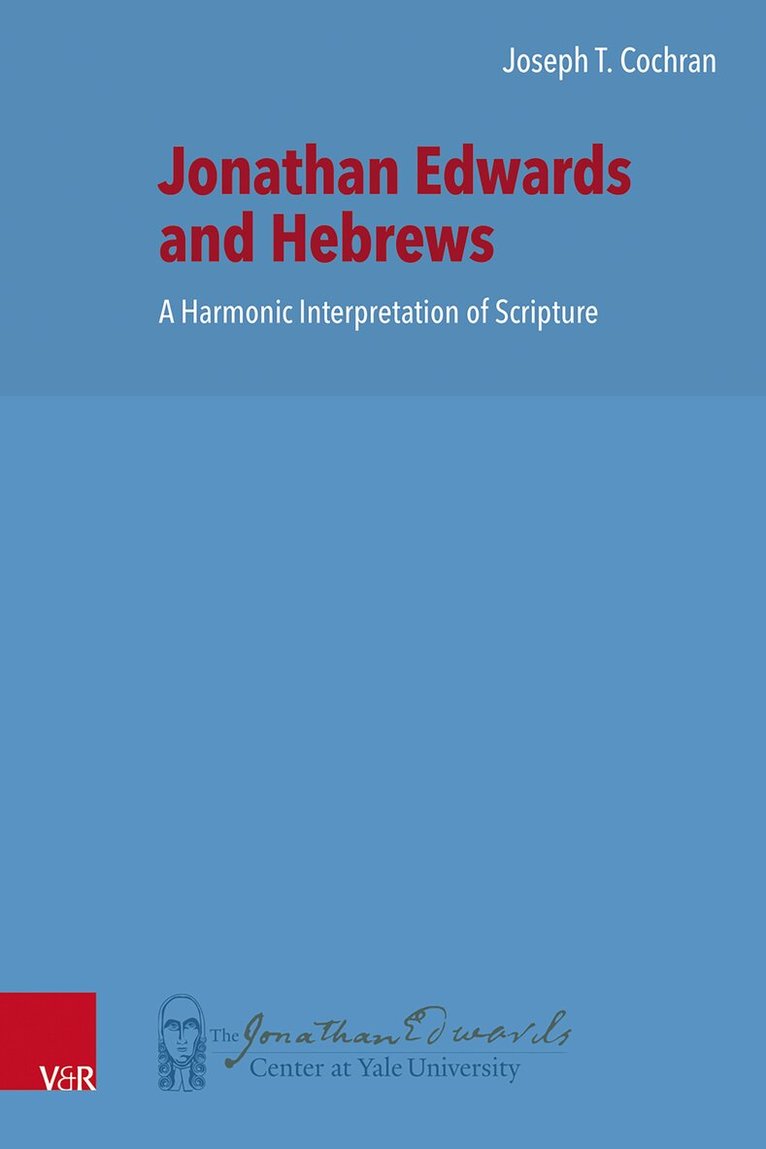
This publication is the first survey of Jonathan Edwards’s harmonic interpretation of Epistle to the Hebrews. This methodology emphasized harmony between the history of the world and its account in the Word. Drawn from a planned publication on The Harmony of the Old and New Testament, the harmonic interpretation of Jonathan Edwards sought to harmonize the Old and New Testament by employing three habits: (1) the habit of observing Old Testament prophetic fulfillment in the person and work of Christ in the New Testament; (2) the habit of perceiving typology in the natural world and Scripture that typified the Messiah, Jesus Christ; (3) the habit of harmonizing the Old and New Testament according to its doctrines and precepts. After introducing this methodology to readers, this study provides eight thematic case studies on how Edwards demonstrated this methodology in his interpretation of the Epistle to the Hebrews.