New Southern Studies Series – serie
457 kr
Läs direkt efter köp
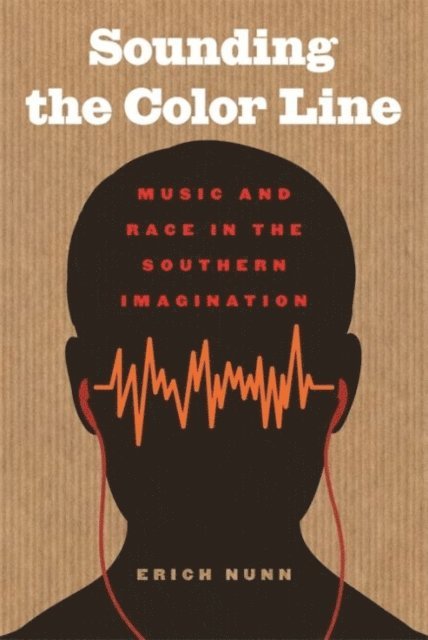
Sounding the Color Line explores how competing understandings of the U.S. South in the first decades of the twentieth century have led us to experience musical forms, sounds, and genres in racialized contexts. Yet, though we may speak of white or black music, rock or rap, sounds constantly leak through such barriers. A critical disjuncture exists, then, between actual interracial musical and cultural forms on the one hand and racialized structures of feeling on the other. This is nowhere more apparent than in the South.Like Jim Crow segregation, the separation of musical forms along racial lines has required enormous energy to maintain. How, asks Nunn, did the protocols structuring listeners’ racial associations arise? How have they evolved and been maintained in the face of repeated transgressions of the musical color line? Considering the South as the imagined ground where conflicts of racial and national identities are staged, this book looks at developing ideas concerning folk song and racial and cultural nationalism alongside the competing and sometimes contradictory workings of an emerging culture industry. Drawing on a diverse archive of musical recordings, critical artifacts, and literary texts, Nunn reveals how the musical color line has not only been established and maintained but also repeatedly crossed, fractured, and reformed. This push and pull—between segregationist cultural logics and music’s disrespect of racially defined boundaries—is an animating force in twentieth-century American popular culture.
888 kr
Läs direkt efter köp
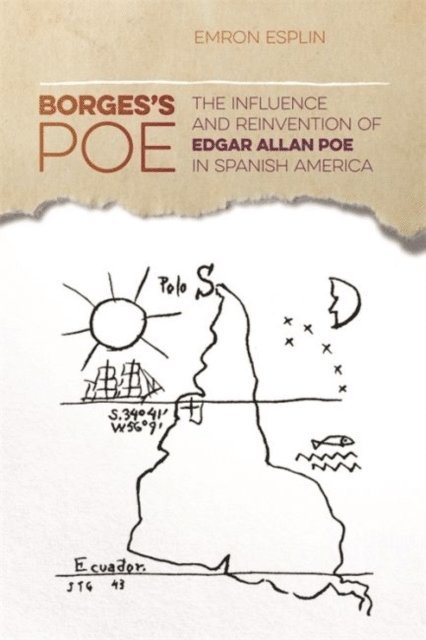
Edgar Allan Poe’s image and import shifted during the twentieth century, and this shift is clearly connected to the work of three writers from the Río de la Plata region of South America—Uruguayan Horacio Quiroga and Argentines Jorge Luis Borges and Julio Cortázar. In Borges’s Poe, Emron Esplin focuses on the second author in this trio and argues that Borges, through a sustained and complex literary relationship with Poe’s works, served as the primary catalyst that changed Poe’s image throughout Spanish America from a poet-prophet to a timeless fiction writer.Most scholarship that couples Poe and Borges focuses primarily on each writer’s detective stories, refers only occasionally to their critical writings and the remainder of their fiction, and deemphasizes the cultural context in which Borges interprets Poe. In this book, Esplin explores Borges’s and Poe’s published works and several previously untapped archival resources to reveal an even more complex literary relationship between the two writers. Emphasizing the spatial and temporal context in which Borges interprets Poe—the Río de la Plata region from the 1920s through the 1980s—Borges’s Poe underlines Poe’s continual presence in Borges’s literary corpus. More important, it demonstrates how Borges’s literary criticism, his Poe translations, and his own fiction create a disparate Poe who serves as a precursor to Borges’s own detective and fantastic stories and as an inspiration to the so-called Latin American Boom.Seen through this more expansive context, Borges’s Poe shows that literary influence runs both ways since Poe’s writings visibly affect Borges the poet, story writer, essayist, and thinker while Borges’s analyses and translations of Poe’s work and his responses to Poe’s texts in his own fiction forever change how readers of Poe return to his literary corpus.
1 168 kr
Läs direkt efter köp
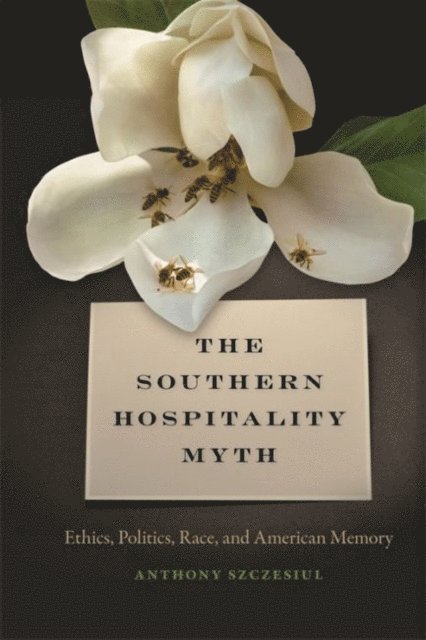
Hospitality as a cultural trait has been associated with the South for well over two centuries, but the origins of this association and the reasons for its perseverance often seem unclear. Anthony Szczesiul looks at how and why we have taken something so particular as the social habit of hospitality—which is exercised among diverse individuals and is widely varied in its particular practices—and so generalized it as to make it a cultural trait of an entire region of the country.Historians have offered a variety of explanations of the origins and cultural practices of hospitality in the antebellum South. Economic historians have at times portrayed southern hospitality as evidence of conspicuous consumption and competition among wealthy planters, while cultural historians have treated it peripherally as a symptomatic expression of the southern code of honor. Although historians have offered different theories, they generally agree that the mythic dimensions of southern hospitality eventually outstripped its actual practices. Szczesiul examines why we have chosen to remember and valorize this particular aspect of the South, and he raises fundamental ethical questions that underlie both the concept of hospitality and the cultural work of American memory, particularly in light of the region’s historical legacy of slavery and segregation.
1 168 kr
Läs direkt efter köp
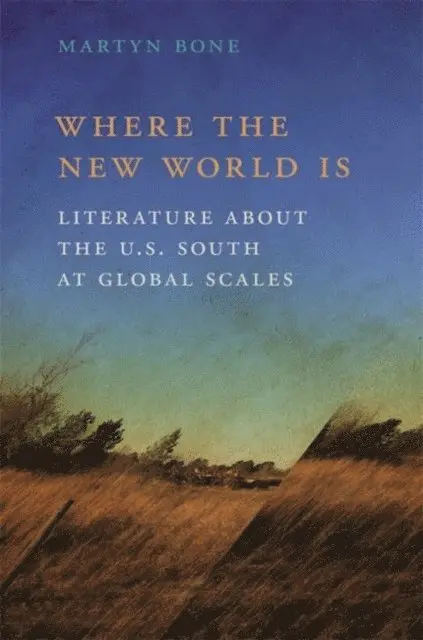
Where the New World Is assesses how fiction published since 1980 has resituated the U.S. South globally and how earlier twentieth-century writing already had done so in ways traditional southern literary studies tended to ignore. Martyn Bone argues that this body of fiction has, over the course of some eighty years, challenged received readings and understandings of the U.S. South as a fixed place largely untouched by immigration (or even internal migration) and economic globalization.The writers discussed by Bone emphasize how migration and labor have reconfigured the region’s relation to the nation and a range of transnational scales: hemispheric (Jamaica, the Bahamas, Haiti), transatlantic/Black Atlantic (Denmark, England, Mauritania), and transpacific/global southern (Australia, China, Vietnam). Writers under consideration include Zora Neale Hurston, Nella Larsen, John Oliver Killens, Russell Banks, Erna Brodber, Cynthia Shearer, Ha Jin, Monique Truong, Lan Cao, Toni Morrison, Peter Matthiessen, Dave Eggers, and Laila Lalami.The book also seeks to resituate southern studies by drawing on theories of “scale” that originated in human geography. In this way, Bone also offers a new paradigm in which the U.S. South is thoroughly engaged with a range of other scales from the local to the global, making both literature about the region and southern studies itself truly transnational in scope.
1 086 kr
Läs direkt efter köp
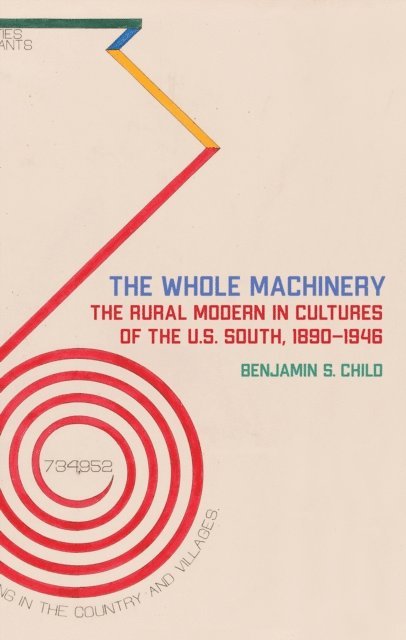
A familiar story holds that modernization radiates outward from metropolitan origins. Expanding on Walter Benjamin’s notion of die Moderne, The Whole Machinery explores representations of people and places, objects and occasions, that reverse that trajectory, demonstrating how modernizing agents move in a contrary direction as well—from the country to the city. In a crucial reconsideration, these figures aren’t pulled by or into urban modernity so much as they bring alternate—and transformative—iterations of the modern to the urban world.Upending the U.S. South’s reputation as either retrograde or unresponsive to modernity, Benjamin S. Child shows how the effects of national and transnational exchange, emergent technologies, and industrialization animate environments and bodies associated with, or performing, versions of the rural. To this end, he also exposes the shadow side of the cosmopolitan modern by investigating the rural sources—the laboring bodies and raw materials—that made such urban spaces possible, thus taking a broader survey of landscapes created by the Atlantic world’s histories of uneven development.In this investigation of the rural modern that considers multiple media and forms of technology, Child’s sources range widely, encompassing a spectrum of texts and their networks of transmission, reception, and signification. These include novels, poems, and short stories but also radio broadcasts, sound recordings, political pamphlets, photographs, magazine articles, newspaper reports, and agricultural bulletins. Folding such expressive artifacts into his larger arguments, Child considers how they both reflect and form modern(ist) culture. The result is a geography of southern modernism that includes an unexpected combination of landmarks, both actual and imagined: Twisted Oak, Arkansas, and Tukabahchee County, Alabama; Manhattan, Manchester, and Moscow; Tuskegee and Gobbler’s Knob, North Carolina.