Optical and Fiber Communications Reports - Böcker
Visar alla böcker i serien Optical and Fiber Communications Reports. Handla med fri frakt och snabb leverans.
15 produkter
15 produkter
2 650 kr
Skickas inom 10-15 vardagar
the model for low-PMD ?bers; Nicolas Gisin covered the increasingly important topic of the interaction of PMD with polarization dependent loss. Other topics that were included in the school were: "PMD models," which was covered byAntonio Mecozzi and Mark Shtaif; "Interaction of PMD with nonlinearity and chromatic dispersion," which was covered by Curtis Menyuk; "PMD measurement techniques," which was covered by Paul Williams and by Marco Schiano in two separate lectures; "Spatially resolved measurement of ?ber polarization properties," which was covered by Luca PalmieriandAndreaGaltarossa;"PMDimpactonopticalsystems,"whichwascovered by Magnus Karlsson and by Francesco Matera in two separate lectures; "Polarization effects in recirculating loops," which was covered by Brian Marks, Gary Carter, and Yu Sun; "PMD Emulation," which was covered byAlan Willner and Michelle Hauer; and, ?nally, "Applications of importance sampling to PMD," which was covered by Gino Biondini, Bill Kath, and Sarah Fogal. Dipak Chowdhury worked withArtis and VPI-two producers at that time of commercial software for modeling optical ?ber communications systems-to present a lecture that covered numerical modeling of PMD.Additionally, we had lectures on special topics by Hermann Haus, Jim Gordon, Herwig Kogelnik, and Carlo Someda. Finally, we had a poster session, which gave the lecturers the opportunity to learn something from our participants. The feedback that we received from the participants and the lecturers was ov- whelmingly positive. This success was due to the great time and energy that all the instructors put into their lectures.
2 967 kr
Skickas inom 10-15 vardagar
Free-space laser communications, also referred to as optical communica tions, is a popular subject in today's technological marketplace. A number of conferences on this subject have been organized by professional societies such as SPIE (the International Society of Photo Optical and Instrumenta tion Engineering), OSA (Optical Society of America), and IEEE (Instituteof Electrical and Electronics Engineers). The evolving technology of free-space laser communications is emerging as an appealing alternative to RF com munications for links between satellites, as well as a promising addition to terrestrial applications such as video or computer linkups between buildings. There is a pressing need for more information on laser communications that is comprehensive enough to provide in-depth knowledge of free-space com munications, and that can satisfy the current demands of the research and commercial needs. This book has been designed to provide a comprehensive, unified tutorial to further understanding of the fundamental techniques for laser communi cations through the earth's atmosphere. The driving force behind free-space laser communications is the continuous demand for higher bandwidth to deliver high-capacity voice, data, and images to the customer. Free-space propagation distances include ranges that encompass a few millimeters (for example between optical interconnects in a computer using photonics to replace metal interconnects), a fewmeters (such as indoor communications), a fewkilometers (between buildings, campuses, and hospitals), and even up to thousands of kilometers (such as from an aircraft or satellite to the ground).
2 121 kr
Skickas inom 10-15 vardagar
This is the first book on Dispersion Compensating Fibers. It is written by leading experts on DCF.
2 183 kr
Skickas inom 5-8 vardagar
the model for low-PMD ?bers; Nicolas Gisin covered the increasingly important topic of the interaction of PMD with polarization dependent loss. Other topics that were included in the school were: "PMD models," which was covered byAntonio Mecozzi and Mark Shtaif; "Interaction of PMD with nonlinearity and chromatic dispersion," which was covered by Curtis Menyuk; "PMD measurement techniques," which was covered by Paul Williams and by Marco Schiano in two separate lectures; "Spatially resolved measurement of ?ber polarization properties," which was covered by Luca PalmieriandAndreaGaltarossa;"PMDimpactonopticalsystems,"whichwascovered by Magnus Karlsson and by Francesco Matera in two separate lectures; "Polarization effects in recirculating loops," which was covered by Brian Marks, Gary Carter, and Yu Sun; "PMD Emulation," which was covered byAlan Willner and Michelle Hauer; and, ?nally, "Applications of importance sampling to PMD," which was covered by Gino Biondini, Bill Kath, and Sarah Fogal. Dipak Chowdhury worked withArtis and VPI-two producers at that time of commercial software for modeling optical ?ber communications systems-to present a lecture that covered numerical modeling of PMD.Additionally, we had lectures on special topics by Hermann Haus, Jim Gordon, Herwig Kogelnik, and Carlo Someda. Finally, we had a poster session, which gave the lecturers the opportunity to learn something from our participants. The feedback that we received from the participants and the lecturers was ov- whelmingly positive. This success was due to the great time and energy that all the instructors put into their lectures.
2 028 kr
Skickas inom 5-8 vardagar
Free-space laser communications, also referred to as optical communica tions, is a popular subject in today's technological marketplace. A number of conferences on this subject have been organized by professional societies such as SPIE (the International Society of Photo Optical and Instrumenta tion Engineering), OSA (Optical Society of America), and IEEE (Instituteof Electrical and Electronics Engineers). The evolving technology of free-space laser communications is emerging as an appealing alternative to RF com munications for links between satellites, as well as a promising addition to terrestrial applications such as video or computer linkups between buildings. There is a pressing need for more information on laser communications that is comprehensive enough to provide in-depth knowledge of free-space com munications, and that can satisfy the current demands of the research and commercial needs. This book has been designed to provide a comprehensive, unified tutorial to further understanding of the fundamental techniques for laser communi cations through the earth's atmosphere. The driving force behind free-space laser communications is the continuous demand for higher bandwidth to deliver high-capacity voice, data, and images to the customer. Free-space propagation distances include ranges that encompass a few millimeters (for example between optical interconnects in a computer using photonics to replace metal interconnects), a fewmeters (such as indoor communications), a fewkilometers (between buildings, campuses, and hospitals), and even up to thousands of kilometers (such as from an aircraft or satellite to the ground).
2 115 kr
Skickas inom 10-15 vardagar
A pulse of light spreads in time as it propagates in a fiber due to the physical phenomenon called dispersion. While dispersion can be deleterious in optical communications systems, it can also be exploited to manage the temporal and spectral shapes of pulses and their interactions with other pulses. Much of dispersion control is realized in optical communications systems with discrete devices – the so-called dispersion compensators, and almost all commercially deployed dispersion compensators today are based on specially designed fibers. This book addresses various aspects of this device technology, such as the physics of optical dispersive effects, the design philosophy and properties of devices deployed in optical networks today, futuristic devices utilizing novel fibers, and their systems level impact. Written by leaders in the field drawn from both academia and industry, this book serves as a comprehensive introduction to the topic of dispersion management of light for graduate students and applications engineers. Since each chapter provides a detailed description of the state-of-the-art in each technological platform, this book also serves as a practical reference for industry experts tasked with designing next generation optical networks.
1 588 kr
Skickas inom 10-15 vardagar
This book covers the recent progress in fiber-optic communication systems with a main focus on the impact of fiber nonlinearities on the system performance. Over the past few years, there has been significant progress in coherent communication systems mainly because of the advances in digital signal processing techniques. This has led to renewed interest in fiber linear and nonlinear impairments and techniques to mitigate them in electrical domain. In this book, the reader will find all the important topics of fiber optic communication systems in one place with in-depth coverage by the experts of each subtopics. Pioneers from each of the sub-topics have been invited to contribute. Each chapter will have a section on fundamentals, review of literature survey and the recent developments. The reader will benefit from this approach since many of the conference proceedings and journal articles mainly focus on the authors’ research work without spending space on preliminaries.
1 588 kr
Skickas inom 10-15 vardagar
This book covers the recent progress in fiber-optic communication systems with a main focus on the impact of fiber nonlinearities on the system performance. Over the past few years, there has been significant progress in coherent communication systems mainly because of the advances in digital signal processing techniques. This has led to renewed interest in fiber linear and nonlinear impairments and techniques to mitigate them in electrical domain. In this book, the reader will find all the important topics of fiber optic communication systems in one place with in-depth coverage by the experts of each subtopics. Pioneers from each of the sub-topics have been invited to contribute. Each chapter will have a section on fundamentals, review of literature survey and the recent developments. The reader will benefit from this approach since many of the conference proceedings and journal articles mainly focus on the authors’ research work without spending space on preliminaries.
2 333 kr
Skickas inom 10-15 vardagar
Ultrahigh-speed optical transmission technology is a key technology for increasing the communication capacity. In optical fibre networks, the number of wavelength channels and the bit rate per wavelength channel, i.e. the TDM (Time Division Multiplexing) bit rate, determine the transmission capacity. Currently, TDM bit rates of more than 40 Gbit/s require optical signal processing (Optical Time Division Multiplexing, OTDM). OTDM bit rates of up to 1.2 Tbit/s have already been reported. The devices developed for ultrahigh-speed optical transmission are not limited to communication applications only. They are key devices for high-speed optical signal processing, i.e. monitoring, measurement and control, and will thus give a wide technological basis for innovative science and technology. All these aspects of ultrahigh-speed optical transmission technology are described in detail in this book.
2 333 kr
Skickas inom 10-15 vardagar
Ultrahigh-speed optical transmission technology is a key technology for increasing the communication capacity. In optical fibre networks, the number of wavelength channels and the bit rate per wavelength channel, i.e. the TDM (Time Division Multiplexing) bit rate, determine the transmission capacity. Currently, TDM bit rates of more than 40 Gbit/s require optical signal processing (Optical Time Division Multiplexing, OTDM). OTDM bit rates of up to 1.2 Tbit/s have already been reported. The devices developed for ultrahigh-speed optical transmission are not limited to communication applications only. They are key devices for high-speed optical signal processing, i.e. monitoring, measurement and control, and will thus give a wide technological basis for innovative science and technology. All these aspects of ultrahigh-speed optical transmission technology are described in detail in this book.
1 593 kr
Skickas inom 10-15 vardagar
The growth of Internet traf?c in recent years surpassed the prediction of one decade ago. Data stream in individual countries already reached terabit/s level. To cope with the petabit class demands of traf?c in coming years the communication engineers are required to go beyond the incremental improvement of today’s technology. A most promising breakthrough would be the introduction of modulation f- mats enabling higher spectral ef?ciency than that of binary on–off keying scheme, virtually the global standard of ?ber-optic communication systems. In wireless communication systems, techniques of high spectral density modulation have been well developed, but the required techniques in optical frequency domain are much more complicated because of the heavier ?uctuation levels. Therefore the past trials of coherent optical modulation/detection schemes were not successful. However, the addition of high-speed digital signal processing technology is the fundam- tal difference between now and two decades ago, when trials of optical coherent communication systems were investigated very seriously. This approach of digital coherent technology has attracted keen interest among communication specialists, as indicated by the rapid increase in the pioneering presentations at the post-deadline sessions of major international conferences. For example, 32 terabit/s transmission in a ?ber experiment based on this technology was reported in post-deadline session of Optical Fiber Communication Conference (OFC) 2009. The advancement of the digital coherent technologies will inevitably affect the network architecture in terms of the network resource management for the new generation photonic networks, rather than will simply provide with huge transmission capacity.
1 593 kr
Skickas inom 10-15 vardagar
The growth of Internet traf?c in recent years surpassed the prediction of one decade ago. Data stream in individual countries already reached terabit/s level. To cope with the petabit class demands of traf?c in coming years the communication engineers are required to go beyond the incremental improvement of today’s technology. A most promising breakthrough would be the introduction of modulation f- mats enabling higher spectral ef?ciency than that of binary on–off keying scheme, virtually the global standard of ?ber-optic communication systems. In wireless communication systems, techniques of high spectral density modulation have been well developed, but the required techniques in optical frequency domain are much more complicated because of the heavier ?uctuation levels. Therefore the past trials of coherent optical modulation/detection schemes were not successful. However, the addition of high-speed digital signal processing technology is the fundam- tal difference between now and two decades ago, when trials of optical coherent communication systems were investigated very seriously. This approach of digital coherent technology has attracted keen interest among communication specialists, as indicated by the rapid increase in the pioneering presentations at the post-deadline sessions of major international conferences. For example, 32 terabit/s transmission in a ?ber experiment based on this technology was reported in post-deadline session of Optical Fiber Communication Conference (OFC) 2009. The advancement of the digital coherent technologies will inevitably affect the network architecture in terms of the network resource management for the new generation photonic networks, rather than will simply provide with huge transmission capacity.
2 121 kr
Skickas inom 10-15 vardagar
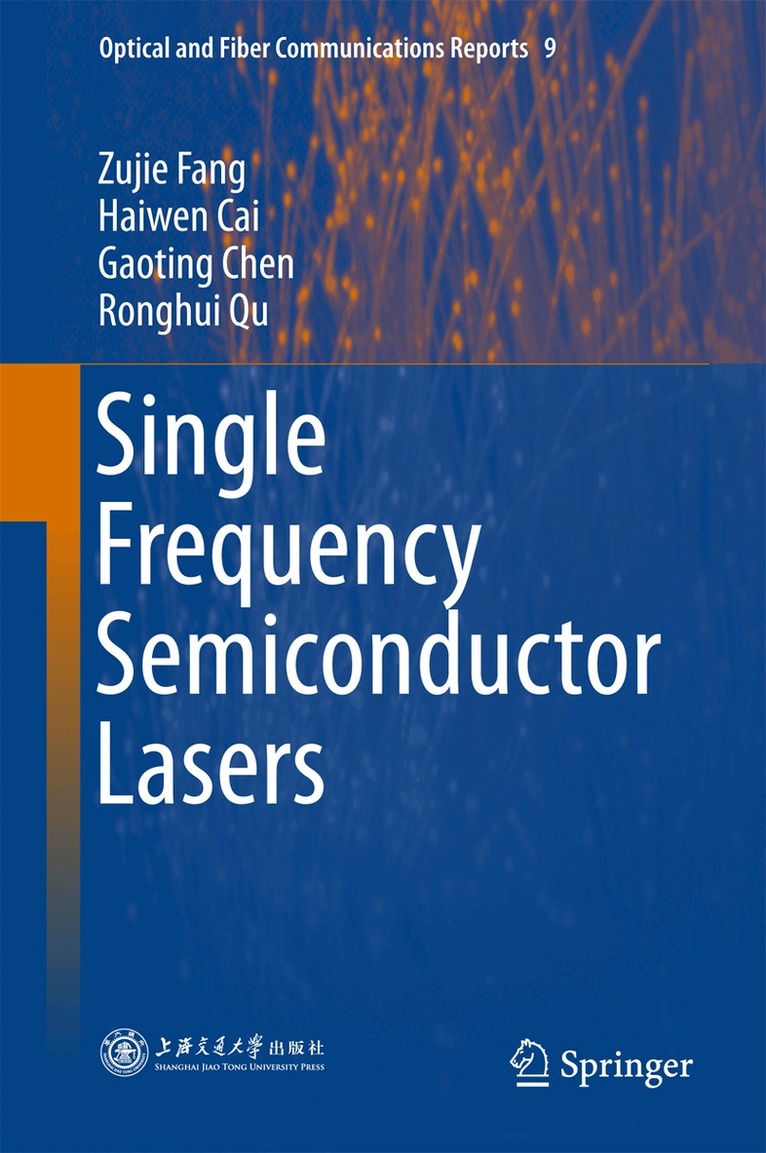
This book systematically introduces the single frequency semiconductor laser, which is widely used in many vital advanced technologies, such as the laser cooling of atoms and atomic clock, high-precision measurements and spectroscopy, coherent optical communications, and advanced optical sensors.
2 121 kr
Skickas inom 10-15 vardagar
This book systematically introduces the single frequency semiconductor laser, which is widely used in many vital advanced technologies, such as the laser cooling of atoms and atomic clock, high-precision measurements and spectroscopy, coherent optical communications, and advanced optical sensors.
Del 8 - Optical and Fiber Communications Reports
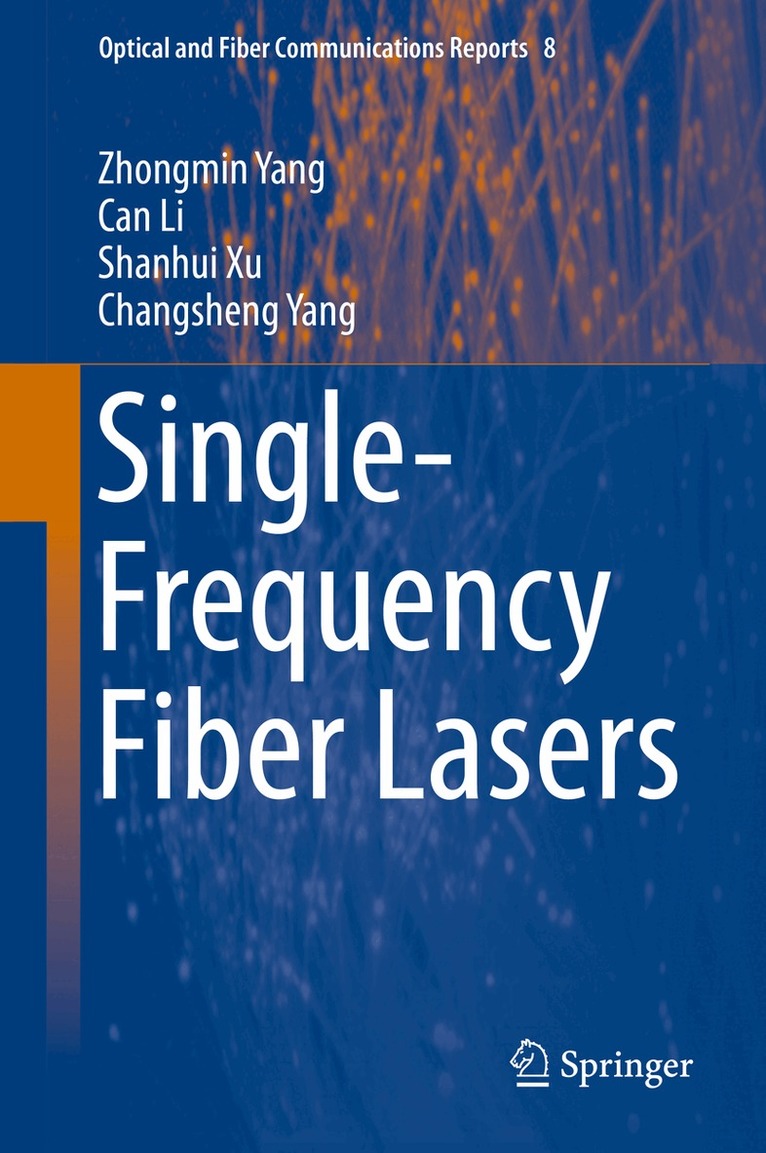
Single-Frequency Fiber Lasers
Inbunden, Engelska, 2019
1 064 kr
Skickas inom 10-15 vardagar
This book gives a contemporary overview of the technologies of single-frequency fiber lasers. The development of single-frequency fiber lasers is one of the most significant achievements in the field of laser photonics over the past two decades. Owing to the crucial demands of a laser sources with highly stable single-frequency operation, narrow linewidth, low noise, scalable to high output power, compact and robustness structure, fiber lasers have been intensively studied since its introduction to the single-frequency laser community and they still continuously proceed to trigger the emergence of new technologies and applications. This book systematically demonstrates the single-frequency fiber laser technologies from fundamental principles to state-of-the-art progress. Details of selected typical applications of single-frequency fiber lasers are also given and discussed. The reader will acquire a good knowledge of the current situation within this important field.