Organizing for Sustainable Effectiveness - Böcker
Visar alla böcker i serien Organizing for Sustainable Effectiveness. Handla med fri frakt och snabb leverans.
5 produkter
5 produkter
Del 1 - Organizing for Sustainable Effectiveness
Organizing for Sustainability
Inbunden, Engelska, 2011
1 233 kr
Skickas inom 7-10 vardagar
A large literature has been generated about sustainability, and many organizations, governments, communities and citizens have focused on it. Yet, given how quickly the limits of the current models of the global economy are being approached, we must accelerate the rate at which we learn to operate differently. This first volume of the Emerald series Organizing for Sustainable Effectiveness learns from some of the pioneers articulating these challenges and organizing to address them. There is an urgent need to grow the knowledge bases to guide the transition. Each chapter in this volume, crafted to bring together the knowledge of practice and theory, is based on rich empirical data about particular cases in which organizations are, individually or collectively, working to build a more sustainable future. Contributors bring theoretical knowledge to bear on these case examples and test the applicability of the formal knowledge base about management and organizations, while refining, modifying, and extending it to increase its usefulness in addressing the challenges of organizing for sustainable effectiveness.
Del 2 - Organizing for Sustainable Effectiveness
Organizing for Sustainable Healthcare
Inbunden, Engelska, 2012
1 340 kr
Skickas inom 7-10 vardagar
Health care, as it is currently organized, is not sustainable. Health care systems in the developed world are encountering increased demand for high quality health care but facing societal resource limits. Health care managers, professionals and academics worldwide are debating how to redesign its current organizational configurations and delivery paradigms to deliver more with less, amidst profound changes in demographics, increased cost of new technology and changing health care priorities. Health care is inextricably linked to the overall sustainability of society and it is critical that solutions are found. The chapters in this volume examine health care systems that are building the foundations for sustainable, high quality health care. Case-based analyses discuss substantive organizing changes aimed at operating within resource limitations, while taking advantage of new knowledge and medical advances that could have an unprecedented positive impact on the health of individuals and societies. The volume also explores the change capabilities and learning mechanisms that health care systems need in order to implement fundamental change and continue to improve over time.
Del 3 - Organizing for Sustainable Effectiveness
Building Networks and Partnerships
Inbunden, Engelska, 2013
1 340 kr
Skickas inom 7-10 vardagar
Organizing for Sustainable Effectiveness highlights research and practice aimed at understanding how organizations and more inclusive systems of actors develop a continuous, unfaltering focus on sustainability. It will examine how they organize to achieve expanded purposes, the associated changes in purpose and governance, relationships among various stakeholders, boundaries between organizations and other elements of the environment in which they operate, organizational systems and processes, leadership, competencies and capabilities. Thus 'sustainability' is seen as entailing a continuous dynamic adaptive process in people, organizations and systems, striving to be as proactive as possible, moving 'upstream' in improving and developing organizational processes and issues.
Del 4 - Organizing for Sustainable Effectiveness
Reconfiguring the Eco-System for Sustainable Healthcare
Inbunden, Engelska, 2014
1 327 kr
Skickas inom 7-10 vardagar
Volume 4 extends the examination of "Organizing for Sustainable Healthcare" (Volume 2 of the same series, 2012). It presents case studies and theoretical analyses that illustrate practical approaches to, and further the theoretical understanding of, the creation of a more sustainable healthcare. Given economic, ecological, and population trends, the sustainability of healthcare delivery as it is organized today cannot be taken for granted. Politicians, healthcare regulators and professionals worldwide are debating how to redesign today's delivery paradigms to deliver greater value to our societies while consuming fewer resources. Even in countries with national health systems, healthcare organization has been fragmented, diminishing outcome effectiveness and wasting society's resources. With complex value chains and dynamic interactions among various players, the reconfiguration of the healthcare system will require the reconciliation of different - often conflicting - goals, values, conceptions of social justice, work processes, knowledge bases, and business models. The chapters in this volume build on multiple disciplines and varied approaches to address this complexity.
Del 5 - Organizing for Sustainable Effectiveness
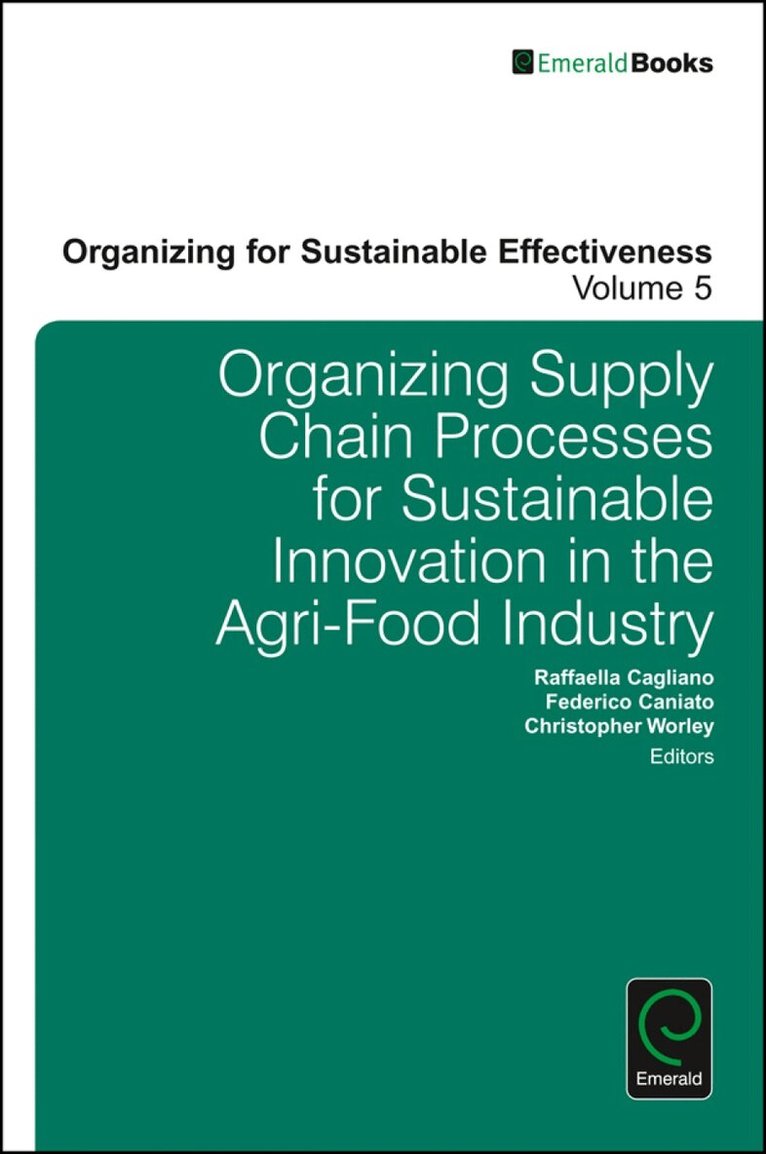
Organizing Supply Chain Processes for Sustainable Innovation in the Agri-Food Industry
Inbunden, Engelska, 2016
1 475 kr
Skickas inom 7-10 vardagar
The sustainability of agri-food supply chains is particularly relevant for global sustainable development. Many existing food production systems do more harm than good. They compromise the natural rhythms of the Earth, introduce toxins, and therefore sacrifice future capability for current demands – the opposite of sustainable development norms. The existing system is also unbalanced with respect to its capacity to produce, the amount of waste it generates, the number of people who suffer from hunger, and the nutritional value it provides. Most of the current supply chains have been developed within the classic economic paradigm, where scale and leverage drive choices towards more profitable models. As a consequence, finding new ways to produce, distribute and consume food is a morale, financial, and environmental necessity. Sustainable development and triple bottom line perspectives provide the logic for questioning this paradigm. This book presents and discusses nine cases of organizational innovation in food supply chain, covering different phases of food production, facing different challenges, and proposing different solutions to the challenge of sustainable food development.