Oxf Greek Latin College Comment Series - Böcker
Visar alla böcker i serien Oxf Greek Latin College Comment Series. Handla med fri frakt och snabb leverans.
4 produkter
4 produkter
1 567 kr
Skickas inom 7-10 vardagar
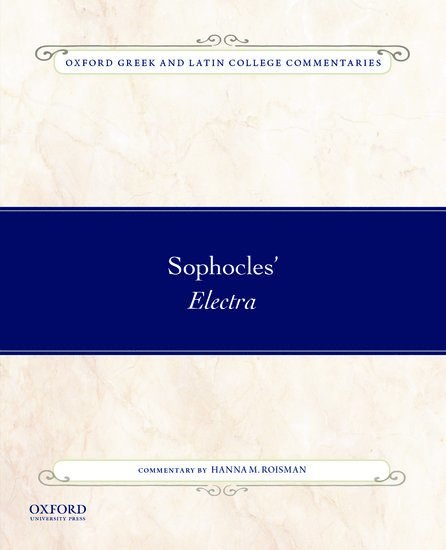
Sophocles' Electra is a riveting play with a long and varied reception. Its nuanced treatment of matricidal revenge with all the questions it raises; its compelling depictions of the idealistic, long -grieving, rebellious Electra; her compliant sister; her brother; and her mother; and its superb poetry have all contributed to making this one of Sophocles' most admired plays, as have the moral issues it raises and its political reverberations. In recent decades it has been repeatedly translated, adapted, and produced, sometimes on its own, sometimes in combination with selections from Aeschylus' Libation Bearers and (more often) Euripides' Electra. While the play certainly stands on its own in any language, reading it in the original Greek adds immense value.A commentary on the Greek text would enrich its reading by elucidating the words and world of the ancient language for those who are reading it more than twenty- five hundred years after the play was written. Such a commentary would also contribute to our understanding of other ancient Greek texts, not necessarily because they use the same words in the same way, but by providing information for contrast, comparison, and clarification.This commentary includes an introduction, text and notes, an abbreviations list, a stylistic & metrical terminology list, an appendix of recurrent words, and, a list of irregular verbs and their principal parts.
378 kr
Skickas inom 5-8 vardagar
Sophocles' Electra is a riveting play with a long and varied reception. Its nuanced treatment of matricidal revenge with all the questions it raises; its compelling depictions of the idealistic, long -grieving, rebellious Electra; her compliant sister; her brother; and her mother; and its superb poetry have all contributed to making this one of Sophocles' most admired plays, as have the moral issues it raises and its political reverberations. In recent decades it has been repeatedly translated, adapted, and produced, sometimes on its own, sometimes in combination with selections from Aeschylus' Libation Bearers and (more often) Euripides' Electra. While the play certainly stands on its own in any language, reading it in the original Greek adds immense value.A commentary on the Greek text would enrich its reading by elucidating the words and world of the ancient language for those who are reading it more than twenty- five hundred years after the play was written. Such a commentary would also contribute to our understanding of other ancient Greek texts, not necessarily because they use the same words in the same way, but by providing information for contrast, comparison, and clarification.This commentary includes an introduction, text and notes, an abbreviations list, a stylistic & metrical terminology list, an appendix of recurrent words, and, a list of irregular verbs and their principal parts.
1 130 kr
Skickas inom 7-10 vardagar
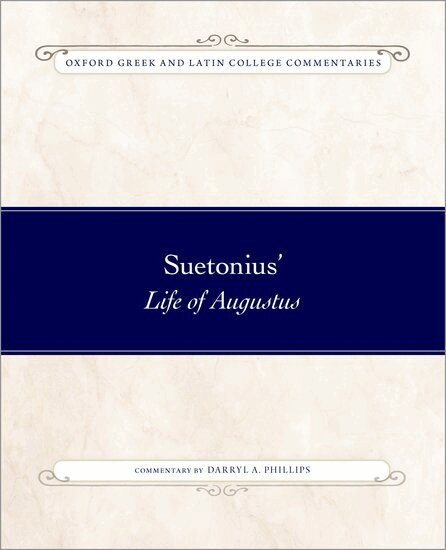
The lifetime of Augustus (63 BCE -14 CE) was a key moment of transition for the Roman world. Following decades of civil war, the traditional government of the Roman Republic evolved to include a leading role for Augustus. Peace at home was balanced with wars of expansion and consolidation on the frontiers. Literature and the arts flourished. A building boom transformed the city of Rome. Augustus was at the center of it all, and thus the lifetime of Augustus and the life of Augustus himself have attracted keen interest from antiquity up to the present day.In his biography of Augustus, the early second century CE author C. Suetonius Tranquillus offers not only a survey of the major political, military and civic accomplishments of his subject, but also includes such diverse topics as Augustus's family lineage, spouses, personal appearance, leisure activities, intellectual pursuits and style of living. We find in the Life of Augustus a detailed biography of a leading figure at a pivotal historical moment, as well as the material for political, social, and cultural history that offers a wide range of approaches to the Augustan age.This volume provides a comprehensive edition of Suetonius's Life of Augustus for readers of Latin at the intermediate and advanced levels. The complete Latin text is presented, accompanied on the same page by a running vocabulary, grammatical support, and historical notes to aid comprehension, making this volume ideally suited for use on its own. An introduction to Suetonius and his style of biographical writing provides context for interpreting the text.
324 kr
Skickas inom 5-8 vardagar
The lifetime of Augustus (63 BCE -14 CE) was a key moment of transition for the Roman world. Following decades of civil war, the traditional government of the Roman Republic evolved to include a leading role for Augustus. Peace at home was balanced with wars of expansion and consolidation on the frontiers. Literature and the arts flourished. A building boom transformed the city of Rome. Augustus was at the center of it all, and thus the lifetime of Augustus and the life of Augustus himself have attracted keen interest from antiquity up to the present day.In his biography of Augustus, the early second century CE author C. Suetonius Tranquillus offers not only a survey of the major political, military and civic accomplishments of his subject, but also includes such diverse topics as Augustus's family lineage, spouses, personal appearance, leisure activities, intellectual pursuits and style of living. We find in the Life of Augustus a detailed biography of a leading figure at a pivotal historical moment, as well as the material for political, social, and cultural history that offers a wide range of approaches to the Augustan age.This volume provides a comprehensive edition of Suetonius's Life of Augustus for readers of Latin at the intermediate and advanced levels. The complete Latin text is presented, accompanied on the same page by a running vocabulary, grammatical support, and historical notes to aid comprehension, making this volume ideally suited for use on its own. An introduction to Suetonius and his style of biographical writing provides context for interpreting the text.