OXFORD GUIDES TO PHILOSOPHY SERIES - Böcker
Visar alla böcker i serien OXFORD GUIDES TO PHILOSOPHY SERIES. Handla med fri frakt och snabb leverans.
11 produkter
11 produkter
Bentham's An Introduction to the Principles of Morals and Legislation
A Guide
Inbunden, Engelska, 2023
1 146 kr
Skickas inom 5-8 vardagar
Bentham's An Introduction to the Principles of Morals and Legislation is often considered the first work of the philosophical school of utilitarianism and is thus a vital text for students of philosophy. In this comprehensive guide to the text, Steven Sverdlik provides an entry point into this important work, examining the text in its entirety and highlighting its central claims and their relevance to contemporary discussions in a variety of fields.Sverdlik works through the chapters of Bentham's text sequentially, explaining and evaluating the work's main themes. The Guide emphasizes Bentham's original goal of introducing a utilitarian penal code. Sverdlik explains Bentham's fundamental moral claims and principles: the principle of utility, his hedonistic theory of intrinsic value, and his claims about the measurement of pleasure and pain. Bentham also discusses at length human action, motivation, and decision. Sverdlik discusses these ideas in general terms, and then examines how Bentham applies them in the context of penal or criminal law. All of this lays the groundwork for a careful discussion of Bentham's treatment of the deterrence of potential offenders, the punishment of convicted offenders, and the criminalization of various types of behavior. By restating Bentham's arguments in contemporary philosophical terms, Sverdlik allows readers to see how his thinking connects to current debates about the criminal justice system.This guide provides a systematic contemporary overview of Bentham's Introduction that will be valuable to undergraduate philosophy students, as well as students and scholars with a working knowledge of basic philosophy who are interested in criminal law, moral philosophy, and moral psychology.
1 268 kr
Skickas inom 5-8 vardagar
Scottish philosopher Lady Mary Shepherd (1777-1847) wrote two books that she conceived as one unified project: Essay Upon the Relation of Cause and Effect (1824) and Essays on the Perception of an External Universe (1827). While they were well received in her day, Shepherd's insightful philosophical writings have been neglected for some 150 years and are only now receiving the scholarly attention they deserve. Mary Shepherd: A Guide by Deborah Boyle, part of the Oxford Guides to Philosophy series, navigates students of philosophy or general readers through Shepherd's two significant works. The first four chapters address topics raised in the 1824 Essay: Shepherd's arguments for two key causal principles, her objections to Hume and her alternative accounts of causation and causal inference; her theory of objects as bundles of qualities; her critique of Thomas Brown's defence of Humean causation; and her discussion of London surgeon William Lawrence's accounts of sentience and life, which Shepherd treats as a case study of how Humean theory can lead to errors in scientific reasoning. Chapter 5 covers topics central to both of Shepherd's books: what she means by "sensation," "idea," "will," "imagination," "understanding," "reasoning," and "latent reasoning." The remaining five chapters proceed systematically through Shepherd's 1827 book, where she seeks to prove, against Berkeleian idealism, that we can know that an external world of mind-independent matter exists. Boyle discusses Shepherd's proofs for such an external world, her responses to various sceptical challenges, and her specific objections to Berkeley. Each chapter ends with a list of works for further reading and a glossary of terms that explain Shepherd's sometimes idiosyncratic philosophical vocabulary, resulting in an essential guide to a philosopher who exerted considerable influence during her time.
312 kr
Skickas inom 5-8 vardagar
Scottish philosopher Lady Mary Shepherd (1777-1847) wrote two books that she conceived as one unified project: Essay Upon the Relation of Cause and Effect (1824) and Essays on the Perception of an External Universe (1827). While they were well received in her day, Shepherd's insightful philosophical writings have been neglected for some 150 years and are only now receiving the scholarly attention they deserve. Mary Shepherd: A Guide by Deborah Boyle, part of the Oxford Guides to Philosophy series, navigates students of philosophy or general readers through Shepherd's two significant works. The first four chapters address topics raised in the 1824 Essay: Shepherd's arguments for two key causal principles, her objections to Hume and her alternative accounts of causation and causal inference; her theory of objects as bundles of qualities; her critique of Thomas Brown's defence of Humean causation; and her discussion of London surgeon William Lawrence's accounts of sentience and life, which Shepherd treats as a case study of how Humean theory can lead to errors in scientific reasoning. Chapter 5 covers topics central to both of Shepherd's books: what she means by "sensation," "idea," "will," "imagination," "understanding," "reasoning," and "latent reasoning." The remaining five chapters proceed systematically through Shepherd's 1827 book, where she seeks to prove, against Berkeleian idealism, that we can know that an external world of mind-independent matter exists. Boyle discusses Shepherd's proofs for such an external world, her responses to various sceptical challenges, and her specific objections to Berkeley. Each chapter ends with a list of works for further reading and a glossary of terms that explain Shepherd's sometimes idiosyncratic philosophical vocabulary, resulting in an essential guide to a philosopher who exerted considerable influence during her time.
929 kr
Skickas inom 5-8 vardagar
Candrakīrti's Introduction to the Middle Way (Madhyamakāvatāra) is a central work of Buddhist philosophy for two reasons. First, it provides an introduction to Madhyamaka, one of the three major philosophical schools of Buddhist thought (the other two being Abhidharma and Yogācāra). Second, within Madhyamaka, Candrakīrti's text occupies a very prominent role. This is primarily due to its enormous influence in Tibet, where Candrakīrti's work became the main entry-point into the study of Madhyamaka thought. While the historical importance of the Introduction to the Middle Way for understanding a major section of Buddhist thought is evident, what makes it particularly interesting for students is the role it plays as an 'introduction'. It is one of Candrakīrti's earlier works and presents a comprehensive guide to the key philosophical ideas and problems of Madhyamaka thought.This Oxford Guide is for the philosophically interested student or scholar reading the Introduction to the Middle Way. Westerhoff's commentary focuses on the philosophical content of the text, using Candrakīrti's auto-commentary as the main explicatory resource.
292 kr
Skickas inom 5-8 vardagar
Candrakīrti's Introduction to the Middle Way (Madhyamakāvatāra) is a central work of Buddhist philosophy for two reasons. First, it provides an introduction to Madhyamaka, one of the three major philosophical schools of Buddhist thought (the other two being Abhidharma and Yogācāra). Second, within Madhyamaka, Candrakīrti's text occupies a very prominent role. This is primarily due to its enormous influence in Tibet, where Candrakīrti's work became the main entry-point into the study of Madhyamaka thought. While the historical importance of the Introduction to the Middle Way for understanding a major section of Buddhist thought is evident, what makes it particularly interesting for students is the role it plays as an 'introduction'. It is one of Candrakīrti's earlier works and presents a comprehensive guide to the key philosophical ideas and problems of Madhyamaka thought.This Oxford Guide is for the philosophically interested student or scholar reading the Introduction to the Middle Way. Westerhoff's commentary focuses on the philosophical content of the text, using Candrakīrti's auto-commentary as the main explicatory resource.
929 kr
Skickas inom 7-10 vardagar
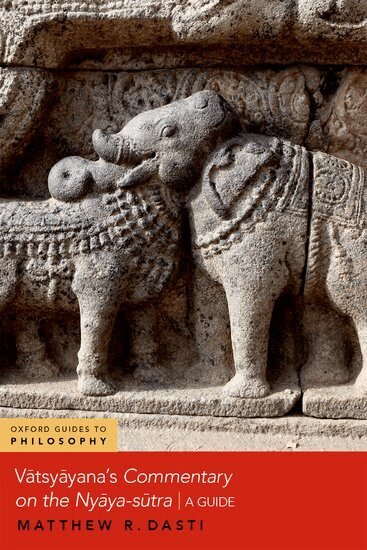
Vātsyāyana's Commentary on the Nyāya-sūtra is one of classical India's most important philosophical works. This Guide offers both a map and interpretation of this challenging canonical text, suitable for any student or novice reader.Treating them as a single hybrid text, the Nyāya-sūtra with Vātsyāyana's commentary systematizes in skeletal form centuries of ancient Indian philosophical developments concerning logic, epistemology, and dialectics, while also defending a realist categorial metaphysics. It offers a number of epistemological and methodological insights that inform intellectual inquiry in the Subcontinent for over a millennium. Vātsyāyana's Commentary also provides sophisticated arguments for distinct positions in metaphysics, epistemology, philosophy of language, and value theory that stand amongst the best contributions to world philosophy.This guide, accessible to students and researchers not familiar with classical Indian philosophy, provides a distilled, accessible understanding of the major scholarly, historical, and philosophical issues that inform the Commentary, while unpacking its philosophical content such that it speaks to modern readers. It also illustrates the way that the Commentary may serve as a lens through which to view the formative period of classical Indian philosophy.
292 kr
Skickas inom 5-8 vardagar
Vātsyāyana's Commentary on the Nyāya-sūtra is one of classical India's most important philosophical works. This Guide offers both a map and interpretation of this challenging canonical text, suitable for any student or novice reader.Treating them as a single hybrid text, the Nyāya-sūtra with Vātsyāyana's commentary systematizes in skeletal form centuries of ancient Indian philosophical developments concerning logic, epistemology, and dialectics, while also defending a realist categorial metaphysics. It offers a number of epistemological and methodological insights that inform intellectual inquiry in the Subcontinent for over a millennium. Vātsyāyana's Commentary also provides sophisticated arguments for distinct positions in metaphysics, epistemology, philosophy of language, and value theory that stand amongst the best contributions to world philosophy.This guide, accessible to students and researchers not familiar with classical Indian philosophy, provides a distilled, accessible understanding of the major scholarly, historical, and philosophical issues that inform the Commentary, while unpacking its philosophical content such that it speaks to modern readers. It also illustrates the way that the Commentary may serve as a lens through which to view the formative period of classical Indian philosophy.
1 268 kr
Skickas inom 5-8 vardagar
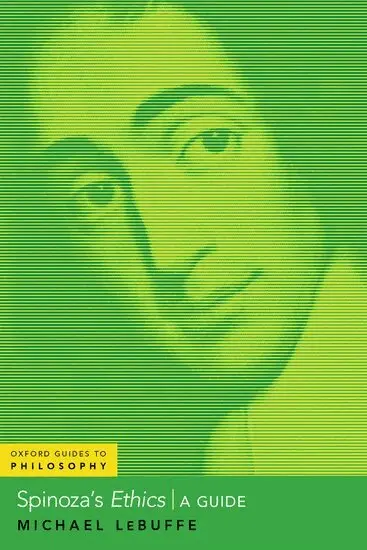
Baruch Spinoza's Ethics was published in 1677 just after his death. Along with Descartes's Meditations (1641) and Leibniz's mature essays (1685-1714) the Ethics is regarded as among the most important philosophical work of continental Early Modern Europe. In this guide, Michael LeBuffe follows the Ethics closely and helps readers to understand Spinoza's masterpiece for themselves.The Ethics is a hugely ambitious work that offers strong, controversial views on almost every aspect of philosophy. In a geometrical style, in which propositions build upon definitions and axioms, Spinoza contends that there is only one substance, God, and that everything that exists, including God and human beings, is subject to absolute necessity. Nevertheless, he also defends rich theories of human action and ethics. Spinoza maintains that we can and should work to overcome the harmful influence of passion and enjoy salvation and blessedness. LeBuffe includes an introduction designed to supply first time readers with enough background to study the text productively. He then devotes a chapter to each of the Ethics' five parts: on God, mind, the affects or emotions, human bondage, and human freedom. The guide focuses on one manageable part of Spinoza's dense argument at a time, pausing frequently to raise and consider questions for further research. This accessible guide to the Ethics will help readers to understand the challenging text and to develop their own sophisticated interpretations of Spinoza.
594 kr
Skickas inom 3-6 vardagar
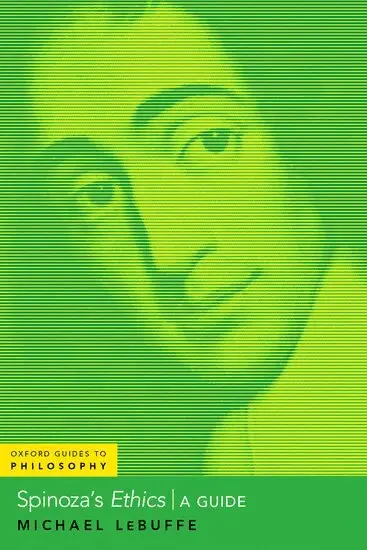
Baruch Spinoza's Ethics was published in 1677 just after his death. Along with Descartes's Meditations (1641) and Leibniz's mature essays (1685-1714) the Ethics is regarded as among the most important philosophical work of continental Early Modern Europe. In this guide, Michael LeBuffe follows the Ethics closely and helps readers to understand Spinoza's masterpiece for themselves.The Ethics is a hugely ambitious work that offers strong, controversial views on almost every aspect of philosophy. In a geometrical style, in which propositions build upon definitions and axioms, Spinoza contends that there is only one substance, God, and that everything that exists, including God and human beings, is subject to absolute necessity. Nevertheless, he also defends rich theories of human action and ethics. Spinoza maintains that we can and should work to overcome the harmful influence of passion and enjoy salvation and blessedness. LeBuffe includes an introduction designed to supply first time readers with enough background to study the text productively. He then devotes a chapter to each of the Ethics' five parts: on God, mind, the affects or emotions, human bondage, and human freedom. The guide focuses on one manageable part of Spinoza's dense argument at a time, pausing frequently to raise and consider questions for further research. This accessible guide to the Ethics will help readers to understand the challenging text and to develop their own sophisticated interpretations of Spinoza.
929 kr
Skickas inom 7-10 vardagar
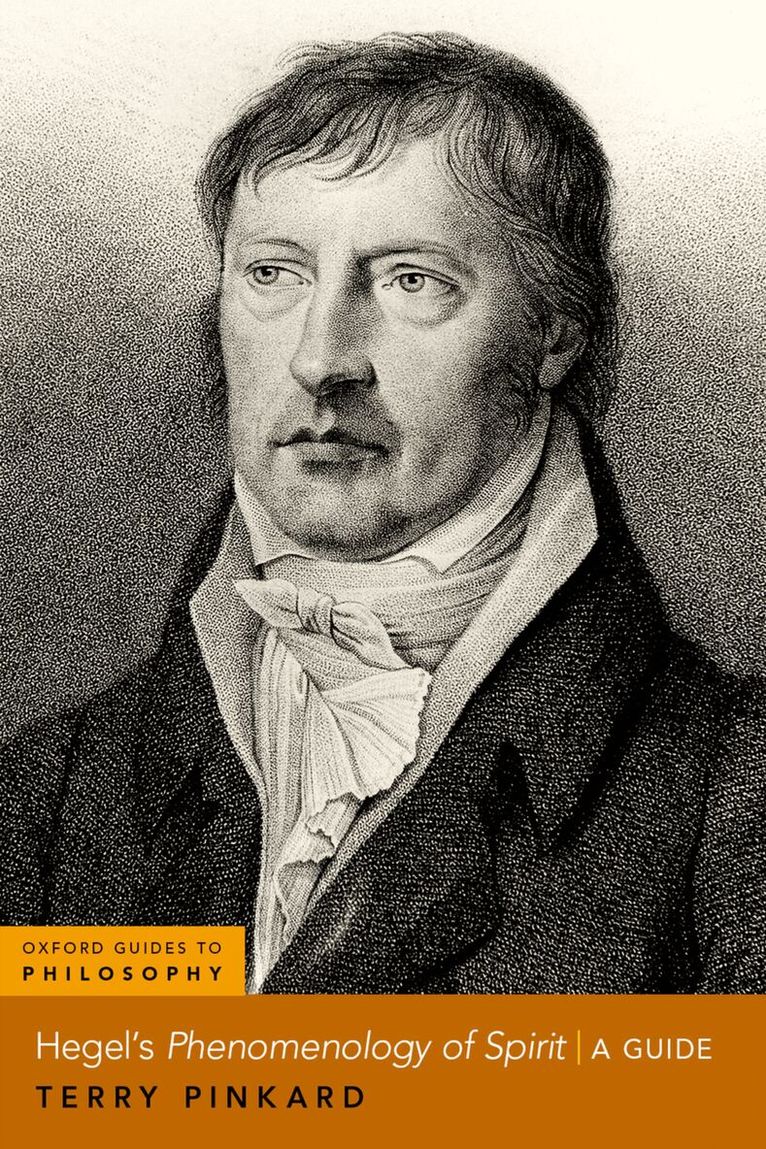
Hegel's Phenomenology of Spirit has a long-standing reputation as one of the key books in the history of Western philosophy, but many are unsure just what it is about. Even the words in the title are disputed: What sense of “phenomenology” is being used? Is Geist to be rendered “spirit” or “mind”? What does this have to do with Hegel's original title, “The Science of the Experience of Consciousness”? To add to the perplexity, Hegel developed his own technical vocabulary in writing the book, but the jargon he created never caught on and thus there is no common usage for it. As a consequence, both the beginner and the Hegel specialist must make key decisions about to understand many basic terms in the book.This Oxford Guide walks the reader through this canonical text paragraph-by-paragraph using accessible and approachable language, such that both students and instructors--whether they come from philosophy, political theory, literature, or history backgrounds--will benefit.
410 kr
Skickas
Hegel's Phenomenology of Spirit has a long-standing reputation as one of the key books in the history of Western philosophy, but many are unsure just what it is about. Even the words in the title are disputed: What sense of “phenomenology” is being used? Is Geist to be rendered “spirit” or “mind”? What does this have to do with Hegel's original title, “The Science of the Experience of Consciousness”? To add to the perplexity, Hegel developed his own technical vocabulary in writing the book, but the jargon he created never caught on and thus there is no common usage for it. As a consequence, both the beginner and the Hegel specialist must make key decisions about to understand many basic terms in the book.This Oxford Guide walks the reader through this canonical text paragraph-by-paragraph using accessible and approachable language, such that both students and instructors--whether they come from philosophy, political theory, literature, or history backgrounds--will benefit.