Points of Conflict - Böcker
Visar alla böcker i serien Points of Conflict. Handla med fri frakt och snabb leverans.
5 produkter
5 produkter
574 kr
Skickas inom 10-15 vardagar
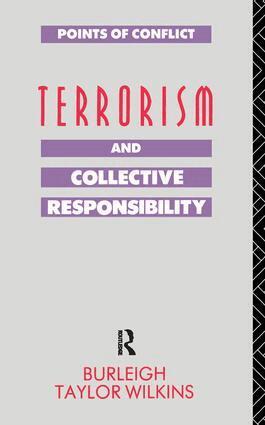
The terrorist threat remains a disturbing issue for the early 1990s. This book explores whether terrorism can ever be morally justifiable and if so under what circumstances.Professor Burleigh Taylor Wilkins suggests that the popular characterisation of terrorists as criminals fails to acknowledge the reasons why terrorists resort to violence. It is argued that terrorism cannot be adequately understood unless the collective responsibility of organised groups, such as political states, for wrongs allegedly done against the groups which the terrorists represent is taken into account. Terrorism and Collective Responsibility provides an analysis of various models of collective responsibility, and it takes into account recent discussions of military responsibility and business ethics. The book also explores the problems that terrorism poses for the just war tradition.The arguments of prominent philosophers against terrorism are critically examined and the claim that terrorism necessarily violates the rights of innocent persons is considered. Wilkins sets forth an original definition of terrorism that is sure to provoke controversy.
574 kr
Skickas inom 10-15 vardagar
First published in 1990. With the exception of Clausewitz, no reflective thinker has seriously engaged with the concept of war - with its persistent changeability and the dominant direction of its changes. The results of this failure are seen in the extreme logical weakness of most debates, during the last two centuries, on the possibility of eliminating war and, since 1945, on the possibility of eliminating nuclear weapons. Orderly, clear, and reflective, Understanding War develops two main theses: first, that the horrendous escalation of war's destructiveness in this century is primarily the result of the inherently cumulative character of war itself rather than of the application to war of recent science-based technologies; and second, that the irreversible destructiveness of nuclear weapons suggests how joint action by the superpowers could prevent their being used in any future war.
2 100 kr
Skickas inom 10-15 vardagar
Modern coverage of world events suggest that war and violence are key to contemporary society. History can convince us that it has ever been so, and many theorist of international relations argue that nothing is likely to change.Roy Weatherford argues that a profound change in social relations is imminent as national sovereignty yields to a democratic world culture, speaking a world language and living as a world wide family - the human family.For too long world peace has seemed a noble but unattainable ideal. Weatherford shows that it is now both economically and politically possible and is therefore our moral duty.
574 kr
Skickas inom 10-15 vardagar
Modern coverage of world events suggest that war and violence are key to contemporary society. History can convince us that it has ever been so, and many theorist of international relations argue that nothing is likely to change.Roy Weatherford argues that a profound change in social relations is imminent as national sovereignty yields to a democratic world culture, speaking a world language and living as a world wide family - the human family.For too long world peace has seemed a noble but unattainable ideal. Weatherford shows that it is now both economically and politically possible and is therefore our moral duty.
2 707 kr
Skickas inom 10-15 vardagar
The terrorist threat remains a disturbing issue for the early 1990s. This book explores whether terrorism can ever be morally justifiable and if so under what circumstances.Professor Burleigh Taylor Wilkins suggests that the popular characterisation of terrorists as criminals fails to acknowledge the reasons why terrorists resort to violence. It is argued that terrorism cannot be adequately understood unless the collective responsibility of organised groups, such as political states, for wrongs allegedly done against the groups which the terrorists represent is taken into account. Terrorism and Collective Responsibility provides an analysis of various models of collective responsibility, and it takes into account recent discussions of military responsibility and business ethics. The book also explores the problems that terrorism poses for the just war tradition.The arguments of prominent philosophers against terrorism are critically examined and the claim that terrorism necessarily violates the rights of innocent persons is considered. Wilkins sets forth an original definition of terrorism that is sure to provoke controversy.