Principles-based Adaptive Teaching - Böcker
Visar alla böcker i serien Principles-based Adaptive Teaching. Handla med fri frakt och snabb leverans.
10 produkter
10 produkter
2 044 kr
Skickas inom 10-15 vardagar
Adolescence in India: An Interdisciplinary Perspective highlights the need and importance of studying adolescence in the domain of education. Using an interdisciplinary approach, it discusses adolescence from the perspective of sociology, psychology, education and health studies. Against the backdrop of economic development and globalization, the book looks at adolescence in the changing social milieu. It offers an understanding of adolescence by exploring the socio-cultural influences on adolescents and their interactions in various spaces like the school, among peers, family and the media. The book reflects on classroom group processes and instructional practices for better psychosocial growth of adolescents as well as discusses the need for a greater emphasis on making resources available for adolescents to realise and strengthen their skills and agency. The book outlines various life-skills policies and programmes in India and uses vignettes, anecdotes, emerging classroom discussions, case studies, activities, and self-assessment tools and questionnaires to facilitate a deeper understanding of the concept. The book will be of interest to students, teachers, and educators in teaching programmes including educational psychology, adolescent psychology, and human development. It will also be useful for policymakers, NGOs, and public and private sector bodies who work in the field of adolescent psychology.
2 044 kr
Skickas inom 10-15 vardagar
The book presents key perspectives on teaching and learning science in India. It offers adaptive expertise to teachers and educators through a pedagogic content knowledge (PCK) approach. Using cases and episodes from Indian science classrooms to contextualise ideas and practices, the volume discusses the nature of science, and aspects of assessments and evaluations for both process skills and conceptual understanding of the subject. It examines the significance of science education at school level and focuses on meaningful learning and development of scientific and technological aptitude. The chapters deal with topics from physics, chemistry and biology at the middle- and secondary-school levels, and are designed to equip student-teachers with theoretical and practical knowledge abilities about science, science learning and the abilities to teach these topics along with teaching.The book draws extensively from research on science education and teacher education and shifts away from knowledge transmission to the active process of constructivist teaching-learning practices. The authors use illustrative examples to highlight flexible planning for inclusive classrooms. Based on studies on cognitive and developmental psychology, pedagogical content knowledge of science, socio-cultural approaches to learning science, and the history and philosophy of science, the book promotes an understanding of science characterized by empirical criteria, logical arguments and sceptical reviews.With its accessible style, examples, exercises and additional references, it will be useful for students and teachers of science, science educators, BEd and MEd programmes for education, secondary and higher secondary school teachers, curriculum designers and developers of science. It will interest research institutes, non-governmental organisations, professionals and public and private sector bodies involved in science outreach, science education and teaching and learning practices.
2 419 kr
Skickas inom 10-15 vardagar
This book situates the teaching and learning of language in general, and English in particular, within the sociocultural context of India. It engages with current scholarship in literacy studies and the pedagogies of language acquisition and learning.The volume discusses the cultural, discursive and sociopolitical functions of language education and the teaching of English in Indian schools. It examines the importance of adopting flexible pedagogical and multimodal strategies in teaching vocabulary; grammar; literary genres like fiction, poetry and drama; rhetorical discourses; and communicative English to learners for whom English is not one of their home language(s). It also discusses pragmatic approaches to curriculum design for communicative competence and critical literacy rooted in theoretical principles of language education. The authors analyse issues relevant to secondlanguage acquisition; English language teaching (ELT); emergent, adult and critical literacies; and critical pedagogies in language and literature.Written in an accessible style, the book comes with case studies, exercises and additional references to support an independent exploration of the fields. This book will be of interest to students and teachers of language, literature and education, as well as teachers and educators in schools and universities. It is also of relevance to policymakers, non-governmental organisations and public and private sector bodies that work in the fields of language and literacy.
546 kr
Skickas inom 10-15 vardagar
The book presents key perspectives on teaching and learning science in India. It offers adaptive expertise to teachers and educators through a pedagogic content knowledge (PCK) approach. Using cases and episodes from Indian science classrooms to contextualise ideas and practices, the volume discusses the nature of science, and aspects of assessments and evaluations for both process skills and conceptual understanding of the subject. It examines the significance of science education at school level and focuses on meaningful learning and development of scientific and technological aptitude. The chapters deal with topics from physics, chemistry and biology at the middle- and secondary-school levels, and are designed to equip student-teachers with theoretical and practical knowledge abilities about science, science learning and the abilities to teach these topics along with teaching.The book draws extensively from research on science education and teacher education and shifts away from knowledge transmission to the active process of constructivist teaching-learning practices. The authors use illustrative examples to highlight flexible planning for inclusive classrooms. Based on studies on cognitive and developmental psychology, pedagogical content knowledge of science, socio-cultural approaches to learning science, and the history and philosophy of science, the book promotes an understanding of science characterized by empirical criteria, logical arguments and sceptical reviews.With its accessible style, examples, exercises and additional references, it will be useful for students and teachers of science, science educators, BEd and MEd programmes for education, secondary and higher secondary school teachers, curriculum designers and developers of science. It will interest research institutes, non-governmental organisations, professionals and public and private sector bodies involved in science outreach, science education and teaching and learning practices.
611 kr
Skickas inom 10-15 vardagar
Adolescence in India: An Interdisciplinary Perspective highlights the need and importance of studying adolescence in the domain of education. Using an interdisciplinary approach, it discusses adolescence from the perspective of sociology, psychology, education and health studies. Against the backdrop of economic development and globalization, the book looks at adolescence in the changing social milieu. It offers an understanding of adolescence by exploring the socio-cultural influences on adolescents and their interactions in various spaces like the school, among peers, family and the media. The book reflects on classroom group processes and instructional practices for better psychosocial growth of adolescents as well as discusses the need for a greater emphasis on making resources available for adolescents to realise and strengthen their skills and agency. The book outlines various life-skills policies and programmes in India and uses vignettes, anecdotes, emerging classroom discussions, case studies, activities, and self-assessment tools and questionnaires to facilitate a deeper understanding of the concept. The book will be of interest to students, teachers, and educators in teaching programmes including educational psychology, adolescent psychology, and human development. It will also be useful for policymakers, NGOs, and public and private sector bodies who work in the field of adolescent psychology.
646 kr
Skickas inom 10-15 vardagar
This book situates the teaching and learning of language in general, and English in particular, within the sociocultural context of India. It engages with current scholarship in literacy studies and the pedagogies of language acquisition and learning.The volume discusses the cultural, discursive and sociopolitical functions of language education and the teaching of English in Indian schools. It examines the importance of adopting flexible pedagogical and multimodal strategies in teaching vocabulary; grammar; literary genres like fiction, poetry and drama; rhetorical discourses; and communicative English to learners for whom English is not one of their home language(s). It also discusses pragmatic approaches to curriculum design for communicative competence and critical literacy rooted in theoretical principles of language education. The authors analyse issues relevant to secondlanguage acquisition; English language teaching (ELT); emergent, adult and critical literacies; and critical pedagogies in language and literature.Written in an accessible style, the book comes with case studies, exercises and additional references to support an independent exploration of the fields. This book will be of interest to students and teachers of language, literature and education, as well as teachers and educators in schools and universities. It is also of relevance to policymakers, non-governmental organisations and public and private sector bodies that work in the fields of language and literacy.
2 044 kr
Skickas inom 10-15 vardagar
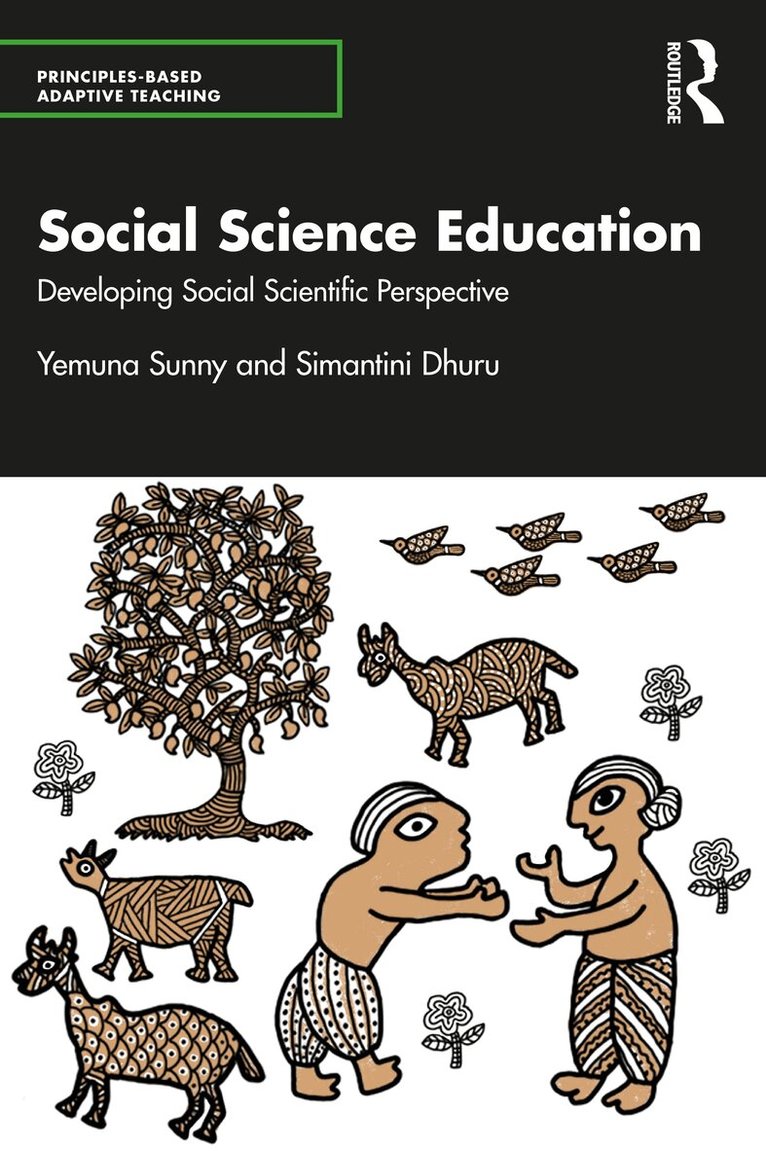
This book provides an introduction into social science pedagogy in India. It delves into the interrelationships between society, social relationships, education, and learning.Social science education in schools helps build a critical understanding of social processes and institutions. This book critically examines school spaces and approaches to social science teaching and pedagogy in Indian schools. It outlines distinguishing features, differences, and similarities in pedagogical models and also explains how these varied approaches can be applied in the teaching process. The book also addresses the challenges and possibilities of integrating technology in teaching social sciences. Part of the series, ‘Principles-based Adaptive Teaching’, this book will be of interest to students and teachers of education and the social sciences. It will also be of interest to teachers, educators, curriculum designers, policy makers and social science course developers, NGOs, and public and private sector bodies who focus on teaching and learning practices.
Knowledge, Curriculum and Learning
Knowing Why We Teach, What We Teach and How We Learn
Inbunden, Engelska, 2025
2 044 kr
Skickas inom 10-15 vardagar
This book presents key epistemological ideas to enable teachers to understand different perspectives on knowledge, knowing and learning. It engages them to critically analyse various dimensions of knowledge and learning alongside their social and political implications.Drawing on theoretical perspectives in psychology, philosophy, sociology and anthropology, this book offers an opportunity for teachers to understand the multiple dimensions of learning. This encompasses values, beliefs and the cultivation of habits in various domains of learning such as the arts, languages, sciences, mathematics and sports. While engaging with questions of the know-that and know-how of knowledge, the book focuses on its different forms and their characterisation as school subjects. It critically examines the role of culture and politics in the formulation of the curriculum. With illustrative examples, it discusses the ideas shaping curriculum development and reforms such as child-centred education, inclusive education and integrated curriculum.This book will be of interest to students and teachers of education, BA, BEd and MEd courses, and epistemology. It will also be of interest to teachers of secondary and higher secondary schools, teacher educators, curriculum designers, developers of textbooks and other curriculum resources, non-governmental organisations (NGOs) and public and private sector bodies working in the area of education.
Knowledge, Curriculum and Learning
Knowing Why We Teach, What We Teach and How We Learn
Häftad, Engelska, 2025
559 kr
Skickas inom 10-15 vardagar
This book presents key epistemological ideas to enable teachers to understand different perspectives on knowledge, knowing and learning. It engages them to critically analyse various dimensions of knowledge and learning alongside their social and political implications.Drawing on theoretical perspectives in psychology, philosophy, sociology and anthropology, this book offers an opportunity for teachers to understand the multiple dimensions of learning. This encompasses values, beliefs and the cultivation of habits in various domains of learning such as the arts, languages, sciences, mathematics and sports. While engaging with questions of the know-that and know-how of knowledge, the book focuses on its different forms and their characterisation as school subjects. It critically examines the role of culture and politics in the formulation of the curriculum. With illustrative examples, it discusses the ideas shaping curriculum development and reforms such as child-centred education, inclusive education and integrated curriculum.This book will be of interest to students and teachers of education, BA, BEd and MEd courses, and epistemology. It will also be of interest to teachers of secondary and higher secondary schools, teacher educators, curriculum designers, developers of textbooks and other curriculum resources, non-governmental organisations (NGOs) and public and private sector bodies working in the area of education.
545 kr
Skickas inom 10-15 vardagar
This book provides an introduction into social science pedagogy in India. It delves into the interrelationships between society, social relationships, education, and learning.Social science education in schools helps build a critical understanding of social processes and institutions. This book critically examines school spaces and approaches to social science teaching and pedagogy in Indian schools. It outlines distinguishing features, differences, and similarities in pedagogical models and also explains how these varied approaches can be applied in the teaching process. The book also addresses the challenges and possibilities of integrating technology in teaching social sciences. Part of the series, ‘Principles-based Adaptive Teaching’, this book will be of interest to students and teachers of education and the social sciences. It will also be of interest to teachers, educators, curriculum designers, policy makers and social science course developers, NGOs, and public and private sector bodies who focus on teaching and learning practices.