Race Relations in the United States – serie
Visar alla böcker i serien Race Relations in the United States. Handla med fri frakt och snabb leverans.
4 produkter
4 produkter
695 kr
Skickas inom 10-15 vardagar
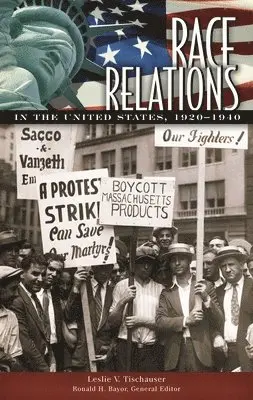
Race relations in the 1920s ranged from an epidemic of lynchings of African Americans, race riots, and the execution of Italian immigrants Sacco and Vanzetti to citizenship for American Indians but not for Mexican immigrants. As the 1930s unfolded, there was more discrimination of Latinos and a legal lynching in the Scottsboro Boys trial, and German Jewish children were refused refuge from Hitler's Germany. This volume is THE content-rich source in a desirable decade-by-decade organization to help students and general readers understand the crucial race relations of the fascinating Jazz Age and Great Depression era. Race Relations in the United States, 1920-1940 provides comprehensive reference coverage of the key events, influential voices, race relations by group, legislation, media influences, cultural output, and theories of inter-group interactions.The volume covers two decades with a standard format coverage per decade, including Timeline, Overview, Key Events, Voices of the Decade, Race Relations by Group, Law and Government, Media and Mass Communications, Cultural Scene, Influential Theories and Views of Race Relations, Resource Guide. This format allows comparison of topics through the decades. The bulk of the coverage is topical essays, written in a clear, encyclopedic style. Historical photos, a selected bibliography, and index complement the text.
695 kr
Skickas inom 10-15 vardagar
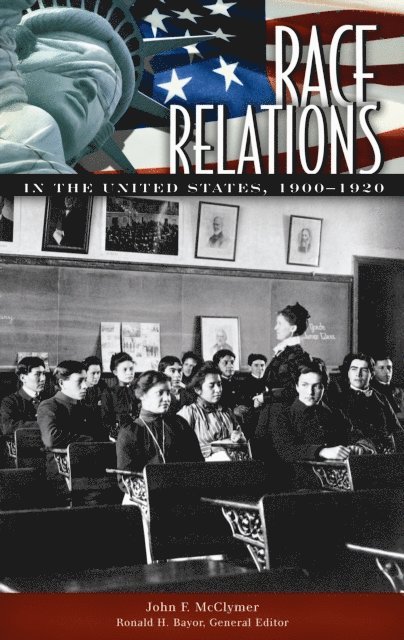
In the first decades of the twentieth century, virulent racism lingered from Reconstruction, and segregation increased. Hostility met the millions of new immigrants from Eastern and southern Europe, and immigration was restricted. Still, even in an inhospitable climate, blacks and other minority groups came to have key roles in popular culture, from ragtime and jazz to film and the Harlem Renaissance. This volume is THE content-rich source in a desirable decade-by-decade organization to help students and general readers understand the crucial race relations of the start of modern America. Race Relations in the United States, 1900-1920 provides comprehensive reference coverage of the key events, influential voices, race relations by group, legislation, media influences, cultural output, and theories of inter-group interactions.The volume covers two decades with a standard format coverage per decade, including Timeline, Overview, Key Events, Voices of the Decade, Race Relations by Group, Law and Government, Media and Mass Communications, Cultural Scene, Influential Theories and Views of Race Relations, Resource Guide. This format allows comparison of topics through the decades. The bulk of the coverage is topical essays, written in a clear, encyclopedic style. Historical photos, a selected bibliography, and index complement the text.
675 kr
Skickas inom 10-15 vardagar
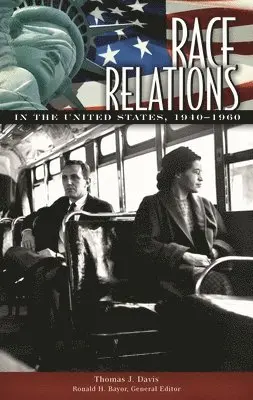
The 1940s and 1950s were decades of far-reaching change and mobilization in the United States. White culture strove to make nonwhites invisible with segregation and discrimination as Southern blacks continued the Great Migration north and the government brought in Mexican labor via the Bracero Program to take up labor slack while U.S. troops were overseas. The rise of the civil rights movement and Brown v. Board of Education, which struck down segregation in schools 1954, were some results. This volume is THE content-rich source in a desirable decade-by-decade organization to help students and general readers understand the crucial race relations of the war years into the Cold War. Race Relations in the United States, 1940-1960 provides comprehensive reference coverage of the key events, influential voices, race relations by group, legislation, media influences, cultural output, and theories of inter-group interactions.The volume covers two decades with a standard format coverage per decade, including Timeline, Overview, Key Events, Voices of the Decade, Race Relations by Group, Law and Government, Media and Mass Communications, Cultural Scene, Influential Theories and Views of Race Relations, Resource Guide. This format allows comparison of topics through the decades. The bulk of the coverage is topical essays, written in a clear, encyclopedic style. Historical photos, a selected bibliography, and index complement the text.
675 kr
Skickas inom 10-15 vardagar
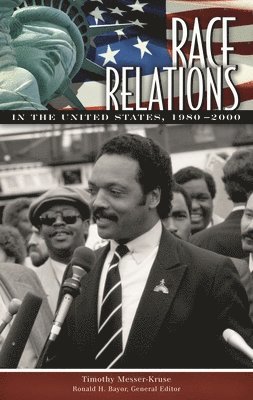
In the 1980s, many Americans began to believe that racial problems and institutional discrimination were a thing of the past, but the race issue turned out to be as divisive and powerful as it had ever been. Major events related to race included the Reagan/Carter presidential race, Jesse Jackson's 1984 presidential campaign, the Tawana Brawley case, and President George H. W. Bush's manipulation in his 1998 presidential campaign of convict Willie Horton. The 1990s saw the Immigration Act of 1990 allowing more Asians into the United States, the Anita Hill testimony against the first black U.S. Supreme Court Justice, the Rodney King beating in Los Angeles, and the Million Man March. This volume is THE content-rich source in a desirable decade-by-decade organization to help students and general readers understand the crucial race relations of the recent past. Race Relations in the United States, 1980-2000 provides comprehensive reference coverage of the key events, influential voices, race relations by group, legislation, media influences, cultural output, and theories of inter-group interactions.The volume covers two decades with a standard format coverage per decade, including Timeline, Overview, Key Events, Voices of the Decade, Race Relations by Group, Law and Government, Media and Mass Communications, Cultural Scene, Influential Theories and Views of Race Relations, Resource Guide. This format allows comparison of topics through the decades. The bulk of the coverage is topical essays, written in a clear, encyclopedic style. Historical photos, a selected bibliography, and index complement the text.