RES Insect Identification Handbooks – serie
Visar alla böcker i serien RES Insect Identification Handbooks. Handla med fri frakt och snabb leverans.
3 produkter
3 produkter
Inbunden, Engelska, 2026
139 kr
Skickas inom 5-8 vardagar
The orthopteroid orders include the Orthoptera (bush-crickets, crickets, groundhoppers and grasshoppers), Phasmida (stick-insects), Embioptera (webspinners), Blattodea (cockroaches), Mantodea (praying mantises) and Dermaptera (earwigs). This handbook covers the orthopteroid insects native to the British Isles and Channel Islands, as well as migrants, regularly reported adventive species and naturalized aliens, including species established inside buildings and heated plant houses in addition to those normally found outdoors. This is an exciting time for British entomology. Recent years have seen the arrival of numerous insect species new to the British list. This handbook includes notes on the identification of a number of species of Orthoptera present on the near continent which could plausibly find their way to the British Isles in the future. This handbook will allow the identification of specimens with a high level of precision by means of keys, tables and descriptions, which are supported by colour photographs giving general views of the insects as well as showing anatomical details of diagnostic importance. Where relevant to the purposes of identification, examples of colour variants of the various species are included. The author has maintained a lifelong interest in entomology while devoting special attention to the study of the orthopteroid insects. He has been a regular contributor to local and national recording schemes since the 1970s and was for many years the county recorder for Orthoptera in Sussex. He has published papers on Orthoptera from the British Isles, Europe and Africa as well as a guidebook to the grasshoppers and crickets of Berkshire, Buckinghamshire and Oxfordshire. John Paul's professional background is in medical microbiology. This handbook updates and considerably expands on the information provided in the original RES orthopteroid handbook by W.D. Hincks, last revised in 1956. This handbook will be of value to anyone with an interest in Orthoptera and allied insects as well as to students of entomology, ecologists, horticulturalists, pest controllers and general naturalists.
Inbunden, Engelska, 2026
1 693 kr
Skickas inom 5-8 vardagar
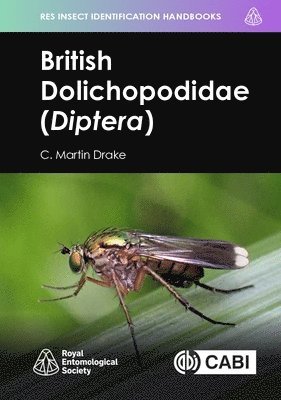
This handbook covers British species of the family Dolichopodidae, popularly called long-legged flies. These are often attractive both visually and in their behaviour so the larger species will be familiar to most naturalists. The sexes are often strongly dimorphic, males having their legs and wings modified for signalling during sometimes complex courtship. Both the larvae and adults are predators, with the exception of one genus whose larvae are miners within monocotyledons. Most species are associated with wetlands from the sea shore to montane pools, while a small number have more xerophilic tendencies and others are associated with rot-holes or wood-boring beetles. Dolichopodids can play an important role in nature conservation assessment of sites as their habitat affinities, rarity status and distributions are fairly well known. This book focuses on the British fauna of about 327 species in 47 genera placed in 12 subfamilies. One species so far found only in Ireland is also included. The limits of several subfamilies are poorly defined, and phylogenetic relationships based on morphological and molecular data are also not always in agreement so the placement in this book of some genera differs from previous British checklists. In particular, some genera are assigned to the Peloropeodinae which has not been accepted previously in the British literature. Owing to their secondary sexual characteristics, males are easier to identify than females so separate keys are provided for nearly all genera. Some males can be separated reliably only by using genitalia characters which are therefore often included in the keys and are illustrated for most species. In a few cases no reliable differences have been found for females. Line drawings illustrate many of the characters mentioned in the couplets and photographs show representative species of all genera. Most keys are derived de novo rather than updating those already existing. Species accounts briefly describe the most important characters to confirm the identification arrived at using the key, distinctions from similar species that may occur in Britain, the distribution in Britain, and their habitat associations.
Inbunden, Engelska, 2026
1 733 kr
Kommande
This handbook covers all those British fungus gnats not included in a volume published in 2022, which keyed 334 species of the subfamily Mycetophilinae of family Mycetophilidae. Here keys are provided to the remaining five subfamilies of Mycetophilidae, and to four other families included in the wider definition of fungus gnats: Bolitophilidae, Diadocidiidae, Ditomyiidae and Keroplatidae. Altogether 250 species are included. Fungus gnats may occur in both wooded and open habitats, but they are mainly forest insects as the development of many species is dependent on saproxylic or mycorrhizal fungi. A systematic list of the known fungus hosts of species covered in this handbook is included. There is a wide range of other larval habitats, with some species developing in rotten wood, in bryophytes, in bird's nests, and in caves, and some, particularly in the family Keroplatidae, have predatory web-spinning larvae on various substrates. Many species are as yet of unknown biology, so there is plenty of scope for new discoveries, but a common factor is that all species are anticipated to have entirely terrestrial life histories, in contrast to some other families of gnats and midges that have aquatic larvae. Fungus gnats may be found throughout the year, their relative abundance affected by prevailing weather conditions and the consequent effect on the availability of fungus hosts. Recognition of species depends on the complex structure of their male genitalia, which are illustrated by photographs for all species; females are not identifiable in some genera but it is indicated where there are characters that enable them to be identified. This latest Royal Entomological Society Insect Identification Handbook is for anyone seeking to identify members of this group of Diptera, which is a large and important component of biodiversity The book: · Completes keys to a large taxonomic group, together with the previous handbook (published in 2022) · Includes photographs of the diagnostic features of all species · Facilitates the identification of a significant part of forest and saproxylic faunas