Research Handbooks on Globalisation and the Law series – Serie
Visar alla böcker i serien Research Handbooks on Globalisation and the Law series. Handla med fri frakt och snabb leverans.
17 produkter
17 produkter
646 kr
Skickas inom 7-10 vardagar
This essential Research Handbook provides a comprehensive and critical assessment of the global governance instruments related to business and human rights from an interdisciplinary perspective. Contributions from a diverse range of leading international scholars offer an overview of the existing literature and rapidly-evolving research discipline, as well as identifying key trends and outlining an ambitious future research agenda.The Research Handbook first examines governance initiatives that operate across economic sectors, discussing both public and private initiatives at state, regional and international levels that seek to develop, implement and enforce rules with regard to the impacts of transnational business activities on human rights. Chapters then investigate particular economic sectors – including textiles, electronics, agro-chemical, construction, and finance – to assess the ways in which different initiatives attempt to mitigate risks and address business-related human rights abuses.Scholars of law, regulatory governance, global governance, management, human rights and social sciences who are interested in gaining a deeper understanding of the emerging business and human rights regime will find this Research Handbook a crucial read. It will also prove a useful and thorough introduction for students, scholars and practitioners new to the field of business and human rights.
3 723 kr
Skickas inom 7-10 vardagar
Events such as the global financial crisis have helped reveal that the drivers and contours of governance on a national and international level remain a mystery in many respects. This is so despite the ever-increasing complexity and sophistication in the management and understanding of economic, legal and political spheres of global society. Set in this context, this timely Research Handbook is the first to explicitly address the constitutive relationship between law and political economy.With scholarly contributions from diverse disciplinary and geographic backgrounds, this authoritative book provides an expansive overview of the legal architecture of the global political economy. It covers, in three parts, topics surrounding money and markets, the relations of organization, and commodities, land and resources.Scholars and policymakers as well as undergraduate and postgraduate law students interested in the intersection of socio-political, economic, and legal dynamics of governance will find this book a thought-provoking and insightful resource.Contributors: A. Andreoni, G. Baars, S. Bailey, B. Bowring, T.A. Canova, D. Danielsen, J. Desautels-Stein, J. Ellis, A. Gupta, F. Guy, A. Hanieh, I. Isailovi , V. Kishore, R. Kreitner, T. Krever, P. Luff, T. Mahmud, B.N. Mamlyuk, M. McCluskey, R. Míguez, C. Mummé, A. Ng Boyte, Ö. Orhangazi, U. Özsu, A. Rasulov, L. Russi, C. Salom o Filho, P. Skott, J. Toporowski, R.A. Woodcock, L.R. Wray
3 529 kr
Skickas inom 7-10 vardagar
This Handbook offers a collection of original writings by leading scholars and practitioners in the exciting, rapidly developing field of cultural heritage law. The detailed essays are the product of a multi-year project of the Committee on Cultural Heritage Law of the International Law Association.Following a comprehensive introduction to cultural heritage law, the book turns to the core topic of international trade. The General Agreement on Tariffs and Trade and a 1970 UNESCO convention on illegal trafficking in cultural material formed the foundation for progressive development of an impressive and still-evolving legal framework. Building on these and other instruments, the essays focus on import and export controls within specific national legal regimes. Concluding chapters contextualize additional important issues - including human rights, pluralism and nationalism - from a broader, global perspective. Innovative in its combination of comparative and international dimensions of the subject, this book provides a ready, well-documented reference to national and international regimes of control and a scholarly source for teaching and further research.Students, professors and practitioners of trade law, cultural heritage law and general international law will find this Handbook an invaluable resource.Contributors include: T. Adlercreutz, E. Beccerril, M. Beukes, J. Blake, K. Chamberlain, P. Conlan, M. Cornu, P. Davies, J. Ding, T. Einhorn, F. Fiorentini, C. Forrest, M. Frigo, K. Hausler, A. Jakubowski, O. Jakubowski, T. Kono, S. Kozai, E.N. Moustaira, P. Myburgh, J.A.R. Nafziger, R.K. Paterson, M.-A. Renold, B. Schönenberger, K. Siehr, A.F. Vrdoljak
698 kr
Skickas inom 7-10 vardagar
The fairness of institutions of global economic governance ranks among the most pressing issues of our time. Most approaches to understanding the complex structure of treaties and intergovernmental organizations such as the WTO tend to uncritically accept an economic focus, highlighting gains from trade and the merits of progressive trade and investment liberalization. While the economic arguments are compelling, other ways of thinking about the roles of these institutions have received less attention. The Research Handbook fills this gap by offering a substantial interdisciplinary examination of the normative and policy underpinnings of the international economic order.The book includes specially commissioned chapters based on theories of justice, human rights, and critical legal studies, as well as on economics and the internal structure of international economic law itself, all written by leading scholars in their respective fields. The contributors offer an interdisciplinary approach to understanding the relationship between international economic law and policy and the rights and welfare of peoples across the globe. The end result is an essential point of reference for developing a comprehensive toolkit for evaluating the institutions of global economic governance.Containing extensive and significant interdisciplinary coverage of key areas of research on international economic law and policy, this Research Handbook will appeal to political scientists, philosophers, legal scholars, economists and international relations theorists.Contributors: G. Brock, B.S. Chimni, L.V. Ciko, P. Clements, C.M. Correa, F.J. Garcia, B. He, C.L. Lim, J. Linarelli, S.M. Lundan, A. Maneschi, H. Murphy, E.-U. Petersmann
2 753 kr
Skickas inom 7-10 vardagar
Transnational corporations (TNCs) have moved to the forefront of regulatory governance both within states and in the international arena. The Research Handbook on Transnational Corporations provides expert background commentary and up-to-date insights into regulatory frameworks impacting on TNCs at global, industry and national levels. Written by global experts in their field, this unique collection of essays provides in-depth understanding of how the forces of globalisation affect the world's largest corporations, and how those corporations, in turn, shape globalisation. Comprehensive yet highly accessible, this is the first major work on the reciprocal impact of TNCs on regulatory processes. The Research Handbook provides guidance on how best to understand the rapidly evolving relationship between TNCs and the processes of treaty making, the formation of global industry standards and the processes of national law making and policy formation (with a focus on resource taxation). Global, industry and national-level case studies are used to explain the basic principles used to support state, private, and international regulatory programs. Delivering both theoretical and practical insights into the regulation of TNCs, this timely and authoritative Research Handbook will be of particular interest to policy makers, industry practitioners and lawyers. Students and academics will also find it to be an invaluable resource.Contributors include: R. Anderson, M. Bowman, L. Catá Backer, A. Chou, A. De Jonge, G. Gilligan, D. Gleeson, M.A. Gonzalez-Perez, V. Harper Ho, J.A. Kirshner, D. Kraal, L. Leonard, R. Lopert, M.E. Monasterio, P. Neuwelt, J. O'Brien, A. Rühmkorf, R. Tomasic, M. Wörsdörfer
3 797 kr
Skickas inom 7-10 vardagar
This Handbook explores the main themes and topics of the emerging field of Global Administrative Law with contributions by leading scholars and experts from universities and organizations around the world. The variety of the subjects addressed and the internationality of the Handbook's perspectives make for a truly global and multi-dimensional view of the field.The book first examines the growth of global administrations, their interactions within global networks, the emergence of a global administrative process, and the development of the rule of law and democratic principles at a global level. It goes on to illustrate the relationship between global law and other legal orders, with particular attention to regional systems and national orders. The final section, devoted to the emergence of a global legal culture, brings the book full circle by identifying the growth of a global epistemic community.The Research Handbook on Global Administrative Law provides a contemporary overview of the nascent field in detailed yet accessible terms, making it a valuable book for university courses. Academics and scholars with an interest in international law, administrative law, public law, and comparative law will find value in this book, as well as legal professionals involved with international and supranational organizations and national civil servants dealing with supranational organizations.Contributors: S. Battini, E. Benvenisti, F. Bignami, F. Cafaggi, L. Casini, S. Cassese, E. Chiti, P. Craig, E. D'Alterio, P. Dann, E. Dunlop, R.F.U. Hernandez, R. Howse, M. Infantino, M. Macchia, M.R. Madsen, B. Marchetti, C. Möllers, E. Morlino, M. Savino, R.B. Stewart, A. Vauchez, G. Vesperini, S. Villalpando, J. Wouters
776 kr
Skickas inom 7-10 vardagar
This Handbook offers a collection of original writings by leading scholars and practitioners in the exciting, rapidly developing field of cultural heritage law. The detailed essays are the product of a multi-year project of the Committee on Cultural Heritage Law of the International Law Association.Following a comprehensive introduction to cultural heritage law, the book turns to the core topic of international trade. The General Agreement on Tariffs and Trade and a 1970 UNESCO convention on illegal trafficking in cultural material formed the foundation for progressive development of an impressive and still-evolving legal framework. Building on these and other instruments, the essays focus on import and export controls within specific national legal regimes. Concluding chapters contextualize additional important issues - including human rights, pluralism and nationalism - from a broader, global perspective. Innovative in its combination of comparative and international dimensions of the subject, this book provides a ready, well-documented reference to national and international regimes of control and a scholarly source for teaching and further research.Students, professors and practitioners of trade law, cultural heritage law and general international law will find this Handbook an invaluable resource.Contributors include: T. Adlercreutz, E. Beccerril, M. Beukes, J. Blake, K. Chamberlain, P. Conlan, M. Cornu, P. Davies, J. Ding, T. Einhorn, F. Fiorentini, C. Forrest, M. Frigo, K. Hausler, A. Jakubowski, O. Jakubowski, T. Kono, S. Kozai, E.N. Moustaira, P. Myburgh, J.A.R. Nafziger, R.K. Paterson, M.-A. Renold, B. Schönenberger, K. Siehr, A.F. Vrdoljak
3 529 kr
Skickas inom 7-10 vardagar
The increasing prevalence of transnational crime in a mobile and interconnected world presents serious challenges, both in terms of analysing these issues and attempting to tackle and prevent them. This Research Handbook on Transnational Crime is an interdisciplinary, up-to-date guide to this growing field, written by an international cohort of leading scholars and experts.The multifaceted nature of the problem is reflected in the structure of this innovative Research Handbook, covering all the major areas of transnational crime, including terrorism, money laundering, environmental crime, migration-related crime, human trafficking, drug trafficking, cybercrime and heritage crime. Each sector is examined through three dedicated chapters that consider in turn legal responses to a given crime, its current criminological understanding, and the practical challenges of policing and prosecution, providing a well-rounded, detailed discussion of each topic. This timely Research Handbook also includes chapters focusing on responses to transnational crime in specific regions, including the EU, the African Union, Asia, South America and ex-Soviet Union countries.This Research Handbook will be crucial reading for academics and students with an interest in criminal justice and criminology, particularly those working on international and transnational crime. Policymakers and practitioners will also find its insights into practical challenges in the field invaluable.Contributors include: M. Bergström, N.l. Bhatia, L.Y.-C. Chang, D. Chappell, M. den Boer, J. Ferwerda, R. Fortson, F. Galli, P. Gottschalk, M.l. Grewcock, A. Grymaneli, M.J. Guia, R.V. Gundur, S.A. Hardy, Y. Holiday, S. Hufnagel, J. Lindley, A. Marks, S. Mehlbaum, V. Mitsilegas, A. Moiseienko, D. Mystris, E. Papastavridis, M. Peters, K. Polk, R.D. Pucci, W.E. Purvis, K. Roach, J. Sheptycki, M.-L. Skilbrei, E. Smith, T. Spapens, J. Ulph, G. Urbas, G.M. Vagliasindi, G. van Bueren, C. Walker, R.W.Y. Wong, S.N.M. Young
3 245 kr
Skickas inom 7-10 vardagar
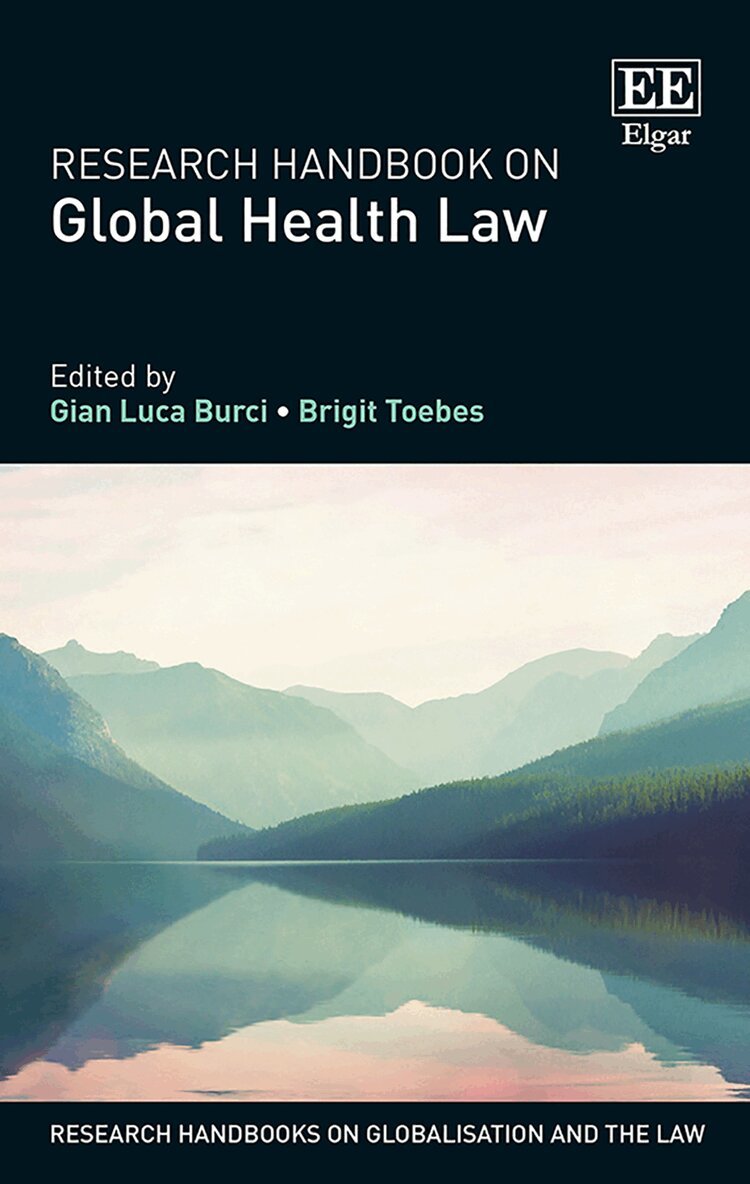
This timely Research Handbook provides a critical conceptualization and definition of the growing field of global health law. The Research Handbook forms the first comprehensive study on the treatment of health issues in international legal regimes and explores the role of international law in addressing the most prominent global health challenges.The editors have consciously adopted a holistic approach by including 'soft' norms and informal law-making processes in the Research Handbook's scope to give a realistic account of the normative framework that shapes contemporary global health. Despite following a predominantly legal perspective, the Research Handbook also adopts an interdisciplinary approach by looking at health from a governance perspective and using insights from international relations scholarship in forecasting possible future developments surrounding health law. The Research Handbook features contributions from a team of leading international legal scholars who have experience of approaching the issue of global health from multiple angles.International law scholars who are seeking information on the growing role of health in governance trends will find this Research Handbook to be of great interest. Public health scholars who are researching international legal perspectives on health practice and policy will also find it to be a valuable resource.Contributors include: F. Abbott, A. Bellal, C. Brassart Olsen, G.L. Burci, G. Call, A. Garde, C. Giorgetti, S. Gruskin, M. Hartley, J. Liberman, M.M. Mbengue, B. McGrady, S. Moon, T. Murphy, S. Negri, K. O'Cathaoir, X. Seuba, D. Tarantola, J. Tobin, B. Toebes, S. Waltman, S. Zhou
776 kr
Skickas inom 7-10 vardagar
This Handbook explores the main themes and topics of the emerging field of Global Administrative Law with contributions by leading scholars and experts from universities and organizations around the world. The variety of the subjects addressed and the internationality of the Handbook's perspectives make for a truly global and multi-dimensional view of the field.The book first examines the growth of global administrations, their interactions within global networks, the emergence of a global administrative process, and the development of the rule of law and democratic principles at a global level. It goes on to illustrate the relationship between global law and other legal orders, with particular attention to regional systems and national orders. The final section, devoted to the emergence of a global legal culture, brings the book full circle by identifying the growth of a global epistemic community.The Research Handbook on Global Administrative Law provides a contemporary overview of the nascent field in detailed yet accessible terms, making it a valuable book for university courses. Academics and scholars with an interest in international law, administrative law, public law, and comparative law will find value in this book, as well as legal professionals involved with international and supranational organizations and national civil servants dealing with supranational organizations.Contributors: S. Battini, E. Benvenisti, F. Bignami, F. Cafaggi, L. Casini, S. Cassese, E. Chiti, P. Craig, E. D'Alterio, P. Dann, E. Dunlop, R.F.U. Hernandez, R. Howse, M. Infantino, M. Macchia, M.R. Madsen, B. Marchetti, C. Möllers, E. Morlino, M. Savino, R.B. Stewart, A. Vauchez, G. Vesperini, S. Villalpando, J. Wouters
776 kr
Skickas inom 7-10 vardagar
Events such as the global financial crisis have helped reveal that the drivers and contours of governance on a national and international level remain a mystery in many respects. This is so despite the ever-increasing complexity and sophistication in the management and understanding of economic, legal and political spheres of global society. Set in this context, this timely Research Handbook is the first to explicitly address the constitutive relationship between law and political economy.With scholarly contributions from diverse disciplinary and geographic backgrounds, this authoritative book provides an expansive overview of the legal architecture of the global political economy. It covers, in three parts, topics surrounding money and markets, the relations of organization, and commodities, land and resources.Scholars and policymakers as well as undergraduate and postgraduate law students interested in the intersection of socio-political, economic, and legal dynamics of governance will find this book a thought-provoking and insightful resource.Contributors: A. Andreoni, G. Baars, S. Bailey, B. Bowring, T.A. Canova, D. Danielsen, J. Desautels-Stein, J. Ellis, A. Gupta, F. Guy, A. Hanieh, I. Isailovi , V. Kishore, R. Kreitner, T. Krever, P. Luff, T. Mahmud, B.N. Mamlyuk, M. McCluskey, R. Míguez, C. Mummé, A. Ng Boyte, Ö. Orhangazi, U. Özsu, A. Rasulov, L. Russi, C. Salom o Filho, P. Skott, J. Toporowski, R.A. Woodcock, L.R. Wray
3 171 kr
Skickas inom 7-10 vardagar
This essential Research Handbook provides a comprehensive and critical assessment of the global governance instruments related to business and human rights from an interdisciplinary perspective. Contributions from a diverse range of leading international scholars offer an overview of the existing literature and rapidly-evolving research discipline, as well as identifying key trends and outlining an ambitious future research agenda.The Research Handbook first examines governance initiatives that operate across economic sectors, discussing both public and private initiatives at state, regional and international levels that seek to develop, implement and enforce rules with regard to the impacts of transnational business activities on human rights. Chapters then investigate particular economic sectors – including textiles, electronics, agro-chemical, construction, and finance – to assess the ways in which different initiatives attempt to mitigate risks and address business-related human rights abuses.Scholars of law, regulatory governance, global governance, management, human rights and social sciences who are interested in gaining a deeper understanding of the emerging business and human rights regime will find this Research Handbook a crucial read. It will also prove a useful and thorough introduction for students, scholars and practitioners new to the field of business and human rights.
3 812 kr
Skickas inom 7-10 vardagar
This carefully curated Research Handbook provides a wide-ranging exploration of global governance, including its successes and failures. It challenges the promise that global institutions and frameworks offer solutions to major world challenges such as climate change, pandemics, war, democracy, human rights and inequalities.Adopting diverse theoretical and methodological approaches, the Research Handbook draws on a broad range of perspectives to interrogate the concepts of ‘global’ and ‘governance’, considering the ideologies reflected by these terms. Leading experts discuss the roles played by the state as well as local, regional and international organisations, addressing their accountability, transparency and governance legitimacy. Interdisciplinary in scope, the Research Handbook combines law with history, politics, sociology and international relations to challenge the conventional paradigms of global governance scholarship. It further illustrates the reshaping of transnational interactions and emphasises the need for local, indigenous and comparative viewpoints that are traditionally overlooked.The ,i>Research Handbook on Global Governance is a vital resource for scholars and students of public international law, international economic and environmental law, the laws of war and peace, and international relations and politics. It will also benefit academics in political geography and sub-altern studies, as well as policymakers and practitioners in law, regulation and governance.
3 812 kr
Skickas inom 7-10 vardagar
This cutting-edge Research Handbook examines how investment law and policy can foster or frustrate sustainable development goals and accords. Expert authors explore opportunities for environmental, social, and economic rules to shape international investment flows, advancing global sustainability and justice.Featuring contributions from leading professors and practitioners, the Research Handbook analyzes innovative legal procedures including sustainability impact assessment, examines new treaty provisions advancing Sustainable Development Goals (SDGs), and considers emerging practices in dispute resolution. Chapters evaluate evolving international investment rules in light of recent law and policy changes, outlining strategies for incentivizing more sustainable development. Ultimately, they argue that international law can and should guide investment decisions which affect human rights, environmental protection and poverty eradication.Presenting novel proposals, this Research Handbook is a crucial resource for scholars and practitioners in international investment law, environmental law, human rights law, and sustainable development law. Its insights will also benefit policy leaders in governments, tribunals and international organizations.
4 006 kr
Skickas inom 7-10 vardagar
This thoroughly revised Handbook presents an up-to-date political and philosophical history of global constitutionalism. By exploring the constitutional-like qualities of international affairs, it provides key insights into the evolving world order.Through a sustained examination of current events, as well as an acknowledgement of the significance of early constitutional history, this erudite Handbook brings together contributions from world-leading academics. New chapters offer timely commentaries on important developments in methodology such as postcolonial and feminist approaches. By providing additional scope for analysis, this updated edition further emphasises the central message of the first: that the global order cannot be understood without a clear comprehension of constitutional theory.The Handbook on Global Constitutionalism will act as an essential resource for scholars and academics of law, politics and human rights. Due to its comprehensive examination of vital concepts such as legal theory, it will additionally be beneficial for practitioners and policy makers.
3 812 kr
Skickas inom 7-10 vardagar
This thoroughly revised second edition examines the current state of literature in law and political economy, drawing on scholarship across a variety of subject areas, geographies and orientations.Capturing recent developments in the field, it expands upon the range of debates and themes explored by the previous edition to include growing cross-disciplinary and cross-jurisdictional perspectives. Throughout the many chapters included in this updated Research Handbook, contributing authors tackle questions of money and finance, commodities, labour, markets, property and larger questions of economic inequality and justice. The chapters capture contemporary debates on themes such as digital data and investment and unpack complex historical and theoretical shifts in the dynamics of institutional change.The Research Handbook on Law and Political Economy is an invaluable tool for students and academics with interests related to economics, law and politics. Its useful insights on varying worlds of struggle will also greatly benefit legal policymakers and practising lawyers.
2 678 kr
Skickas inom 7-10 vardagar
The fairness of institutions of global economic governance ranks among the most pressing issues of our time. Most approaches to understanding the complex structure of treaties and intergovernmental organizations such as the WTO tend to uncritically accept an economic focus, highlighting gains from trade and the merits of progressive trade and investment liberalization. While the economic arguments are compelling, other ways of thinking about the roles of these institutions have received less attention. The Research Handbook fills this gap by offering a substantial interdisciplinary examination of the normative and policy underpinnings of the international economic order.The book includes specially commissioned chapters based on theories of justice, human rights, and critical legal studies, as well as on economics and the internal structure of international economic law itself, all written by leading scholars in their respective fields. The contributors offer an interdisciplinary approach to understanding the relationship between international economic law and policy and the rights and welfare of peoples across the globe. The end result is an essential point of reference for developing a comprehensive toolkit for evaluating the institutions of global economic governance.Containing extensive and significant interdisciplinary coverage of key areas of research on international economic law and policy, this Research Handbook will appeal to political scientists, philosophers, legal scholars, economists and international relations theorists.Contributors: G. Brock, B.S. Chimni, L.V. Ciko, P. Clements, C.M. Correa, F.J. Garcia, B. He, C.L. Lim, J. Linarelli, S.M. Lundan, A. Maneschi, H. Murphy, E.-U. Petersmann