River Publishers Series in Electronic Materials and Devices - Böcker
Visar alla böcker i serien River Publishers Series in Electronic Materials and Devices. Handla med fri frakt och snabb leverans.
4 produkter
4 produkter
1 325 kr
Skickas inom 10-15 vardagar
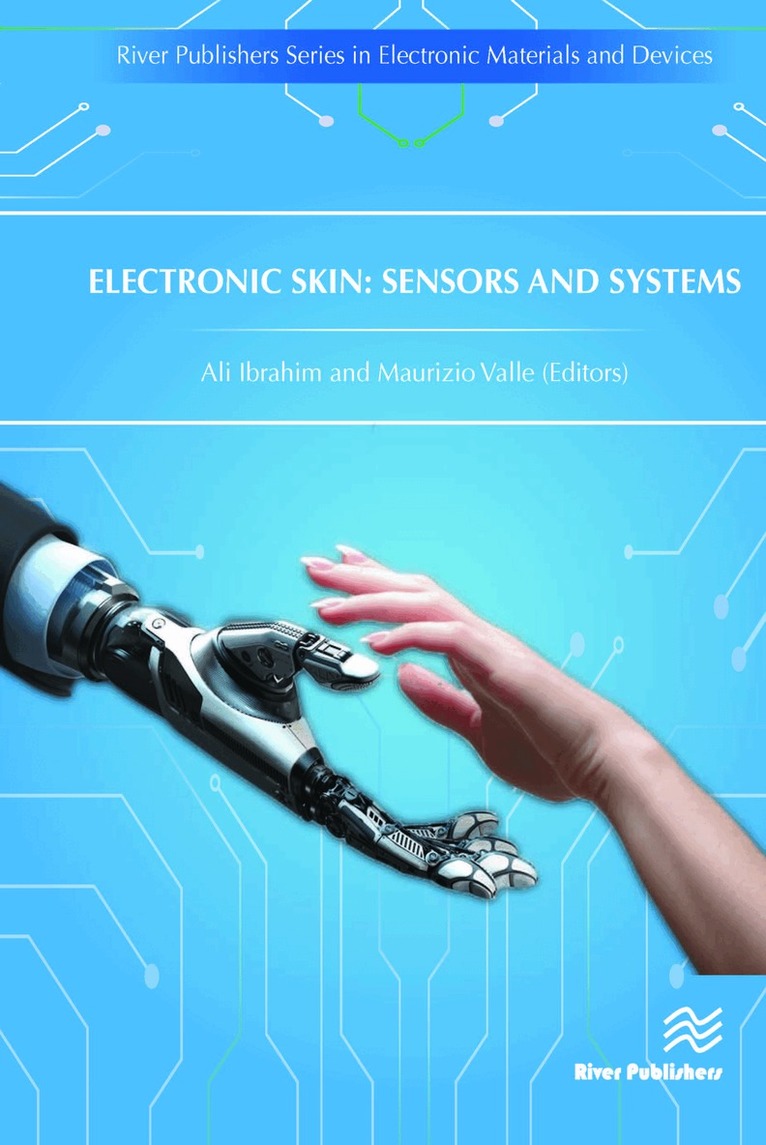
Considerable amount of effort has been devoted, over the recent years, towards the development of electronic skin (e-skin) for many application domains such as prosthetics, robotics, and industrial automation. Electronic Skin: Sensors and Systems focuses on the main components constituting the e-skin system. The e-skin system is based on: i) sensing materials composing the tactile sensor array, ii) the front end electronics for data acquisition and signal conditioning, iii) the embedded processing unit performing tactile data decoding, and iv) the communication interface in charge of transmitting the sensors data for further computing. Technical topics discussed in the book include: •Tactile sensing material; •Electronic Skin systems;•Embedded computing and tactile data decoding; •Communication systems for tactile data transmission; •Relevant applications of e-skin system; The book takes into account not only sensing materials but it also provides a thorough assessment of the current state of the art at system level. The book addresses embedded electronics and tactile data processing and decoding, techniques for low power embedded computing, and the communication interface. Electronic Skin: Sensors and Systems is ideal for researchers, Ph.D. students, academic staff and Masters/research students in sensors/sensing systems, embedded systems, data processing and decoding, and communication systems.
1 325 kr
Skickas inom 10-15 vardagar
Advances in Highly Correlated Systems explores the fundamentals, recent advances, and applications of the physics of highly correlated materials. This book serves as a handbook/reference for advanced graduate students.•Provides fascinating insights into the major developments and applications of strongly correlated materials.•Integrates various numerical/theoretical models, such as dynamic mean-field theory, Hubbard model, Ab-Initio Calculation etc.•Encompasses a useful experimental and theoretical basis for students, researchers, and scientists.
Understanding Communications Networks - for Emerging Cybernetic Applications
Inbunden, Engelska, 2021
1 325 kr
Skickas inom 10-15 vardagar
Information networking has emerged as a multidisciplinary diversified area of research over the past few decades. From traditional wired telephony to cellular voice telephony and from wired access to wireless access to the Internet, information networks have profoundly impacted our lifestyles as they have undergone enormous growth. To understand this technology, students need to learn several disciplines and develop an intuitive feeling of how they interact with one another. To achieve this goal, the book describes important networking standards, classifying their underlying technologies in a logical manner and gives detailed examples of successful applications. The emergence of wireless access and dominance of the Ethernet in LAN technologies has shifted the innovations in networking towards the physical layer and characteristics of the medium. This book pays attention to the physical layer while we provide fundamentals of information networking technologies which are used in wired and wireless networks designed for local and wide area operations. The book provides a comprehensive treatment of the wired IEEE802.3 Ethernet, and Internet as well as ITU cellular 2G-6G wireless networks, IEEE 802.11 for Wi-Fi, and IEEE 802.15 for Bluetooth, ZigBee and ultra-wideband (UWB) technologies. The novelty of the book is that it places emphasis on physical communications issues related to formation and transmission of packets and characteristics of the medium for transmission in variety of networks. Material presented in the book will be beneficial for students of Electrical and Computer Engineering, Computer Science, Robotics Engineering, Biomedical Engineering, or other disciplines who are interested in integration of navigation into their multi-disciplinary projects. The book provides examples with supporting MATLAB codes and hands-on projects throughout to improve the ability of the readers to understand and implement variety of algorithms.
Computational Electrodynamics
A Gauge Approach with Applications in Microelectronics
Inbunden, Engelska, 2017
1 189 kr
Skickas inom 10-15 vardagar
Computational Electrodynamics is a vast research field with a wide variety of tools. In physics the principle of gauge invariance plays a pivotal role as a guide towards a sensible formulation of the laws of nature as well as computing the properties of elementary particles using the lattice formulation of gauge theories, yet the gauge principle has played a much less pronounced role in performing computation in classical electrodynamics. In this work the author will demonstrate that starting from the gauge formulation of electrodynamics using the electromagnetic potentials leads to computational tools that can very well compete with the conventional electromagnetic field-based tools. Once accepting the formulation based on gauge fields, the computational code is very transparent due to the mimetic mapping of the electrodynamic variables on the computational grid. Although the illustrations and applications originate from microelectronic engineering, the method has a much larger range of applicability. Therefore this book is of interest to everyone having interest in computational electrodynamics. The volume is organized as follows: In part 1, a detailed introduction and overview is presented of the Maxwell equations as well as the derivation of the current and charge densities is different materials. Semiconductors are responding to electromagnetic fields in a non-linear way and the induced complications are discussed in detail. In part 2, the transition of the theory of electrodynamics, using the gauge potentials, to a formulation that can serve as the gateway to computational code is presented. In part 3, the feasibility and success of the methods of part 2 are demonstrated by a collection of microelectronic device designs. Part 4 focuses on a set of topical themes that brings the reader to the frontier of research in building the simulation tools using the gauge principle in computational electrodynamics. Technical topics discussed in the book include: Electromagnetic Field EquationsConstitutive RelationsDiscretization and Numerical AnalysisFinite Element and Finite Volume MethodsDesign of Integrated Passive Components