Routledge Library Editions: Idealism - Böcker
Visar alla böcker i serien Routledge Library Editions: Idealism. Handla med fri frakt och snabb leverans.
9 produkter
9 produkter
8 900 kr
Skickas inom 10-15 vardagar
Spanning the twentieth century, this 4-volume set contains titles originally published between 1935 and 1990. The volumes explore the concept of Idealism from its roots in the theories of Plato, discussing many other philosophers and their perspectives, as views have developed through the centuries, to more modern interpretations.
1 637 kr
Skickas inom 10-15 vardagar
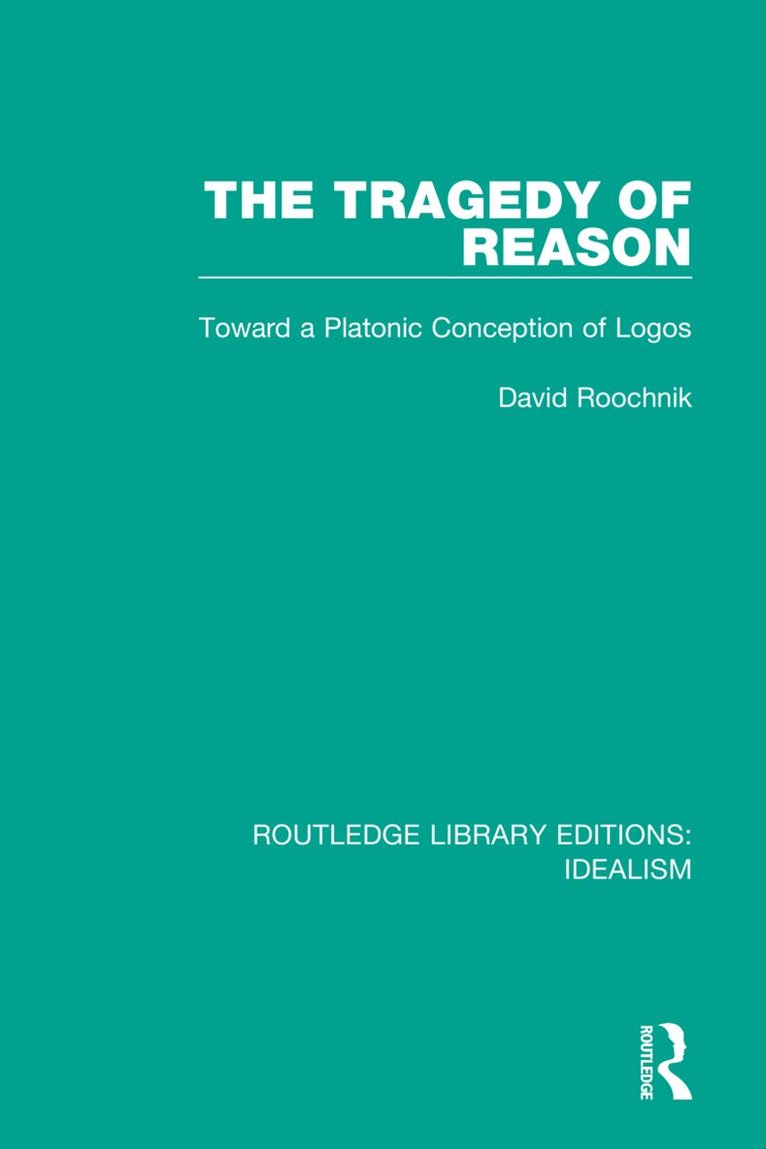
The classical conception of reason (or logos) has been repeatedly attacked in the modern era. Its enemies range from Descartes, who complains that logos is not sufficiently useful or precise, to Derrida who hopes to liberate Western thought from its bondage to "logocentrism."At least since the time of Nietzsche, Plato has been damned as the chief architect of the classical conception of logos. He is accused of overvaluing reason and thereby devaluing the other, more human aspects of life. As it was originally formulated in Nietzsche’s The Birth of Tragedy, Plato has been taken to be the arch-enemy of tragedy, which for Nietzsche was the most life-affirming of all the art forms of Greek culture.Originally published in 1990, The Tragedy of Reason defends Plato against his accusers. Employing a mode of exposition which exhibits Plato’s position, Roochnik presents the Platonic conception of logos in confrontation with texts by Homer, Hesiod, Heraclitus, Aristotle, Descartes, Porty, and Derrida. In clear language, unencumbered by technical terminology, Roochnik shows that Platonic conception of logos is keenly aware of the strength of its opponents. The result is a presentation of Plato as a "tragic philosopher" whose conception of logos is characterized by an affirmation of its own limits as well as its goodness.
442 kr
Skickas inom 10-15 vardagar
The classical conception of reason (or logos) has been repeatedly attacked in the modern era. Its enemies range from Descartes, who complains that logos is not sufficiently useful or precise, to Derrida who hopes to liberate Western thought from its bondage to "logocentrism."At least since the time of Nietzsche, Plato has been damned as the chief architect of the classical conception of logos. He is accused of overvaluing reason and thereby devaluing the other, more human aspects of life. As it was originally formulated in Nietzsche’s The Birth of Tragedy, Plato has been taken to be the arch-enemy of tragedy, which for Nietzsche was the most life-affirming of all the art forms of Greek culture.Originally published in 1990, The Tragedy of Reason defends Plato against his accusers. Employing a mode of exposition which exhibits Plato’s position, Roochnik presents the Platonic conception of logos in confrontation with texts by Homer, Hesiod, Heraclitus, Aristotle, Descartes, Porty, and Derrida. In clear language, unencumbered by technical terminology, Roochnik shows that Platonic conception of logos is keenly aware of the strength of its opponents. The result is a presentation of Plato as a "tragic philosopher" whose conception of logos is characterized by an affirmation of its own limits as well as its goodness.
2 113 kr
Skickas inom 10-15 vardagar
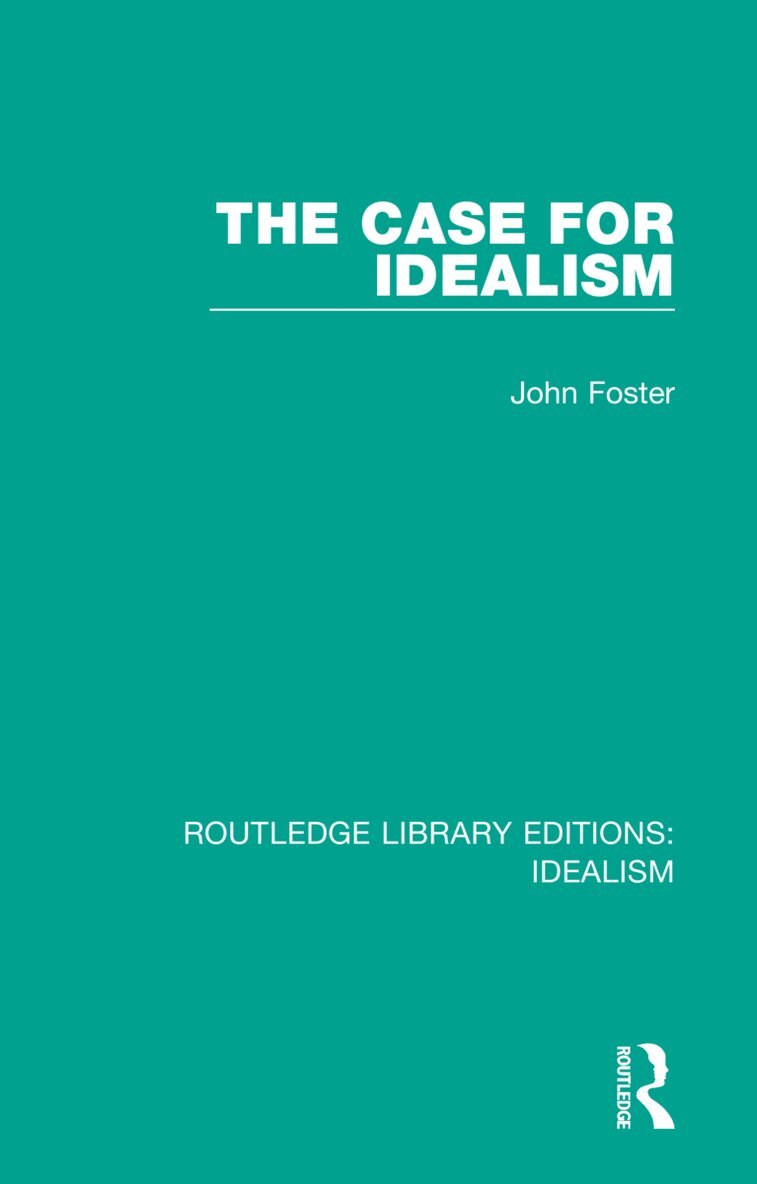
Originally published in 1982, the aim of this book is a controversial one – to refute, by the most rigorous philosophical methods, physical realism and to develop and defend in its place a version of phenomenalism. Physical realism here refers to the thesis that the physical world (or some selected portion of it) is an ingredient of ultimate reality, where ultimate reality is the totality of those entities and facts which are not logically sustained by anything else. Thus, in arguing against physical realism, the author sets out to establish that ultimate reality is wholly non-physical. The crucial elements in this argument are the topic-neutrality of physical description and the relationship between physical geometry and natural law. The version of phenomenalism advanced by John Foster develops out of this refutation of physical realism. Its central claim is that the physical world is the logical creation of the natural (non-logical) constraints on human sense-experience. This phenomenalist perspective assumes that there is some form of time in which human experience occurs but which is logically prior to the physical world, and Foster explores in detail the nature of this pre-physical time and its relation to time as a framework for physical events.This book was a major contribution to contemporary philosophical thinking at the time.
482 kr
Skickas inom 10-15 vardagar
Originally published in 1982, the aim of this book is a controversial one – to refute, by the most rigorous philosophical methods, physical realism and to develop and defend in its place a version of phenomenalism. Physical realism here refers to the thesis that the physical world (or some selected portion of it) is an ingredient of ultimate reality, where ultimate reality is the totality of those entities and facts which are not logically sustained by anything else. Thus, in arguing against physical realism, the author sets out to establish that ultimate reality is wholly non-physical. The crucial elements in this argument are the topic-neutrality of physical description and the relationship between physical geometry and natural law. The version of phenomenalism advanced by John Foster develops out of this refutation of physical realism. Its central claim is that the physical world is the logical creation of the natural (non-logical) constraints on human sense-experience. This phenomenalist perspective assumes that there is some form of time in which human experience occurs but which is logically prior to the physical world, and Foster explores in detail the nature of this pre-physical time and its relation to time as a framework for physical events.This book was a major contribution to contemporary philosophical thinking at the time.
1 909 kr
Skickas inom 10-15 vardagar
At the turn of the century Idealism was perhaps the leading school of philosophy in the English-speaking world. By the 1960s the situation was very different. There had occurred during the previous two generations what has been described as ‘a revolution in philosophy’, one consequence of which had been the almost total eclipse of Idealism. Originally published in 1962, this book is a critical study of certain aspects of the work of four Idealist philosophers: F. H. Bradley, T. H. Green, Bernard Bosanquet and Josiah Royce. It deals mainly with their social philosophy, but some consideration is also given to their metaphysics. It is the thesis of this book that there is a valid and significant form of Idealism to be found in the work of these philosophers, but that they did not succeed in developing it fully and consistently.
482 kr
Skickas inom 10-15 vardagar
At the turn of the century Idealism was perhaps the leading school of philosophy in the English-speaking world. By the 1960s the situation was very different. There had occurred during the previous two generations what has been described as ‘a revolution in philosophy’, one consequence of which had been the almost total eclipse of Idealism. Originally published in 1962, this book is a critical study of certain aspects of the work of four Idealist philosophers: F. H. Bradley, T. H. Green, Bernard Bosanquet and Josiah Royce. It deals mainly with their social philosophy, but some consideration is also given to their metaphysics. It is the thesis of this book that there is a valid and significant form of Idealism to be found in the work of these philosophers, but that they did not succeed in developing it fully and consistently.
1 909 kr
Skickas inom 10-15 vardagar
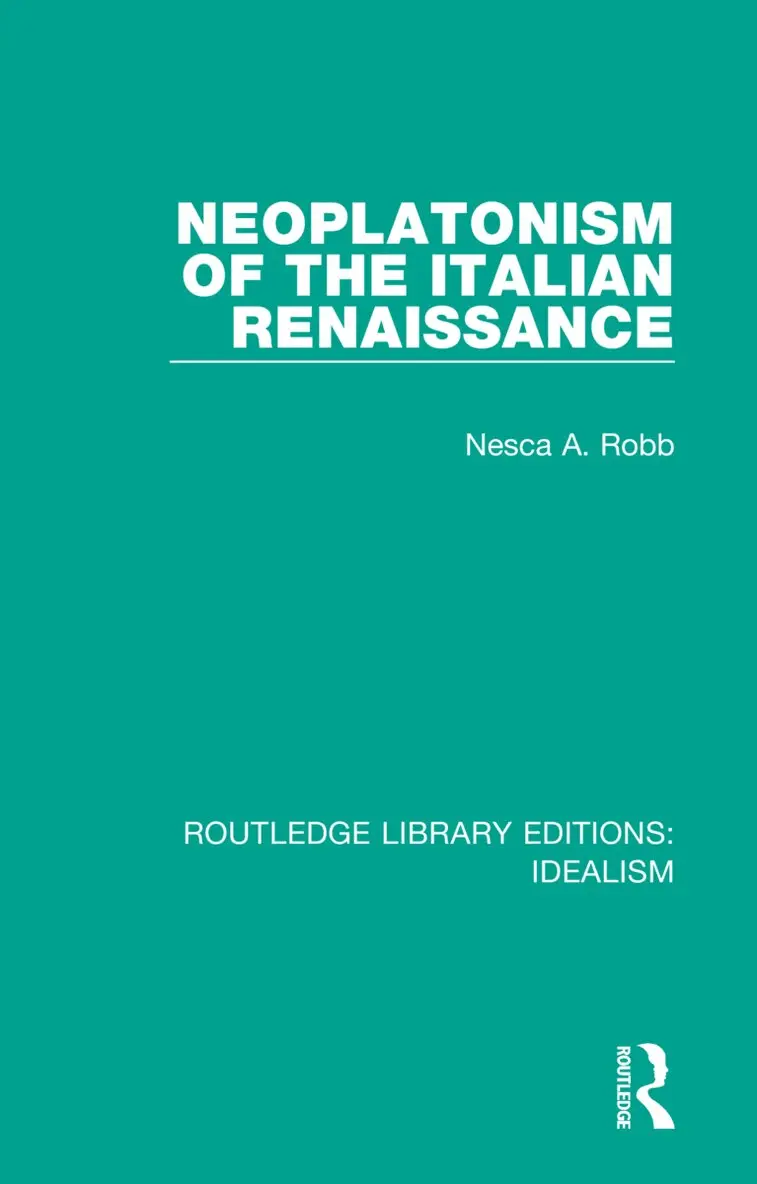
Originally published in 1935, the aim of this title is first to give a clear outline of Florentine Neoplatonism, and then to consider its influence on art and literature during a period that extends roughly from the age of Lorenzo de’ Medici to the middle of the sixteenth century and the beginnings of the Counter-Reformation. No rigid divisions of time have been fixed, but with few exceptions the works discussed may be placed between these bounds.Even within these limits it would require a work of greater dimensions that the present to exhaust so large a subject in all its bearings. The leaven of Neoplatonism had penetrated the thought of the age in many directions; this study is confined to such of its manifestations as were, in a somewhat narrow sense, artistic and literary and to the use and abuse of philosophical ideas for aesthetic purposes.
482 kr
Skickas inom 10-15 vardagar
Originally published in 1935, the aim of this title is first to give a clear outline of Florentine Neoplatonism, and then to consider its influence on art and literature during a period that extends roughly from the age of Lorenzo de’ Medici to the middle of the sixteenth century and the beginnings of the Counter-Reformation. No rigid divisions of time have been fixed, but with few exceptions the works discussed may be placed between these bounds.Even within these limits it would require a work of greater dimensions that the present to exhaust so large a subject in all its bearings. The leaven of Neoplatonism had penetrated the thought of the age in many directions; this study is confined to such of its manifestations as were, in a somewhat narrow sense, artistic and literary and to the use and abuse of philosophical ideas for aesthetic purposes.