Securities Institute Operations Management - Böcker
Visar alla böcker i serien Securities Institute Operations Management. Handla med fri frakt och snabb leverans.
6 produkter
6 produkter
736 kr
Skickas inom 7-10 vardagar
An analysis of the major securities, derivatives and money markets from an operations point of view, 'Understanding the Markets' takes the reader through the major features and characteristics of the markets and the products. The relationship between the trading and dealing functions and the operations functions is examined and the issues discussed.This book looks at the financial markets from the viewpoint of the person working in the operations functions that support the trading, dealing and investment processes, and as such is essential reading in order to fully understand the industry - an industry which has gone, and is still going through, much change.As the markets undergo change so too do the administration, clearing and settlement functions, as the clearing houses, securities depositories and custodians merge and diversify. This is going to impact on the operations teams that support the trading, sales and retail business. A failure to be aware of and to understand the impact of changes in the markets will create massive problems, greater risk and ultimately financial losses. And yet the sheer size and diversity of the global markets, together with the rapid pace of change and expansion, and the increasing volume of transactions needing to be processed, presents a massive challenge to operations teams and managers. Knowing how the markets work and what impacts on the operations team is crucial for managers and supervisors. In this book the author provides a full explanation of the markets and their impact in operations terms. So if you are about to embark on a career in operations 'Understanding the Markets' is essential reading. Alternatively, if you are planning a career as a dealer it will prove very useful in explaining the process that occurs after you have traded.The definitive series of professional references for those finance professionals concerned with "Back office" or operations management unique to this industry.Presents concise references on the essential management functions such as technology, client services, and risk management for financial operations management professionals.A comprehensive resource from a leading financial management consultant for global banks and institutions.
648 kr
Skickas inom 7-10 vardagar
"Clearing, Settlement and Custody" focuses on the clearing, settlement and custody functions by analyzing how they work and the interaction between the organizations involved. The author examines the roles of clearing houses, central counterparties, central securities depositories and the custodians, as well as, assessing the impact on the workflow and procedures in the operations function at banks, brokers and institutions. The changes that are taking place in the industry are explored and the impact for operations managers and supervisors assessed. Clearing, settlement and custody is at the heart of everything that happens in the financial markets. The evolution of clearing and settlement is one that is still happening and as such, it is impacting on the operations function through both new practices but also, increasingly, in terms of regulation, risk and reputation. In essence the efficient clearing and settlement operation is managing risk, not because it is a direct part of the process but more because it is a bi-product. The routine procedures relate to reconciliation and record keeping.If these are performed efficiently and accurately it will result in accurate records of activity and profit and loss. The settlement process is a key element in identifying and correcting errors made by dealers and traders. Failure to identify the error or act promptly will result in potentially serious financial loss, as well as worrying audit and the regulators. In addition to these concerns the financial service sector is also undergoing a massive rationalization of the structure of clearing and settlement and seeking the twin goals of automation and shortening settlement cycles. The challenge for operations managers is considerable: manage costs, eradicate inefficiencies, create an environment to be competitive, and implement the procedures to meet future changes that will occur. In this book the author looks at some of the different roles, the processes and procedures, and the key issues, in order to help those in operations meet the challenge. The definitive series of professional references for those finance professionals concerned with 'Back office' or operations management unique to this industry.It presents concise references on the essential management functions such as technology, client services, and risk management for financial operations management professionals. It is a comprehensive resource from a leading financial management consultant for global banks and institutions.
736 kr
Skickas inom 7-10 vardagar
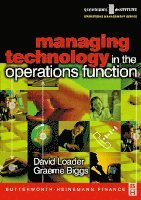
'Managing Technology in The Operations Function' looks at issues in technology from the operations function rather than from an IT perspective. It explores the use of technology for processing, provision of client services, risk management and business management. The authors analyse the benefits of straight through processing and the practical implications of managing technology products in operations. System risk and opportunities are explored and case studies are examined along with industry trends to assess upcoming developments and their impacts.The use of technology is one of the key drivers of growth in the volumes of business in the financial markets today. The impact that technology has had, and is still having in the operations function is truly substantial. Technology now reaches into just about every aspect of the business. Electronic trading, messaging systems, and information distribution have created a global market that is, relatively speaking, instantly accessible and available. For operations this manifests itself in two ways: the automation of processes and the automation of information gathering and distribution. For operations managers this period of change has elevated the function from a pure support service into a dynamic revenue protector/generator, with a heavy client service and risk management focus. The reliance on technology to drive this progression forward and to meet the challenge is therefore of crucial consideration for the operations manager.The challenge for the operations teams and managers is to embrace technology and maximize the use of this vital and powerful tool within the business. A failure to do so will inevitably have a negative impact on the operations function and ultimately damage the whole business.The definitive series of professional references for those finance professionals concerned with "Back office" or operations management unique to this industry. Presents concise references on the essential management functions such as technology, client services, and risk management for financial operations management professionals.A comprehensive resource from a leading financial management consultant for global banks and institutions. DMS has also developed a wide range of financial management courses, materials and programs over the last seven years.
736 kr
Skickas inom 7-10 vardagar
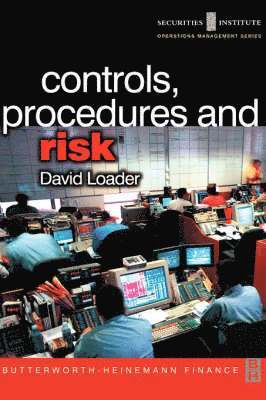
'Controls, Procedures and Risk' covers the skills and procedures needed to enable the monitoring and managing of risk and the authors focus on procedures design, implementation and documentation. Considerable emphasis is also given to the key controls and the importance of control functions, audit and risk management groups and policy. Case studies are used to effectively demonstrate 'success' and 'failure'. In the financial services industry risk is a constant threat to organizations of all sizes and to the markets themselves. Many industry 'events' have shown how dangerous it is when a business operates in an uncontrolled way, particularly when the lack of control was not evident to the management of the business until it was too late.Controls, procedures and risk are occupying more and more management time. The responsibility to manage the risks lies with the whole operations team. If it is successful in fulfilling this role the overall risk of the business is reduced, if it is not successful the consequences may be severe.In this book the author has deliberately focussed on the practical side of risk, controls and procedures, rather than analyse the Basel Capital Accord and the capital requirements etc.(however, the Accord and updates are contained in the Appendices). Operations teams need to be aware of risk but not overwhelmed by it. Risk management within, and by, the operations function is the focus of this book. From day-to-day risk to wider risk implications the operations function is reviewed to show the sources and implications of risk situations.
686 kr
Skickas inom 7-10 vardagar
'Regulation and Compliance in Operations' looks at how regulation affects the operations function by focusing on regulatory issues and drivers. As regulatory demands ever increasing, it is important for operations teams to be aware of the important regulatory issues which exist globally. Like any other part of an organization in the financial services industry, operations has rules and regulations to comply with. Although many view regulation as being about rooting out rogue traders and controlling speculators, its role is much more profound than this, and without it many more 'scandals' would undoubtedly occur. The problem for the regulator is that unless total oversight of every transaction, account, business and individual can be made, there will always be rogue traders or more recent examples like Enron and World.Com. As such intense oversight is not practical, the regulator can only do so much, with most of the responsibility resting with the firms and organizations themselves.For operations teams their role in protecting the firm stems from their ability to manage critical processes like reconciliation, asset position agreements and the nostro accounts efficiently and effectively. Regulators need the help and support of the businesses to have a 'business-friendly environment'. When some abuse the trust placed in them and the regulatory environment, a 'scandal' or worse occurs, with the result that the majority are penalized as regulators react to criticism and apply more onerous regulations.It is often the operations teams that bear most, or at least some, of the repercussions of greater regulatory oversight of the business. It is therefore vitally important for operations teams to have a firm understanding of the regulatory issues and drivers. This book will help you gain that understanding, as well as looking at the important regulatory issues in the various global markets in which your business operates.
648 kr
Skickas inom 7-10 vardagar
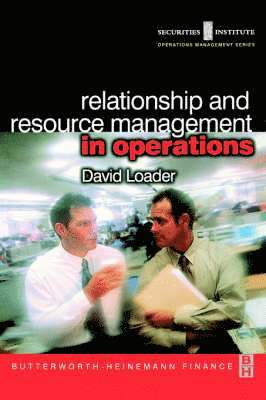
'Relationship and Resource Management in Operations' explains in practical terms the importance of the business relationships with internal and external counterparts while demonstrating how things can go wrong and what causes the situation. The authors examine the need to instil cultures in the team focusing on client service, risk and cost effectiveness. The text covers, via practical examples, the kind of scenario managers or supervisors might face in their role and shows what decisions could and should be made. The operations function in a financial organization is crucial to the success of the business. It drives both profitability and reputation as well as contributing to business development and support. It is also a complex part of a business and one that is treated differently in different types of organizations. The complexity of operations and the diverseness of the teams and the people they interact with create a need for a high degree of relationship and resource management. For instance a bank that is involved in both retail and investment banking will have hundreds of different relationship situations, but so too will a small private client broker. Some situations may be common to all types of organizations; others common to particular types of organizations and a few will be very specific to an organization. These relationships may be very open or highly discreet and confidential. Whatever the type of relationship, whether problematic or successful, it is likely that any problems will have an impact of the business. For operations managers their role is a key one. Charged with managing resources and the numerous relationship issues, it is neither a simple task nor, because of the variety and frequency of the issues that might arise, one that is easy to find solutions for. This book, however, explores some of the situations that managers might find themselves in and puts forward some solutions. Relationships and resources are the energy source that makes operations work and managed well they will provide the means to grow and to attain success. The central aim of this book is to provide knowledge and guidance on this important and key area of operations management. Successful operations teams are built on talented resource and effective management - let this book be your guide.