Software Engineering - Böcker
Visar alla böcker i serien Software Engineering. Handla med fri frakt och snabb leverans.
2 produkter
2 produkter
1 292 kr
Skickas inom 10-15 vardagar
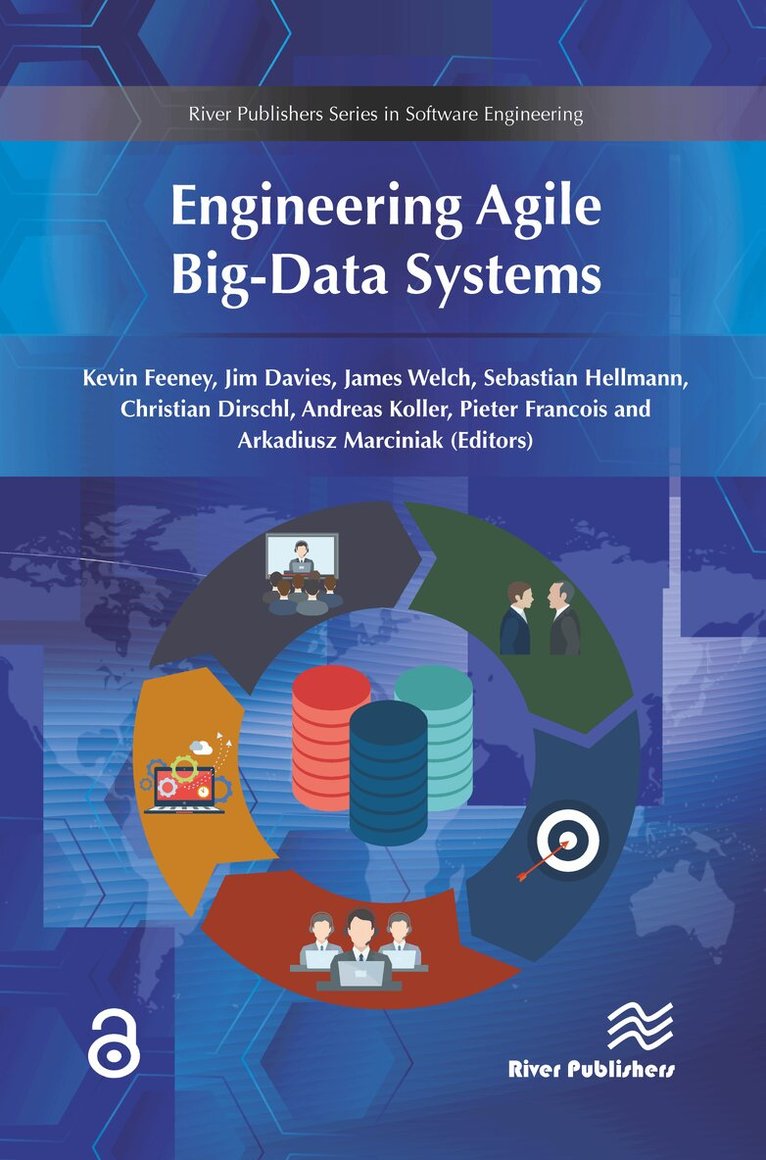
To be effective, data-intensive systems require extensive ongoing customisation to reflect changing user requirements, organisational policies, and the structure and interpretation of the data they hold. Manual customisation is expensive, time-consuming, and error-prone. In large complex systems, the value of the data can be such that exhaustive testing is necessary before any new feature can be added to the existing design. In most cases, the precise details of requirements, policies and data will change during the lifetime of the system, forcing a choice between expensive modification and continued operation with an inefficient design.Engineering Agile Big-Data Systems outlines an approach to dealing with these problems in software and data engineering, describing a methodology for aligning these processes throughout product lifecycles. It discusses tools which can be used to achieve these goals, and, in a number of case studies, shows how the tools and methodology have been used to improve a variety of academic and business systems.
Foundations of Probabilistic Logic Programming
Languages, Semantics, Inference and Learning
Inbunden, Engelska, 2018
1 292 kr
Skickas inom 10-15 vardagar
Probabilistic Logic Programming extends Logic Programming by enabling the representation of uncertain information by means of probability theory. Probabilistic Logic Programming is at the intersection of two wider research fields: the integration of logic and probability and Probabilistic Programming.Logic enables the representation of complex relations among entities while probability theory is useful for model uncertainty over attributes and relations. Combining the two is a very active field of study.Probabilistic Programming extends programming languages with probabilistic primitives that can be used to write complex probabilistic models. Algorithms for the inference and learning tasks are then provided automatically by the system.Probabilistic Logic programming is at the same time a logic language, with its knowledge representation capabilities, and a Turing complete language, with its computation capabilities, thus providing the best of both worlds.Since its birth, the field of Probabilistic Logic Programming has seen a steady increase of activity, with many proposals for languages and algorithms for inference and learning. Foundations of Probabilistic Logic Programming aims at providing an overview of the field with a special emphasis on languages under the Distribution Semantics, one of the most influential approaches. The book presents the main ideas for semantics, inference, and learning and highlights connections between the methods.Many examples of the book include a link to a page of the web application http://cplint.eu where the code can be run online.