Studies in Peace and Security – serie
Visar alla böcker i serien Studies in Peace and Security. Handla med fri frakt och snabb leverans.
3 produkter
3 produkter
Inbunden, Engelska, 2022
1 191 kr
Skickas inom 10-15 vardagar
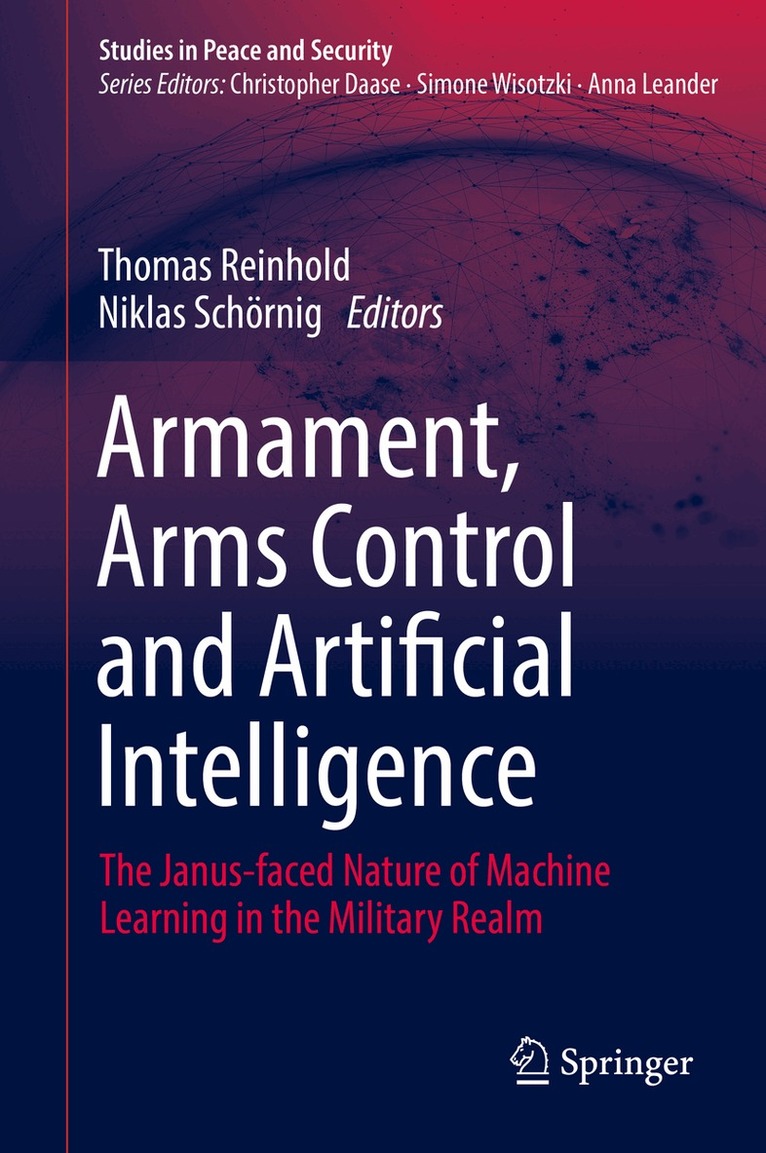
Looking at a variety of armament sectors, the book examines how Artificial Intelligence (AI) impacts the fields of armament and arms control, how existing arms control measures will be affected by AI, and what new approaches based on AI have been or are currently developed. The significant increase in computing power, the increasing reliance on software, and the advent of (narrow) AI and deep-learning algorithms all have the potential to lead to disruptive changes for military operations and warfare, rendering many classical arms control instruments less effective, or even useless. On the other hand, AI might lead to completely new arms control approaches, raising the effectiveness and reliability of new verification measures. To provide a common understanding, the book starts by presenting a general introduction to the state of the art in artificial intelligence and arms control, and how the two topics are interrelated. The second part of the book looks at examples from various fields of weapon technology, including weapons of mass destruction (WMD), conventional armament, and emerging technologies. The final section offers a cross-cutting perspective based on the examples presented in the second part.This volume will appeal to students and scholars of international relations, as well as policy-makers and practitioners interested in a better understanding of peace and security studies in general, and armament and arms control in particular with a strong focus on AI.
Häftad, Engelska, 2023
1 191 kr
Skickas inom 10-15 vardagar
Looking at a variety of armament sectors, the book examines how Artificial Intelligence (AI) impacts the fields of armament and arms control, how existing arms control measures will be affected by AI, and what new approaches based on AI have been or are currently developed. The significant increase in computing power, the increasing reliance on software, and the advent of (narrow) AI and deep-learning algorithms all have the potential to lead to disruptive changes for military operations and warfare, rendering many classical arms control instruments less effective, or even useless. On the other hand, AI might lead to completely new arms control approaches, raising the effectiveness and reliability of new verification measures. To provide a common understanding, the book starts by presenting a general introduction to the state of the art in artificial intelligence and arms control, and how the two topics are interrelated. The second part of the book looks at examples from various fields of weapon technology, including weapons of mass destruction (WMD), conventional armament, and emerging technologies. The final section offers a cross-cutting perspective based on the examples presented in the second part.This volume will appeal to students and scholars of international relations, as well as policy-makers and practitioners interested in a better understanding of peace and security studies in general, and armament and arms control in particular with a strong focus on AI.
Inbunden, Engelska, 2026
1 406 kr
Skickas inom 10-15 vardagar
This book explores how enduring meta-narratives shape international security policies, disarmament efforts, and arms control practices. Zooming-in on dominant political myths, this book critically examines their role in legitimizing and sustaining global weapon governance by influencing both national and international approaches to disarmament.Through a multidisciplinary lens that combines international relations, security studies, political sociology, and political theory, the author provides a nuanced analysis of the symbolic and cultural underpinnings of warfare in contemporary global politics. Drawing on interpretive-qualitative research methodology, this book reveals how narrative structures not only justify and foster militarization but also shape the institutional frameworks that govern weapons and conflict prevention.This timely contribution challenges dominant narratives and representations of war in disarmament and arms control, urging scholars, policymakers, and civil society actors to reimagine global security beyond entrenched mythologies. It offers a compelling perspective for those working in international security, peace and conflict studies, disarmament, cultural politics, and global governance.Ideal for academic researchers, graduate students, and professionals engaged in international security policy and disarmament advocacy, this book delivers both theoretical insight and practical relevance. It encourages a deeper understanding of how storytelling, belief systems, and political heuristics and imaginations continue to influence the pursuit of peace in an increasingly militarized world.