The Albert Schweitzer Library - Böcker
Visar alla böcker i serien The Albert Schweitzer Library. Handla med fri frakt och snabb leverans.
3 produkter
3 produkter
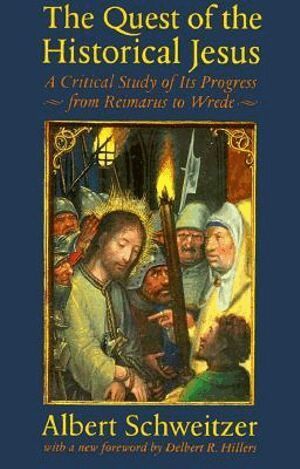
Quest of the Historical Jesus
A Critical Study of Its Progress from Reimarus to Wrede
Häftad, Engelska, 1998
410 kr
Skickas inom 5-8 vardagar
In the last decades of the eighteenth century, old arguments about what constituted true Christianity resumed with the newly refined tools and methods of linguistics, history, and comparative literature. The most sensitive questions sought to probe through the centuries and discover the original Jesus. Why, scholars asked, is the New Testament silent about most of Jesus's life? Why didn't Paul say more about the life of Jesus? To what extent was Jesus Jewish? How significant were the differences among the Gospels? What evidence could be trusted and what views justified? As scholars sought to discover and describe what they thought the "true"Jesus might be, they proved that Jesus could be many things. In this broad survey of the efforts to establish, amend, or deny the historical Jesus, Albert Schweitzer presents the history of a debate about what mattered most to millions of people: If God had entered human history, what could history tell about it? Throughout the course of this heated and prolonged dispute, one retelling of the life of Jesus followed another, enjoying -- in Schweitzer's phrase -- "the immortality of revised editions".Lesser writers might consider differences of opinion as signs of a hopeless enterprise, but Schweitzer instead finds immense value in the differences. Approaches and conclusions may differ, he concludes, but the quest for the historical Jesus has provided ample testimony to the importance of the effort and the rewards of the experience.
410 kr
Skickas inom 5-8 vardagar
"There, in this sorry world of ours, goes a great man."-Albert Einstein, on Albert Schweitzer In July of 1913, thirty-eight-year-old medical doctor Albert Schweitzer gave up his position as a respected professor at the University of Strasbourg and celebrated authority on music and philosophy in order to go as a physician to French Equatorial Africa (present-day Gabon). The Primeval Forest is Schweitzer's own fascinating story of these eventful years--a thrilling tale of his amazingly successful attempt to practice modern medicine and surgery in the face of wild elephant raids, marauding leopards, famine, an flood-a story rich in human interest and high drama. Schweitzer describes how he and his wife, a qualified nurse, worked to establish a hospital in the steaming jungle at Lambarene. At first they treated patients in the open air, amid unbelievably primitive conditions-with few drugs, medicines, or adequate instruments. But they worked tirelessly, caring for as many as forty cases a day, battling the misery caused by sleeping sickness, leprosy, pestilence, and plague.And, as the years went on, they gradually built a more permanent hospital to alleviate the terrible suffering of the Congo people. "Here, in Dr. Schweitzer's own words, is the inspiring and unforgettable account of his years in Africa; his thrilling jungle adventures, and his amazing experiences in bringing modern medicine and surgery to the French Congo. The record of Schweitzer's day-by-day experience is told so vividly that a responsive reader cannot fail to relive these stirring events."-Richmond Times-Dispatch
363 kr
Skickas inom 7-10 vardagar
Immediately after the Gospels, the New Testament takes up the history of the early Christian Church, describing the works of the twelve disciples, and introducing Paul, the man whose influence on the history of Christianity is beyond calculation. Teacher, preacher, conciliator, diplomat, theologian, rule giver, consoler, and martyr, his life and writings became foundations for Christianity. Paul inspired a vast, serious, and intelligent literature that seeks to recapture his meaning, his thinking, and his purpose. In his letters to early Christian communities, Paul gave much practical advice about organization and orthodoxy. These treated the early Christian communities as something more than a group of people who believed in the same faith: they were people bound together by a common spirit unknown before. The significance of that common spirit occupied the greatest of Christian theologians from Athanasius and Augustine through Luther and Calvin.In The Mysticism of Paul the Apostle Albert Schweitzer goes against Luther and the Protestant tradition to look at what Paul actually writes in the Epistles to the Romans and Galatians: an emphasis upon the personal experience of the believer with the divine. Paul's mysticism was not like the mysticism elsewhere described as a soul being at one with God. In the mysticism he felt and encouraged, there is no loss of self but an enriching of it; no erasure of time or place but a comprehension of how time and place fit within the eternal. Schweitzer writes that Paul's mysticism is especially profound, liberating, and precise. Typical of Schweitzer, he introduces readers to his point of view at once, then describes in detail how he came to it, its scholarly antecedents, what its implications are, what objections have been raised, and why all of this matters. To students of the New Testament, this book opens up Paul by presenting him as offering an entirely new kind of mysticism, necessarily and exclusively Christian. "There is at least one other point that Albert Schweitzer scores here...The hard-won recognition that divine authority and human freedom ultimately cannot be in conflict must never be taken for granted, and the irony that the thought of Paul has repeatedly been invoked to undo that recognition truly does make this insight one of 'the permanent elements.'"-from the Introduction