The Morgan Kaufmann Series in Artificial Intelligence - Böcker
1 037 kr
Skickas inom 7-10 vardagar
1 138 kr
Skickas inom 7-10 vardagar
Traditional methods for creating intelligent computational systems haveprivileged private "internal" cognitive and computational processes. Incontrast, Swarm Intelligence argues that humanintelligence derives from the interactions of individuals in a social worldand further, that this model of intelligence can be effectively applied toartificially intelligent systems. The authors first present the foundations ofthis new approach through an extensive review of the critical literature insocial psychology, cognitive science, and evolutionary computation. Theythen show in detail how these theories and models apply to a newcomputational intelligence methodology-particle swarms-which focuseson adaptation as the key behavior of intelligent systems. Drilling downstill further, the authors describe the practical benefits of applying particleswarm optimization to a range of engineering problems. Developed bythe authors, this algorithm is an extension of cellular automata andprovides a powerful optimization, learning, and problem solving method.
This important book presents valuable new insights by exploring theboundaries shared by cognitive science, social psychology, artificial life,artificial intelligence, and evolutionary computation and by applying theseinsights to the solving of difficult engineering problems. Researchers andgraduate students in any of these disciplines will find the materialintriguing, provocative, and revealing as will the curious and savvycomputing professional.
Places particle swarms within the larger context of intelligent adaptive behavior and evolutionary computationDescribes recent results of experiments with the particle swarm optimization (PSO) algorithmIncludes a basic overview of statistics to ensure readers can properly analyze the results of their own experiments using the algorithmSupport software which can be downloaded from the publishers website, includes a Java PSO applet, C and Visual Basic source code1 037 kr
Skickas inom 7-10 vardagar
An essential capacity of intelligence is the ability to learn. An artificially intelligent system that could learn would not have to be programmed for every eventuality; it could adapt to its changing environment and conditions just as biological systems do. Illustrating Evolutionary Computation with Mathematica introduces evolutionary computation to the technically savvy reader who wishes to explore this fascinating and increasingly important field. Unique among books on evolutionary computation, the book also explores the application of evolution to developmental processes in nature, such as the growth processes in cells and plants. If you are a newcomer to the evolutionary computation field, an engineer, a programmer, or even a biologist wanting to learn how to model the evolution and coevolution of plants, this book will provide you with a visually rich and engaging account of this complex subject.* Introduces the major mechanisms of biological evolution.* Demonstrates many fascinating aspects of evolution in nature with simple, yet illustrative examples.* Explains each of the major branches of evolutionary computation: genetic algorithms, genetic programming, evolutionary programming, and evolution strategies.* Demonstrates the programming of computers by evolutionary principles using Evolvica, a genetic programming system designed by the author.* Shows in detail how to evolve developmental programs modeled by cellular automata and Lindenmayer systems.* Provides Mathematica notebooks on the Web that include all the programs in the book and supporting animations, movies, and graphics.
248 kr
Skickas inom 7-10 vardagar
Blondie24 tells the story of a computer that taught itself to play checkers far better than its creators ever could by using a program that emulated the basic principles of Darwinian evolution--random variation and natural selection-- to discover on its own how to excel at the game. Unlike Deep Blue, the celebrated chess machine that beat Garry Kasparov, the former world champion chess player, this evolutionary program didn't have access to strategies employed by human grand masters, or to databases of moves for the endgame moves, or to other human expertise about the game of chekers. With only the most rudimentary information programmed into its "brain," Blondie24 (the program's Internet username) created its own means of evaluating the complex, changing patterns of pieces that make up a checkers game by evolving artificial neural networks---mathematical models that loosely describe how a brain works.It's fitting that Blondie24 should appear in 2001, the year when we remember Arthur C. Clarke's prediction that one day we would succeed in creating a thinking machine. In this compelling narrative, David Fogel, author and co-creator of Blondie24, describes in convincing detail how evolutionary computation may help to bring us closer to Clarke's vision of HAL. Along the way, he gives readers an inside look into the fascinating history of AI and poses provocative questions about its future.
Brings one of the most exciting areas of AI research to life by following the story of Blondie24's development in the lab through her evolution into an expert-rated checkers player, based on her impressive success in Internet competition. Explains the foundations of evolutionary computation, simply and clearly. Presents complex material in an engaging style for readers with no background in computer science or artificial intelligence. Examines foundational issues surrounding the creation of a thinking machine. Debates whether the famous Turing Test really tests for intelligence. Challenges deeply entrenched myths about the successes and implication of some well-known AI experiments. Shows Blondie's moves with checkerboard diagrams that readers can easily follow.885 kr
Skickas inom 7-10 vardagar
This book offers a definitive resource to bridge the computer science and biology communities. Gary Fogel and David Corne, well-known representatives of these fields, introduce biology and bioinformatics to computer scientists, and evolutionary computation to biologists and computer scientists unfamiliar with these techniques. The fourteen chapters that follow are written by leading computer scientists and biologists who examine successful applications of evolutionary computation to various problems in the biological sciences.* Describes applications of EC to bioinformatics in a wide variety of areas including DNA sequencing, protein folding, gene and protein classification, drug targeting, drug design, data mining of biological databases, and biodata visualization.* Offers industrial and academic researchers in computer science, biology, and bioinformatics an important resource for applying evolutionary computation.* Includes a detailed appendix of biological data resources.
889 kr
Skickas inom 7-10 vardagar
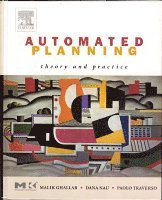
Automated planning technology now plays a significant role in a variety of demanding applications, ranging from controlling space vehicles and robots to playing the game of bridge. These real-world applications create new opportunities for synergy between theory and practice: observing what works well in practice leads to better theories of planning, and better theories lead to better performance of practical applications.
Automated Planning mirrors this dialogue by offering a comprehensive, up-to-date resource on both the theory and practice of automated planning. The book goes well beyond classical planning, to include temporal planning, resource scheduling, planning under uncertainty, and modern techniques for plan generation, such as task decomposition, propositional satisfiability, constraint satisfaction, and model checking.
The authors combine over 30 years experience in planning research and development to offer an invaluable text to researchers, professionals, and graduate students.
Provides a thorough understanding of AI planning theory and practice, and how they relate to each other Covers all the contemporary topics of planning, as well as important practical applications of planning, such as model checking and game playing Presents case studies and applications in planning engineering, space, robotics, CAD/CAM, process control, emergency operations, and games Provides lecture notes, examples of programming assignments, pointers to downloadable planning systems and related information online863 kr
Skickas inom 7-10 vardagar
775 kr
Skickas inom 7-10 vardagar
949 kr
Skickas inom 7-10 vardagar