The Morgan Kaufmann Series on Business Intelligence - Böcker
635 kr
Skickas inom 7-10 vardagar
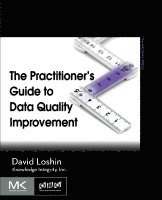
The Practitioner's Guide to Data Quality Improvement offers a comprehensive look at data quality for business and IT, encompassing people, process, and technology. It shares the fundamentals for understanding the impacts of poor data quality, and guides practitioners and managers alike in socializing, gaining sponsorship for, planning, and establishing a data quality program.
It demonstrates how to institute and run a data quality program, from first thoughts and justifications to maintenance and ongoing metrics. It includes an in-depth look at the use of data quality tools, including business case templates, and tools for analysis, reporting, and strategic planning.
This book is recommended for data management practitioners, including database analysts, information analysts, data administrators, data architects, enterprise architects, data warehouse engineers, and systems analysts, and their managers.
Offers a comprehensive look at data quality for business and IT, encompassing people, process, and technology. Shows how to institute and run a data quality program, from first thoughts and justifications to maintenance and ongoing metrics. Includes an in-depth look at the use of data quality tools, including business case templates, and tools for analysis, reporting, and strategic planning.510 kr
Skickas inom 7-10 vardagar
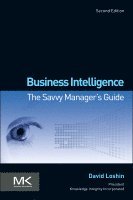
Business Intelligence: The Savvy Managers Guide, Second Edition, discusses the objectives and practices for designing and deploying a business intelligence (BI) program. It looks at the basics of a BI program, from the value of information and the mechanics of planning for success to data model infrastructure, data preparation, data analysis, integration, knowledge discovery, and the actual use of discovered knowledge.
Organized into 21 chapters, this book begins with an overview of the kind of knowledge that can be exposed and exploited through the use of BI. It then proceeds with a discussion of information use in the context of how value is created within an organization, how BI can improve the ways of doing business, and organizational preparedness for exploiting the results of a BI program. It also looks at some of the critical factors to be taken into account in the planning and execution of a successful BI program. In addition, the reader is introduced to considerations for developing the BI roadmap, the platforms for analysis such as data warehouses, and the concepts of business metadata. Other chapters focus on data preparation and data discovery, the business rules approach, and data mining techniques and predictive analytics. Finally, emerging technologies such as text analytics and sentiment analysis are considered.
This book will be valuable to data management and BI professionals, including senior and middle-level managers, Chief Information Officers and Chief Data Officers, senior business executives and business staff members, database or software engineers, and business analysts.
Guides managers through developing, administering, or simply understanding business intelligence technology Keeps pace with the changes in best practices, tools, methods and processes used to transform an organization's data into actionable knowledge Contains a handy, quick-reference to technologies and terminologyMeasuring Data Quality for Ongoing Improvement
A Data Quality Assessment Framework
472 kr
Skickas inom 7-10 vardagar
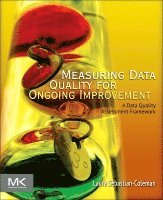
The Data Quality Assessment Framework shows you how to measure and monitor data quality, ensuring quality over time. You'll start with general concepts of measurement and work your way through a detailed framework of more than three dozen measurement types related to five objective dimensions of quality: completeness, timeliness, consistency, validity, and integrity. Ongoing measurement, rather than one time activities will help your organization reach a new level of data quality. This plain-language approach to measuring data can be understood by both business and IT and provides practical guidance on how to apply the DQAF within any organization enabling you to prioritize measurements and effectively report on results. Strategies for using data measurement to govern and improve the quality of data and guidelines for applying the framework within a data asset are included. You'll come away able to prioritize which measurement types to implement, knowing where to place them in a data flow and how frequently to measure. Common conceptual models for defining and storing of data quality results for purposes of trend analysis are also included as well as generic business requirements for ongoing measuring and monitoring including calculations and comparisons that make the measurements meaningful and help understand trends and detect anomalies.
Demonstrates how to leverage a technology independent data quality measurement framework for your specific business priorities and data quality challenges Enables discussions between business and IT with a non-technical vocabulary for data quality measurement Describes how to measure data quality on an ongoing basis with generic measurement types that can be applied to any situationManaging Data in Motion
Data Integration Best Practice Techniques and Technologies
472 kr
Skickas inom 7-10 vardagar
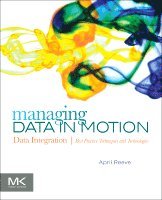
Managing Data in Motion describes techniques that have been developed for significantly reducing the complexity of managing system interfaces and enabling scalable architectures. Author April Reeve brings over two decades of experience to present a vendor-neutral approach to moving data between computing environments and systems. Readers will learn the techniques, technologies, and best practices for managing the passage of data between computer systems and integrating disparate data together in an enterprise environment.
The average enterprise's computing environment is comprised of hundreds to thousands computer systems that have been built, purchased, and acquired over time. The data from these various systems needs to be integrated for reporting and analysis, shared for business transaction processing, and converted from one format to another when old systems are replaced and new systems are acquired.
The management of the "data in motion" in organizations is rapidly becoming one of the biggest concerns for business and IT management. Data warehousing and conversion, real-time data integration, and cloud and "big data" applications are just a few of the challenges facing organizations and businesses today. Managing Data in Motion tackles these and other topics in a style easily understood by business and IT managers as well as programmers and architects.
Presents a vendor-neutral overview of the different technologies and techniques for moving data between computer systems including the emerging solutions for unstructured as well as structured data types Explains, in non-technical terms, the architecture and components required to perform data integration Describes how to reduce the complexity of managing system interfaces and enable a scalable data architecture that can handle the dimensions of "Big Data"359 kr
Skickas inom 7-10 vardagar
Social Data Analytics is the first practical guide for professionals who want to employ social data for analytics and business intelligence (BI). This book provides a comprehensive overview of the technologies and platforms and shows you how to access and analyze the data. You'll explore the five major types of social data and learn from cases and platform examples to help you make the most of sentiment, behavioral, social graph, location, and rich media data. A four-step approach to the social BI process will help you access, evaluate, collaborate, and share social data with ease.
You'll learn everything you need to know to monitor social media and get an overview of the leading vendors in a crowded space of BI applications. By the end of this book, you will be well prepared for your organization's next social data analytics project.
Provides foundational understanding of new and emerging technologies-social data, collaboration, big data, advanced analytics Includes case studies and practical examples of success and failures Will prepare you to lead projects and advance initiatives that will benefit you and your organization434 kr
Skickas inom 7-10 vardagar
Implementing Analytics demystifies the concept, technology and application of analytics and breaks its implementation down to repeatable and manageable steps, making it possible for widespread adoption across all functions of an organization. Implementing Analytics simplifies and helps democratize a very specialized discipline to foster business efficiency and innovation without investing in multi-million dollar technology and manpower. A technology agnostic methodology that breaks down complex tasks like model design and tuning and emphasizes business decisions rather than the technology behind analytics.
Simplifies the understanding of analytics from a technical and functional perspective and shows a wide array of problems that can be tackled using existing technology Provides a detailed step by step approach to identify opportunities, extract requirements, design variables and build and test models. It further explains the business decision strategies to use analytics models and provides an overview for governance and tuning Helps formalize analytics projects from staffing, technology and implementation perspectives Emphasizes machine learning and data mining over statistics and shows how the role of a Data Scientist can be broken down and still deliver the value by building a robust development process434 kr
Skickas inom 7-10 vardagar
Data Warehousing in the Age of the Big Data will help you and your organization make the most of unstructured data with your existing data warehouse.
As Big Data continues to revolutionize how we use data, it doesn't have to create more confusion. Expert author Krish Krishnan helps you make sense of how Big Data fits into the world of data warehousing in clear and concise detail. The book is presented in three distinct parts. Part 1 discusses Big Data, its technologies and use cases from early adopters. Part 2 addresses data warehousing, its shortcomings, and new architecture options, workloads, and integration techniques for Big Data and the data warehouse. Part 3 deals with data governance, data visualization, information life-cycle management, data scientists, and implementing a Big Data-ready data warehouse. Extensive appendixes include case studies from vendor implementations and a special segment on how we can build a healthcare information factory.
Ultimately, this book will help you navigate through the complex layers of Big Data and data warehousing while providing you information on how to effectively think about using all these technologies and the architectures to design the next-generation data warehouse.
Learn how to leverage Big Data by effectively integrating it into your data warehouse. Includes real-world examples and use cases that clearly demonstrate Hadoop, NoSQL, HBASE, Hive, and other Big Data technologies Understand how to optimize and tune your current data warehouse infrastructure and integrate newer infrastructure matching data processing workloads and requirementsUsing Open Source Platforms for Business Intelligence
Avoid Pitfalls and Maximize ROI
359 kr
Skickas inom 7-10 vardagar
Open Source BI solutions have many advantages over traditional proprietary software, from offering lower initial costs to more flexible support and integration options; but, until now, there has been no comprehensive guide to the complete offerings of the OS BI market. Writing for IT managers and business analysts without bias toward any BI suite, industry insider Lyndsay Wise covers the benefits and challenges of all available open source BI systems and tools, enabling readers to identify the solutions and technologies that best meet their business needs. Wise compares and contrasts types of OS BI and proprietary tools on the market, including Pentaho, Jaspersoft, RapidMiner, SpagoBI, BIRT, and many more. Real-world case studies and project templates clarify the steps involved in implementing open source BI, saving new users the time and trouble of developing their own solutions from scratch. For business managers who are hard pressed to indentify the best BI solutions and software for their companies, this book provides a practical guide to evaluating the ROI of open source versus traditional BI deployments.
The only book to provide complete coverage of all open source BI systems and tools specifically for business managers, without bias toward any OS BI suite A practical, step-by-step guide to implementing OS BI solutions that maximize ROI Comprehensive coverage of all open source systems and tools, including architectures, data integration, support, optimization, data mining, data warehousing, and interoperability Case studies and project templates enable readers to evaluate the benefits and tradeoffs of all OS BI options without having to spend time developing their own solutions from scratch