World Scientific Series In 20th Century Biology – serie
Visar alla böcker i serien World Scientific Series In 20th Century Biology. Handla med fri frakt och snabb leverans.
6 produkter
6 produkter
Del 1 - World Scientific Series In 20th Century Biology
Selected Papers Of Frederick Sanger (With Commentaries)
Inbunden, Engelska, 1996
3 278 kr
Skickas inom 3-6 vardagar
This important volume is mainly concerned with the development of methods for “sequencing” — that is, determination of the order of the amino acids in proteins and of nucleotides in RNA and DNA. In 1943 the position of only one amino acid in a protein (insulin) was known, and Sanger's first paper resulted in finding a second amino acid. In his final paper in 1982 he describes the determination of a DNA sequence of 48,502 nucleotides. The papers describe the steady improvements in techniques, and exciting biological results revealed by the sequences.
Del 3 - World Scientific Series In 20th Century Biology
Saga Of The Nerve Growth Factor, The: Preliminary Studies, Discovery, Further Development
Inbunden, Engelska, 1997
2 854 kr
Tillfälligt slut
This volume is a collection of articles written by Nobel Laureate Rita Levi-Montalcini and published from 1942 to 1995. Studies described in the first part set the stage for the discovery of a protein molecule which became known as the Nerve Growth Factor (NGF), described in detail in the second part. The NGF synthesized in minute amounts in all vertebrate tissues, plays an essential role in the differentiation and survival of several nerve cell populations in the peripheral and central nervous system. The discovery of the NGF was defined by the Nobel Foundation as a milestone in developmental neurobiology, and the author was awarded in 1986 with this prestigious award. Studies pursued in subsequent years and still in progress, have unveiled other fundamental properties of the NGF, described in the third part of this volume.
Del 2 - World Scientific Series In 20th Century Biology
Portrait Of The Immune System, A: Scientific Publications Of N K Jerne
Inbunden, Engelska, 1996
4 984 kr
Tillfälligt slut
Using the published work of Nobel Laureate Niels Kaj Jerne, this book shows how he developd his ideas. The book is a compilation of his published work, but in fact it is much more than that. Whether the reader wants to read the book systematically, or only browse, it opens a fascinating world of hypotheses, theories, facts and vistas. His selection theory, his view of how immunological diversity is created, and his concept of lymphocytes interacting as a network, reveals Jerne's revolutionary spirit. The book ought to be a rich source of inspiration for everyone interested in science and how science is made.
Del 2 - World Scientific Series In 20th Century Biology
Portrait Of The Immune System, A: Scientific Publications Of N K Jerne
Häftad, Engelska, 1996
1 009 kr
Tillfälligt slut
Using the published work of Nobel Laureate Niels Kaj Jerne, this book shows how he developd his ideas. The book is a compilation of his published work, but in fact it is much more than that. Whether the reader wants to read the book systematically, or only browse, it opens a fascinating world of hypotheses, theories, facts and vistas. His selection theory, his view of how immunological diversity is created, and his concept of lymphocytes interacting as a network, reveals Jerne's revolutionary spirit. The book ought to be a rich source of inspiration for everyone interested in science and how science is made.
Del 4 - World Scientific Series In 20th Century Biology
Hepatitis B And The Prevention Of Primary Cancer Of The Liver
Inbunden, Engelska, 2000
3 653 kr
Tillfälligt slut
This important book comprises a narrative account of research on the hepatitis B virus (and related subjects) and selected reprints from the laboratory of Nobel laureate Baruch S Blumberg and his colleagues. The hepatitis B virus (HBV) is one of the ten most common deadly infectious diseases and is responsible for 1.1 million deaths a year worldwide.Research in his laboratory resulted in the discovery of HBV and the invention of the vaccine which protects one against it. The research began as an apparently esoteric study of human biochemical and immunologic variation. This required field-work in Africa, the Arctic, the Pacific, the Americas, and in many other locations and populations. The overall goal was to identify inherited biological differences which were related to differing responses to disease-causing agents. The virus was discovered using the blood of an infected person who had developed the antibody, to detect the virus present in another infected person who had become a carrier of the virus. Screening of blood donors led to the near-elimination of post-transfusion hepatitis B.There are now national HBV vaccination programs in more than 70 countries. During the past decade these programs have strikingly reduced the prevalence of HBV in many countries and there has been a significant drop in the incidence of cancer of the liver in the vaccinated cohorts. The HBV vaccination program is now, after smoking cessation, the most widely used cancer prevention program in the world.
Del 5 - World Scientific Series In 20th Century Biology
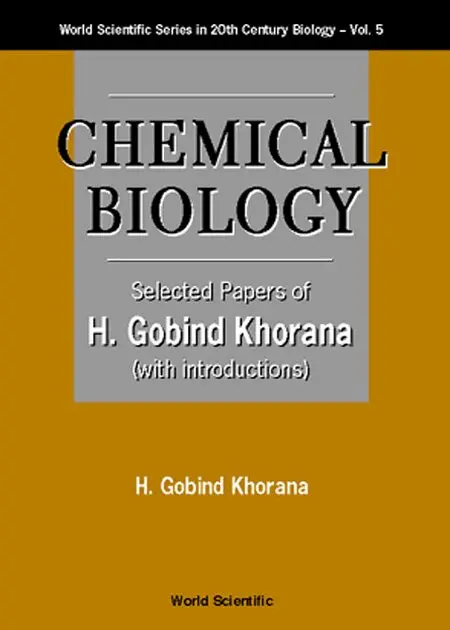
Chemical Biology, Selected Papers Of H G Khorana (With Introductions)
Inbunden, Engelska, 2000
3 461 kr
Tillfälligt slut
The first two chapters of this invaluable book trace the developments of the chemistry and macromolecular structures, respectively, of proteins and nuclei acids. Similarly, the introductions to the succeeding chapters review, step by step, the historical landmarks in the topics covered. These include discoveries of biological phosphate esters, nucleotides and nucleotide coenzymes (important in intermediary metabolism), the nature of the genetic material and biological synthesis of proteins, formulation of the problem of the genetic code, and perspectives on bioenergetics.The selected papers illustrate the developments of the chemical synthesis of nucleotides and nucleotide coenzymes of ribo- and deoxy-ribo-polynucleotides (RNA, DNA), of the total synthesis of genes in the laboratory, and principles for gene amplification (PCR). Another major section covers studies of enzymes that degrade nucleic acids, the structure of transfer RNA and its role in protein synthesis, and the author's work on the elucidation of the genetic code. Finally, there are descriptions of the studies on biological membranes and the membrane protein bacteriorhodopsin, a biological proton pump. These studies elucidated the mechanism of proton translocation, which is central to bioenergetics.