• Fri frakt över 249 kr
  • •
  • Snabba leveranser
  • •
  • Billiga böcker
Kundservice

Du är på sajten för privatpersoner.

Företag, bibliotek eller offentlig verksamhet?

Du handlar på classic.bokus.com, där alla dina funktioner finns intakta.
Till classic.bokus.com
Bokus logotyp. Gå till startsidan.
  • Erbjudanden
  • Nyheter
  • Student
  • Topplistor
  • Barn & ungdom
  • Bokus Play
  • E-böcker
  • Pocketböcker
  • Spel & pussel

10% rabatt på allt med kod: NYSTART10 →

Sidfot

Mina sidor

    Hjälp

    • Kundservice
    • Vanliga frågor och svar
    • Frakt och leverans
    • Retur vid ångerrätt
    • Reklamera vara
    • Betalning
    • Köpvillkor
    • Allmänna villkor
    • Information om webbplatsens tillgänglighet

    Om Bokus

    • Om oss
    • Pressrum
    • För studenter
    • För företag
    • För bibliotek och offentlig verksamhet
    • För leverantörer
    • Hållbarhet

    Populärt

    • Aktuella erbjudanden
    • Presentkort
    • Studentlitteratur
    • Nya böcker
    • Topplistor
    • Signerade böcker
    • Engelska böcker

    Inspiration

    • Boktips
    • BookTok
    • Populära bokserier
    • Barnbokskaraktärer
    • Populära författare
    Logotyp för Bokus
    Följ oss på Facebook (extern länk)Följ oss på Instagram (extern länk)Följ oss på YouTube (extern länk)Följ oss på TikTok (extern länk)
    bokus @ CookiesAnpassa cookiesIntegritetspolicyKöpvillkor
    Till Citymail hemsida (extern länk)Till Budbee hemsida (extern länk)Till Postnord hemsida (extern länk)Till Schenker hemsida (extern länk)Till Early Bird hemsida (extern länk)Till Walleys hemsida (extern länk)
    1. Naturvetenskap och teknik
    2. Teknik och industri
    3. Elektronik och kommunikationer

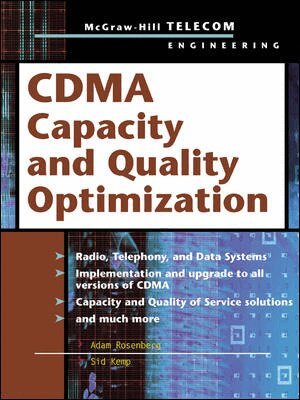
    CDMA Capacity and Quality Optimization

    AvAdam Rosenberg,Sid Kemp

    Inbunden, Engelska, 2003

    1 197 kr

    Beställningsvara. Skickas inom 3-6 vardagar. Fri frakt över 249 kr.

    Beskrivning

    Publisher's Note: Products purchased from Third Party sellers are not guaranteed by the publisher for quality, authenticity, or access to any online entitlements included with the product.


    Now that CDMA has been accepted as a key component of worldwide 3G systems, service providers, capacity planners, engineers and technicians need to understand the best methods and tools for maximizing throughput, capacity, and quality. This book provides that expertise.

    Produktinformation

    • Utgivningsdatum:2003-03-16
    • Mått:193 x 236 x 50 mm
    • Vikt:1 342 g
    • Format:Inbunden
    • Språk:Engelska
    • Antal sidor:627
    • Förlag:McGraw-Hill Education
    • ISBN:9780071399197

    Utforska kategorier

    • Elektronik och kommunikationer inom Naturvetenskap och teknik

    Mer om författaren

    Adam Rosenberg (Atlanta, GA) is an industrial mathematician who has built decision-support systems for telephone companies, airlines, railroads, automobile resellers, and hotels. Dr. Rosenberg was part of the Advanced Mobile Phone Service systems engineering group at Bell Laboratories. Later he worked for InterDigital Communications Corporation on broadband CDMA, where he did statistical capacity analysis of CDMA for wireless local loop. He holds a Ph.D. from Stanford in Operations Research, and an A.B. in mathematics from Princeton University. Sid Kemp (San Antonio, TX), is a leading expert in project management for information technology and telecommunications implementations. His company, Quality Technology and Instruction, provides a custom project management methodology to businesses, government agencies, and educational organizations. He has assisted Fortune 500 companies and government agencies in the deployment of new technology, and developing custom project management methodologies. Mr. Kemp has more than 15 years of experience in IT and telecommunications, and has authored 5 textbooks for use in courses and corporations. He has been teaching a seminar on Project Management for Information Technology for three years.

    Innehållsförteckning

    • Section 1: KEY RADIO CONCEPTSChapter 1: Radio Engineering ConceptsChapter 2: The User TerminalChapter 3: The CDMA Mobile SystemChapter 4: The Base StationChapter 5: Basic Wireless TelephonyChapter 6: Analog Wireless Telephony (AMPS)Chapter 7: TDMA Wireless Telephony (GSM)Chapter 8: The CDMA PrincipleSection 2: STANDARDS FOR CELLULAR SYSTEMSChapter 9: General Cellular StandardsChapter 10: Worldwide CDMA StandardsSection 3: KEY TELEPHONE CONCEPTSChapter 11: The PSTN and Telephone SwitchingChapter 12: Telephony Engineering ConceptsChapter 13: Telephone TransportChapter 14: Signaling with SS7Chapter 15: ANSI-41Chapter 16: Call StatesSection 4: KEY DATA CONCEPTSChapter 17: Quality of Service (QoS)Chapter 18: Speech CodingChapter 19: Hybrid Voice-Data NetworksChapter 20: Short Message Service (SMS)Chapter 21: Wireless Data ServiceSection 5: CAPACITY AND QUALITY PRINCIPLESChapter 22: Capacity and Quality TradeoffsChapter 23: Traffic Engineering for Voice and DataChapter 24: Switching CapacityChapter 25: ANSI-41 Signaling CapacityChapter 26: Capacity Calculations for Cellular NetworksChapter 27: Conventional Reuse PrinciplesChapter 28: CDMA Principles for Multicellular SystemsChapter 29: CDMA Data Capacity PrinciplesChapter 30: Capacity Issues Specific to CDMASection 6: PLANNING FOR CDMA CAPACITYChapter 31: Estimating Wireless Telephone DemandChapter 32: Planning Locations for Base StationsChapter 33: Base Station PlanningChapter 34: Mobile Switching Center (MSC) PlanningChapter 35: Backhaul PlanningChapter 36: Signaling Capacity PlanningChapter 37: MSC Transport PlanningChapter 38: Special SituationsSection 7: INCREASING CAPACITYChapter 39: Measuring System Performance for GrowthChapter 40: Turning Your Complaints into Useful DataChapter 41: Increasing Capacity of a Base StationChapter 42: Adding Cells to a CDMA StationChapter 43: Mobile Switching Center (MSC) GrowthChapter 44: Adding TransportChapter 45: Regional Growth in a Specific AreaSection 8: MODELING FOR CDMAChapter 46: Business-Case ModelsChapter 47: Propagation ModelsChapter 48: Subscriber Traffic ModelingSection 9: CONCLUSIONChapter 49: CDMA Now and in the FutureAppendix A: AcronymsAppendix B: Physical UnitsGlossaryReferencesIndexAbout the Authors