• Fri frakt över 249 kr
  • •
  • Snabba leveranser
  • •
  • Billiga böcker
Kundservice

Du är på sajten för privatpersoner.

Företag, bibliotek eller offentlig verksamhet?

Du handlar på classic.bokus.com, där alla dina funktioner finns intakta.
Till classic.bokus.com
Bokus logotyp. Gå till startsidan.
  • Erbjudanden
  • Nyheter
  • Student
  • Topplistor
  • Barn & ungdom
  • Bokus Play
  • E-böcker
  • Pocketböcker
  • Spel & pussel

10% rabatt på allt med kod NYSTART10 →

Sidfot

Mina sidor

    Hjälp

    • Kundservice
    • Vanliga frågor och svar
    • Frakt och leverans
    • Retur vid ångerrätt
    • Reklamera vara
    • Betalning
    • Köpvillkor
    • Allmänna villkor
    • Information om webbplatsens tillgänglighet

    Om Bokus

    • Om oss
    • Pressrum
    • För studenter
    • För företag
    • För bibliotek och offentlig verksamhet
    • För leverantörer
    • Hållbarhet

    Populärt

    • Aktuella erbjudanden
    • Presentkort
    • Studentlitteratur
    • Nya böcker
    • Topplistor
    • Signerade böcker
    • Engelska böcker

    Inspiration

    • Boktips
    • BookTok
    • Populära bokserier
    • Barnbokskaraktärer
    • Populära författare
    Logotyp för Bokus
    Följ oss på Facebook (extern länk)Följ oss på Instagram (extern länk)Följ oss på YouTube (extern länk)Följ oss på TikTok (extern länk)
    bokus @ CookiesAnpassa cookiesIntegritetspolicyKöpvillkor
    Till Citymail hemsida (extern länk)Till Budbee hemsida (extern länk)Till Postnord hemsida (extern länk)Till Schenker hemsida (extern länk)Till Early Bird hemsida (extern länk)Till Walleys hemsida (extern länk)
    1. Data och IT
    2. Digital livsstil och datorspel

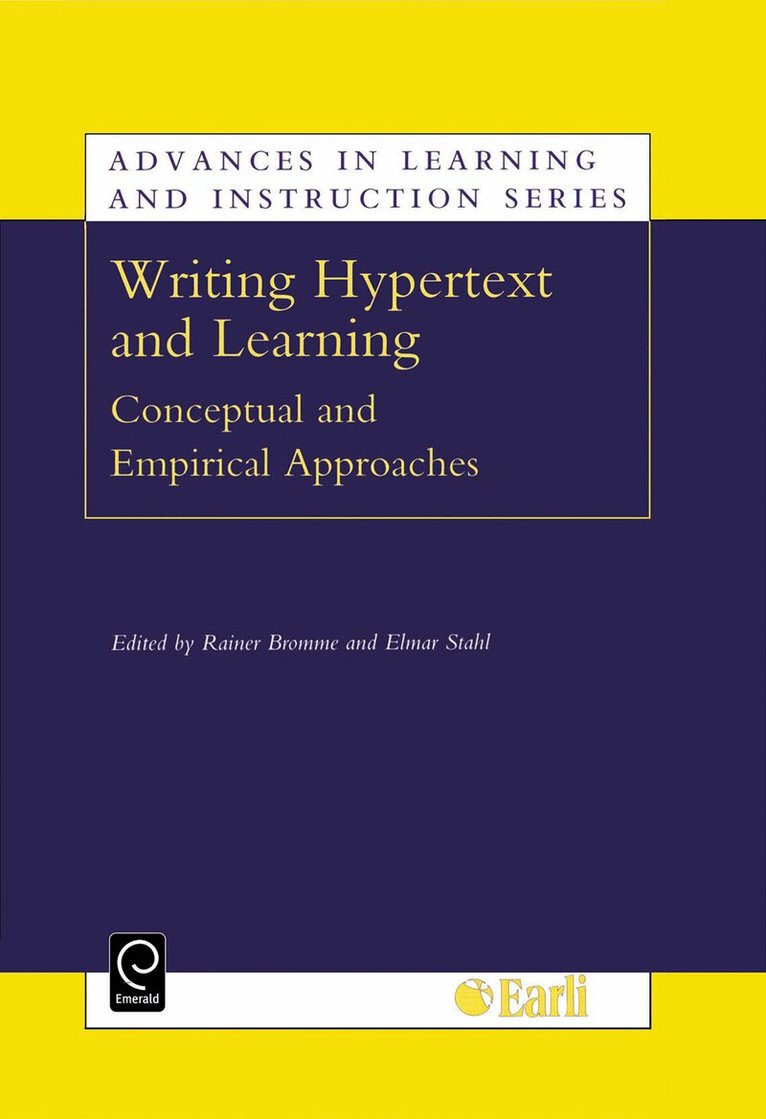
    Writing Hypertext and Learning

    Conceptual and Empirical Approaches

    AvRainer Bromme,E. Stahl

    Inbunden, Engelska, 2002

    Del 10 i serien Advances in Learning and Instruction Series

    1 445 kr

    Beställningsvara. Skickas inom 5-8 vardagar. Fri frakt över 249 kr.

    Beskrivning

    Once the basic idea of hypertext had spread rapidly throughout the world via the Internet, the reception of hypertexts soon became subject of empirical research among psychologists, cognitive scientists, and educational researchers. As easy to use software for the writing of hypertexts (HTML editors) is now broadly available, there are no longer any technical obstacles for the use of hypertext production in teaching and learning. This book presents and analyses the learning effects that can be anticipated from the production of hypertexts. It includes laboratory experiments, studies on the production of hypertexts in the context of educational institutions, and reports on software environments designed for the production of hypertext. It includes theoretical, empirically and developmentally oriented contributions. The first three chapters link up directly with research on traditional writing while addressing aspects of the interaction between content and rhetoric during hypertext writing. The next three chapters focus on cooperative learning of students in and through the production of hypertexts. The following two chapters look at new technological possibilities, namely, a software environment for transforming textbooks into personalized hypertexts and the design of hypervideos. The final chapter discusses potential methods for further research.

    Produktinformation

    • Utgivningsdatum:2002-07-03
    • Mått:165 x 240 x 30 mm
    • Vikt:612 g
    • Format:Inbunden
    • Språk:Engelska
    • Serie:Advances in Learning and Instruction Series
    • Antal sidor:214
    • Förlag:Emerald Publishing Limited
    • ISBN:9780080439877

    Utforska kategorier

    • Digital livsstil och datorspel inom Data och IT
    • Programmeringsböcker inom Data och IT

    Innehållsförteckning

    • Writing and learning: hypertext as a renewal of an old and close relationship. Introduction and overview (R. Bromme, E. Stahl). Learning to compose hypertext and linear text: transfer or inhibition? (M. Braaksma et al.). Learning by producing hypertext from reader perspectives: cognitive flexibility theory reconsidered (R. Bromme, E. Stahl). Writing as design: hypermedia and the shape of information space (A. Dillon). Emergent versus presentational hypertext (C. Bereiters). Sleepy links, collaborative grading and trails - shaping hypertext structures by usage processes (K. Wolf). Opening windows in each other's minds: social sharing of hypertext models (A. Talamo, A. Fasula). Slicing books - the authors' perspective (I. Dahn et al.). Authoring hypervideos: design for learning and learning by design (C. Zahn). Methods for assessing cognitive processes during the construction of hypertexts (E. Stahl).