- Nyhet
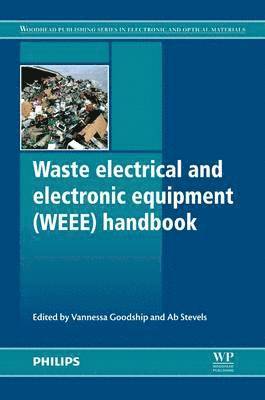
Waste Electrical and Electronic Equipment (WEEE) Handbook
AvVannessa Goodship,Ab Stevels
2 669 kr
Beställningsvara. Skickas inom 10-15 vardagar. Fri frakt över 249 kr.
Beskrivning
Produktinformation
- Utgivningsdatum:2016-08-19
- Mått:154 x 233 x 43 mm
- Vikt:1 040 g
- Format:Häftad
- Språk:Engelska
- Serie:Woodhead Publishing Series in Electronic and Optical Materials
- Antal sidor:752
- Förlag:Elsevier Science & Technology
- ISBN:9780081016053
Utforska kategorier
Mer om författaren
Principal Research Fellow at the Warwick Manufacturing Group (WMG), a department at the University of Warwick providing research, education and knowledge transfer in engineering, manufacturing and technology. Her areas of specialism are plastics materials, their processing and recycling, and she has undertaken many research projects in these areas - most recently looking at multifunctional materials. She - like WMG - works at the interface of academia and industry. She has edited two books under the Woodhead imprint: Management, Recycling and Reuse of Waste Composites (2009) Waste Electrical and Electronic Equipment (WEEE) Handbook (2012). Ab Stevels has done trailblazing work in making Applied EcoDesign into day-to-day business really happen and has researched in detail the setting up of take-back and recycling systems for electronics For these purposes tools and management procedures have been developed which have proven their strength through their practical success.Ab is the author of some 200 journal articles and conference contributions. Training courses on applied EcoDesign have been held at various universities (Delft, Stanford, TU Berlin,TU Vienna, TU Ostrava, the University of Arts and Design in Farnham (UK) , Mexico City, Hong Kong Poly, NTNU( Trondheim, Norway), Tsinghua University (Beijing) , and at various Philips departments and divisions around the globe and at other companies.In 2013 he developed a 'MBA and Sustainability' course in cooperation with the University of Sao Paulo. For his work in Applied EcoDesign he got an honorary degree from the University of Arts and Design. For his contributions in the field of recycling of electronics he got the "Cowbell Award"from the International Electronics Recycling Conference Organization. In 2014 the World Green Design Organization awarded him a "Green Design Contribution Award'. Dr. Huisman holds a Master’s degree in Chemical Engineering from Eindhoven University of Technology and a Ph.D. from Delft University of Technology. He was a Scientific Advisor to the UNU – SCYCLE and steering the group’s research activities related to electronics recycling. He is involved in various international projects providing facts and figures for improving e-waste management. In the past, Dr. Huisman has been the lead author of the UNU study supporting the European Commission’s 2008 Review of the EU WEEE Directive as well as multiple advanced e-waste country studies for various European countries. From 2013 to 2015 he was the scientific coordinator of the EU CWIT-project: “Countering WEEE Illegal Trade and the H2020 project ProSUM: Prospecting Secondary raw materials in the Urban Mine. Currently with the European Commission DG Joint Research Center in the Sustainable Resources Directorate.
Recensioner i media
"In my opinion, this book provides comprehensive and up-to-date coverage of all aspects relating to the complex subject of waste electrical and electronics equipment (WEEE). It is essential reading for anyone involved in addressing what continues to be both a significant global challenge and an opportunity" --highly recommended., Professor Martin Goosey, IeMRC Industrial Director, Loughborough University"In a world about to own 2 billion PCs and countless other electronic products, this book provides a unique insight into the dangers, complexities and the opportunities provided by having to deal with the e-waste that is to come." --Paul Markillie, Innovation Editor, The Economist
Innehållsförteckning
- Contributor contact detailsWoodhead Publishing Series in Electronic and Optical MaterialsPrefaceWecycle, join us in recyclingPart I: Legislation and initiatives to manage WEEEChapter 1: Global e-waste initiativesAbstract:1.1 Introduction1.2 Problems associated with e-waste1.3 Global e-waste management initiatives1.4 Synergizing e-waste initiatives1.5 Future trendsChapter 2: EU legislation relating to electronic waste: the WEEE and RoHS Directives and the REACH regulationsAbstract:2.1 Introduction2.2 The EU and the environment2.3 The Waste Framework Directive2.4 The WEEE Directive2.5 The WEEE Directive in operation2.6 The recast of the WEEE Directive2.7 Directive on the restriction of the use of certain hazardous substances in electrical and electronic equipment (RoHS)2.8 The Commission’s proposal on a recast RoHS2.9 Registration, Evaluation, Authorisation and restriction of CHemicals Directive (REACH)2.10 Review of REACH2.11 SummaryChapter 3: The present recast of the WEEE DirectiveAbstract:3.1 Introduction3.2 Review studies proposing options for the recast of the WEEE Directive3.3 The current proposals for the recast of WEEE3.4 Further developments (July-September 2011)3.5 ConclusionsChapter 4: The WEEE Forum and the WEEELABEX projectAbstract:4.1 Introduction4.2 What is the WEEE Forum?4.3 Context of WEEELABEX4.4 WEEELABEX phase I: standards4.5 WEEELABEX phase II: conformity verification4.6 ConclusionsChapter 5: Conformity assessment of WEEE take-back schemes: the case of Switzerland*Abstract:5.1 Introduction5.2 Approach of the conformity assessment5.3 Scope and elements of the conformity assessment5.4 Future trends5.5 ConclusionsChapter 6: Eco-efficiency evaluation of WEEE take-back systemsAbstract:6.1 Introduction6.2 How much WEEE is out there?6.3 How do WEEE quantify and prioritise environmental impacts?6.4 How much do WEEE have to pay?6.5 How do WEEE benefit from impact assessment in policy development?6.6 ConclusionsPart II: Technologies for refurbishment, treatment and recycling of waste electronicsChapter 7: The materials of WEEEAbstract:7.1 The material content of WEEE7.2 Materials and their recovery and recycling technologies7.3 The transition from cathode ray tube (CRT) to liquid crystal display (LCD) display screens and its implications for materials recycling7.4 The loss of scarce elements7.5 Novel materials recovery approaches7.6 New materials and their implications7.7 Summary and conclusionsChapter 8: Refurbishment and reuse of WEEEAbstract:8.1 Need for WEEE refurbishment and reuse8.2 Reuse processes and their role in sustainable manufacturing8.3 Industry sector specific example: refurbishment of computers8.4 Role of the third sector8.5 Issues in WEEE refurbishment and reuse8.6 Future trends8.7 Summary of WEEE reuse and refurbishmentChapter 9: Shredding, sorting and recovery of metals from WEEE: linking design to resource efficiencyAbstract:9.1 Introduction9.2 Theory of recycling9.3 Product design, shredding and liberation of waste products9.4 Automated and manual sorting of WEEE products9.5 Metallurgical processing9.6 (Dynamic) modelling recycling systems performance9.7 ConclusionsChapter 10: Mechanical methods of recycling plastics from WEEEAbstract:10.1 Introduction10.2 Introduction to waste collection and sorting10.3 Methods of sorting small particle size polymer waste10.4 Conversion of WEEE to a reusable material10.5 Effectiveness of the WEEE legislation to date10.6 Remanufacturing using WEEE polymers10.7 Future trends10.8 Sources of further information and adviceChapter 11: Pyrolysis of WEEE plasticsAbstract:11.1 Introduction11.2 Pyrolysis processes and characterization of the pyrolysis fractions11.3 Pyrolysis of printed circuit boards (PCBs)11.4 Pyrolysis of plastics11.5 Environmental concerns about the products of pyrolysis of WEEE11.6 Future trendsChapter 12: Chemical or feedstock recycling of WEEE productsAbstract:12.1 Introduction12.2 Characteristics of WEEE plastics12.3 European feedstock recycling initiatives since the 1990s12.4 Conclusions and future trendsPart III: Electronic products that present particular challenges for recyclersChapter 13: Recycling printed circuit boardsAbstract:13.1 Introduction13.2 Materials13.3 Flame retardants13.4 Costs and benefits of recycling printed circuit boards (PCBs)13.5 Challenges and future trendsChapter 14: Recycling liquid crystal displaysAbstract:14.1 Introduction14.2 Liquid crystal displays (LCDs)14.3 Recycling processes for liquid crystal displays (LCDs)14.4 Hazardous materials in liquid crystal displays (LCDs)14.5 Recovery of valuable materials14.6 Re-use of liquid crystal display (LCD) equipment and components14.7 Future trendsChapter 15: Recycling cooling and freezing appliancesAbstract:15.1 Introduction15.2 Challenges relating to WEEE refrigerators and freezers15.3 Requirements for de-gassing processes15.4 Emissions of volatile organic compounds (VOCs)15.5 Future trends15.6 Techniques for separation of fridge plastics15.7.Sources of further information and advice15.8. ConclusionsChapter 16: End-of-life options for printed electronicsAbstract:16.1 Introduction16.2 Printed electronics16.3 End-of-life options and their challenges16.4 Consideration of EU legislation16.5 Future trends16.6 Sources of further information and adviceChapter 17: Recycling batteriesAbstract:17.1 Introduction17.2 Main directives worldwide for spent batteries17.3 Methods for the recovery of metals from spent batteries17.4 Future trendsPart IV: Sustainable design of electronics and supply chainsChapter 18: ErP – the European Directive on ecodesignAbstract:18.1 Introduction18.2 Trends leading to ecodesign regulation18.3 Introducing the ErP Directive18.4 Examining the Framework Directive concept18.5 Comparing ErP and WEEE approaches18.6 Status of ErP implementation and coverage of end-of-life (EoL) aspects18.7 ConclusionChapter 19: Sustainable electronic product designAbstract:19.1 Introduction19.2 Drivers for sustainability and ecodesign19.3 How to do design for sustainability (DfS)19.4 Sustainable materials and manufacturing processes19.5 Examples of sustainable electronic product design19.6 Future trends19.7 Sources of further information and adviceChapter 20: Reducing hazardous substances in electronicsAbstract:20.1 Hazardous substances and their functions in electrical and electronic equipment (EEE)20.2 Legislative bans of hazardous substances in EEE: the RoHS Directive20.3 Environmental, technological and economic impacts of the RoHS substance restrictions20.4 Differentiated approaches for the use and ban of hazardous substances20.6 Appendix: abbreviationsChapter 21: Examining subsidy impacts on recycled WEEE material flowsAbstract:21.1 Introduction21.2 A multi-tiered decentralized reverse production system (RPS) problem21.3 Insights from decentralized RPS case study21.4 Conclusions and discussions21.5 AcknowledgmentsPart V: National and regional WEEE management schemesChapter 22: WEEE management in Europe: learning from best practiceAbstract:22.1 Introduction22.2 The waste strategy within the EU22.3 The WEEE Directive and the RoHS framework22.4 Extended producer responsibility (EPR) and polluter pays principles and WEEE management22.5 National waste recovery schemes: case studies22.6 Summing up and discussion22.7 Conclusions and recommendations22.8 Acknowledgements22.10 Appendix: abbreviationsChapter 23: WEEE management in ChinaAbstract:23.1 Introduction23.2 Infrastructure: collecting, processing, recycling facilities23.3 Informal and formal recycling23.4 Contamination from landfill and incineration23.5 Environmental impacts23.6 Management of hazardous materials23.7 Knowledge centers of excellence23.8 Future trends23.9 Sources of further information and advice23.10 AcknowledgementsChapter 24: WEEE management in the USA and India: research and education for a responsible approach to managing WEEEAbstract:24.1 Introduction24.2 Local situational analysis of health and safety monitoring practices in WEEE recycling facilities in the US24.3 What are the issues for the WEEE recyclers?24.4 What do recycling workers expect from this job?24.5 What were the observations at the ECS Refining WEEE treatment site?24.6 Discussion and implications24.7 Recommendations to ECS Refining and similar facilities elsewhere in the US and India for tackling WEEE recycling issues24.8 Conclusions24.9 Sources of further information and advice24.10 Acknowledgements24.12 Appendix: interview question listChapter 25: WEEE management in JapanAbstract:25.1 Introduction25.2 Japan’s home appliance recycling system: purpose and background25.3 The collection rate25.4 Cost and recycling quality25.5 Export problems25.6 Economic analysis for urban mining25.7 ConclusionsChapter 26: WEEE management in AfricaAbstract:26.1 Introduction26.2 Volumes of WEEE imported and generated in African countries26.3 Impacts of current WEEE recycling practices26.4 WEEE policy and legislation26.5 ConclusionsPart VI: Corporate WEEE management strategiesChapter 27: Hewlett-Packard’s WEEE management strategyAbstract:27.1 Environmental business management at Hewlett-Packard (HP)27.2 HP e-waste management in practice: HP end-of-life product return and recycling27.3 Future trends27.4 Sources of further information and advice27.5 ConclusionsChapter 28: Siemens’ WEEE management strategyAbstract:28.1 Introduction: WEEE as an important element of the overall environmental protection strategy28.2 Siemens’ environmental business management28.3 Significance of WEEE aspects within the product life-cycle management (PLM) process28.4 Healthcare products as an example of WEEE management28.5 Future trends28.6 Sources of further information and adviceChapter 29: The history of take-back and treatment of WEEE at the Philips Consumer Lifestyle divisionAbstract:29.1 Introduction29.2 The period 1990–199829.3 Implementation of a take-back and treatment system in The Netherlands (1997–2000)29.4 The WEEE Directive (2000–2008)29.5 Summary and conclusionsChapter 30: Creating a corporate environmental strategy including WEEE take-back and treatmentAbstract:30.1 Position of take-back and treatment in an environmental strategy30.2 Corporate environmental strategy30.3 Product characteristics, take-back and treatment30.4 WEEE implementation, materials recycling and corporate environmental strategy30.5 Summary and conclusionsIndex
Du kanske också är intresserad av
Waste Electrical and Electronic Equipment (WEEE) Handbook
Jaco Huisman, Ab Stevels, Vannessa Goodship
4 793 kr
Waste Electrical and Electronic Equipment (WEEE) Handbook
Goodship,Vanness, Vannessa Goodship, Ab Stevels, Jaco Huisman
Häftad, 2019
3 397 kr
Waste Electrical and Electronic Equipment (WEEE) Handbook
Jaco Huisman, Ab Stevels, Vannessa Goodship
2 714 kr
- Signerad!