• Fri frakt över 249 kr
  • •
  • Snabba leveranser
  • •
  • Billiga böcker
Kundservice

Du är på sajten för privatpersoner.

Företag, bibliotek eller offentlig verksamhet?

Du handlar på classic.bokus.com, där alla dina funktioner finns intakta.
Till classic.bokus.com
Bokus logotyp. Gå till startsidan.
  • Erbjudanden
  • Nyheter
  • Student
  • Topplistor
  • Barn & ungdom
  • Bokus Play
  • E-böcker
  • Pocketböcker
  • Spel & pussel

10% rabatt på allt med kod: NYSTART10 →

Sidfot

Mina sidor

    Hjälp

    • Kundservice
    • Vanliga frågor och svar
    • Frakt och leverans
    • Retur vid ångerrätt
    • Reklamera vara
    • Betalning
    • Köpvillkor
    • Allmänna villkor
    • Information om webbplatsens tillgänglighet

    Om Bokus

    • Om oss
    • Pressrum
    • För studenter
    • För företag
    • För bibliotek och offentlig verksamhet
    • För leverantörer
    • Hållbarhet

    Populärt

    • Aktuella erbjudanden
    • Presentkort
    • Studentlitteratur
    • Nya böcker
    • Topplistor
    • Signerade böcker
    • Engelska böcker

    Inspiration

    • Boktips
    • BookTok
    • Populära bokserier
    • Barnbokskaraktärer
    • Populära författare
    Logotyp för Bokus
    Följ oss på Facebook (extern länk)Följ oss på Instagram (extern länk)Följ oss på YouTube (extern länk)Följ oss på TikTok (extern länk)
    bokus @ CookiesAnpassa cookiesIntegritetspolicyKöpvillkor
    Till Citymail hemsida (extern länk)Till Budbee hemsida (extern länk)Till Postnord hemsida (extern länk)Till Schenker hemsida (extern länk)Till Early Bird hemsida (extern länk)Till Walleys hemsida (extern länk)
    1. Naturvetenskap och teknik
    2. Teknik och industri
    3. Tillverkningsteknik

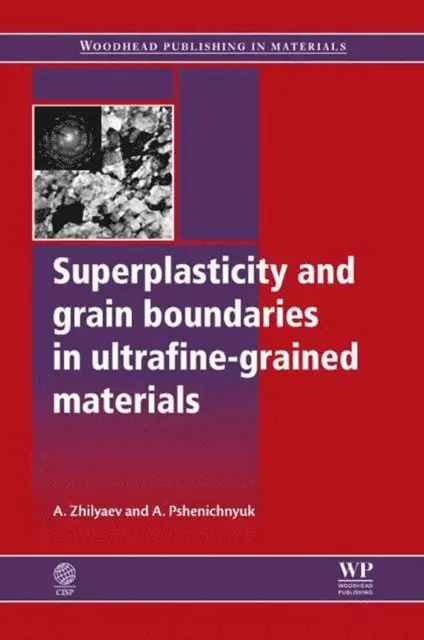
    Superplasticity and Grain Boundaries in Ultrafine-Grained Materials

    AvPeter M. Burgess,Anatoly I. Pshenichnyuk

    Häftad, Engelska, 2016

    Del i serien Woodhead Publishing in Materials

    1 751 kr

    Beställningsvara. Skickas inom 10-15 vardagar. Fri frakt över 249 kr.

    Beskrivning

    Superplasticity is a state in which solid crystalline materials, such as some fine-grained metals, are deformed well beyond their usual breaking point. The phenomenon is of importance in processes such as superplastic forming which allows the manufacture of complex, high-quality components in such areas as aerospace and biomedical engineering.

    Superplasticity and grain boundaries in ultrafine-grained materials discusses a number of problems associated with grain boundaries in metallic polycrystalline materials. The role of grain boundaries in processes such as grain boundary diffusion, relaxation and grain growth is investigated. The authors explore the formation and evolution of the microstructure, texture and ensembles of grain boundaries in materials produced by severe plastic deformation.

    Written by two leading experts in the field, Superplasticity and grain boundaries in ultrafine-grained materials significantly advances our understanding of this important phenomenon and will be an important reference work for metallurgists and those involved in superplastic forming processes.

    • Discusses significant problems associated with grain boundaries in polycrystals incorporating structural superplasticity and grain boundary sliding
    • Assesses the role of grain boundaries in processes such as grain boundary diffusion, relaxation and grain growth
    • Explores the formation and evolution of the microstructure, texture and ensembles of grain boundaries in materials produced by severe plastic deformation

    Produktinformation

    • Utgivningsdatum:2016-08-19
    • Mått:156 x 234 x 18 mm
    • Vikt:460 g
    • Format:Häftad
    • Språk:Engelska
    • Serie:Woodhead Publishing in Materials
    • Antal sidor:328
    • Förlag:Elsevier Science
    • ISBN:9780081017319

    Utforska kategorier

    • Tillverkningsteknik inom Naturvetenskap och teknik

    Mer om författaren

    Dr A. I. Pshenichnyuk works at the Institute for Superplasticity of Metals, Russia. Both are noted for their research on superplasticity.

    Innehållsförteckning

    • IntroductionChapter 1: Structural Superplasticity of Polycrystalline Materials1.1 Structural levels, spatial scales and description levels1.2 Structural superplasticity: from the combination of mechanisms to cooperative grain boundaries sliding1.3 Structural superplasticity: from meso-description to macrocharacteristicsChapter 2: Characteristics of Grain Boundary Ensembles2.1 Crystal geometry and structure of intercrystalline boundaries2.2 Special grain boundaries in the monoclinic lattice2.3 Description of the grain boundary misorientation distribution (GBMD)2.4 Computer model of a polycrystal: a calculation algorithmChapter 3: Orientation-Distributed Parameters of the Polycrystalline Structure3.1 The distribution function of the grains with respect to crystallographic orientations: calculation methods3.2 Relationship between the grain boundary misorientation distribution and the ODF3.3 Correlation orientation of adjacent grains: the concept of the basis spectra of misorientation of the grain boundaries3.4 Modelling the misorientation spectra of the grain boundaries in the FCC crystals with modelling ODFChapter 4: Experimental Investigations of Grain Boundary Ensembles in Polycrystals4.1 Diffraction methods of measuring misorientation4.2 Experimental spectra of the grain boundaries in FCC polycrystals4.3 Orientation distribution function in Ni–Cr alloy: experimental and modelling GBMDs4.4 Special features of the grain boundaries in the FCC materials with a high stacking fault energyChapter 5: Grain Boundary Sliding in Metallic bi- and Tricrystals5.1 Dislocation nature of grain boundary sliding (GBS)5.2 Formulation of the model of stimulated grain boundary sliding5.3 Formal solution and its analysis5.4 Special features of pure grain boundary sliding5.5 Local migration of the grain boundary as the mechanism of reorganisation of the triple junction: weak migration approximation5.6 Variance formulation of the system of equations for the shape of the boundary and pile-up density5.7 The power of pile-ups of grain boundary dislocationsChapter 6: Percolation Mechanism of Deformation Processes in Ultrafine-Grained Polycrystals6.1 Percolation mechanism of the formation of a band of cooperative grain boundary sliding6.2 Conditions of formation of CGBS bands as the condition of realisation of the superplastic deformation regime6.3 Shear rate along the CGBS band6.4 Kinetics of deformation in CGBS bands6.5 Comparison of the calculated values with the experimental resultsChapter 7: Percolation Processes in a Network of Grain Boundaries in Ultrafine-Grained Materials7.1 Effect of grain boundaries on oxidation and diffusion processes in polycrystalline oxide films7.2 High-resolution electron microscopy of zirconium oxide: grain clusters, surrounded only by special boundaries7.3 Effect of the statistics of the grain boundaries on diffusion in zirconium oxide7.4 Special features of oxidation kinetics under the effect of stresses at the metal/oxide boundary7.5 Texture and spectrum of misorientation of the grain boundaries in an NiO film on (100) and (111) substrates: modelling and experimentsChapter 8: Microstructure and Grain Boundary Ensembles in Ultrafine-Grained Materials8.1 Methods of producing ultrafine-grained and nanostructured materials by severe plastic deformation8.2 Effect of the parameters of quasi-hydrostatic pressure on the microstructure and grain boundary ensembles in nickel8.3 Spectrum of misorientation of grain boundaries in ultrafine-grained nickel8.4 Advanced methods of automatic measurement of the grain boundary parameters8.5 The misorientation distribution of the grain boundaries in ultrafine-grained nickel: experiments and modellingChapter 9: Grain Boundary Processes in Ultrafine-Grained Nickel and Nanonickel9.1 Grain growth kinetics in ECAP specimens9.2 Activation energy and stored enthalpy in ultrafine-grained nickel9.3 Evolution of the microstructure and texture in HPT nickel in annealing9.4 Superplasticity of nanocrystalline nickelChapter 10: Duration of the Stable Flow Stage in Superplastic Deformation10.1 Superplastic capacity and the rate sensitivity parameter10.2 Description of thickness differences of a flat specimen in tensile deformation10.3 Formation of thickness difference as a random process10.4 Absorption condition and the equation for limiting strain10.5 Some properties of limiting strainChapter 11: Derivation of Constitutive Equations in Multicomponent Loading Conditions11.1 From the deformation mechanism to constitutive equations11.2 Kinematics of polycrystalline continuum11.3 Strain rate tensor determined by shear along the CGBS bands11.4 Degenerate cases and variants of coaxiality of the tensorsConclusionIndex