• Fri frakt över 249 kr
  • •
  • Snabba leveranser
  • •
  • Billiga böcker
Kundservice

Du är på sajten för privatpersoner.

Företag, bibliotek eller offentlig verksamhet?

Du handlar på classic.bokus.com, där alla dina funktioner finns intakta.
Till classic.bokus.com
Bokus logotyp. Gå till startsidan.
  • Erbjudanden
  • Nyheter
  • Student
  • Topplistor
  • Barn & ungdom
  • Bokus Play
  • E-böcker
  • Pocketböcker
  • Spel & pussel

10% rabatt på allt med kod: NYSTART10 →

Sidfot

Mina sidor

    Hjälp

    • Kundservice
    • Vanliga frågor och svar
    • Frakt och leverans
    • Retur vid ångerrätt
    • Reklamera vara
    • Betalning
    • Köpvillkor
    • Allmänna villkor
    • Information om webbplatsens tillgänglighet

    Om Bokus

    • Om oss
    • Pressrum
    • För studenter
    • För företag
    • För bibliotek och offentlig verksamhet
    • För leverantörer
    • Hållbarhet

    Populärt

    • Aktuella erbjudanden
    • Presentkort
    • Studentlitteratur
    • Nya böcker
    • Topplistor
    • Signerade böcker
    • Engelska böcker

    Inspiration

    • Boktips
    • BookTok
    • Populära bokserier
    • Barnbokskaraktärer
    • Populära författare
    Logotyp för Bokus
    Följ oss på Facebook (extern länk)Följ oss på Instagram (extern länk)Följ oss på YouTube (extern länk)Följ oss på TikTok (extern länk)
    bokus @ CookiesAnpassa cookiesIntegritetspolicyKöpvillkor
    Till Citymail hemsida (extern länk)Till Budbee hemsida (extern länk)Till Postnord hemsida (extern länk)Till Schenker hemsida (extern länk)Till Early Bird hemsida (extern länk)Till Walleys hemsida (extern länk)
    1. Naturvetenskap och teknik
    2. Matematik och naturvetenskap
    3. Fysik

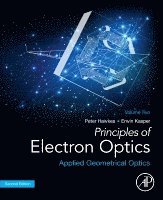
    Principles of Electron Optics, Volume 1

    Basic Geometrical Optics

    AvPeter W. Hawkes,Erwin Kasper

    Häftad, Engelska, 2017

    2 312 kr

    Beställningsvara. Skickas inom 10-15 vardagar. Fri frakt över 249 kr.

    Beskrivning

    Volume one of Principles of Electron Optics: Basic Geometrical Optics, Second Edition, explores the geometrical optics needed to analyze an extremely wide range of instruments: cathode-ray tubes; the family of electron microscopes, including the fixed-beam and scanning transmission instruments, the scanning electron microscope and the emission microscope; electron spectrometers and mass spectrograph; image converters; electron interferometers and diffraction devices; electron welding machines; and electron-beam lithography devices.

    The book provides a self-contained, detailed, modern account of electron optics for anyone involved with particle beams of modest current density in the energy range up to a few mega-electronvolts. You will find all the basic equations with their derivations, recent ideas concerning aberration studies, extensive discussion of the numerical methods needed to calculate the properties of specific systems and guidance to the literature of all the topics covered. A continuation of these topics can be found in volume two, Principles of Electron Optics:�Applied Geometrical Optics.

    The book is intended for postgraduate students and teachers in physics and electron optics, as well as researchers and scientists in academia and industry working in the field of electron optics, electron and ion microscopy and nanolithography.


    • Offers a fully revised and expanded new edition based on the latest research developments in electron optics
    • Written by the top experts in the field
    • Covers every significant advance in electron optics since the subject originated
    • Contains exceptionally complete and carefully selected references and notes
    • Serves both as a reference and text
    Produktinformation

    • Utgivningsdatum:2017-10-29
    • Mått:191 x 235 x 42 mm
    • Vikt:1 500 g
    • Format:Häftad
    • Språk:Engelska
    • Antal sidor:728
    • Upplaga:2
    • Förlag:Elsevier Science
    • ISBN:9780081022566

    Utforska kategorier

    • Fysik inom Naturvetenskap och teknik

    Mer om författaren

    Peter Hawkes obtained his M.A. and Ph.D (and later, Sc.D.) from the University of Cambridge, where he subsequently held Fellowships of Peterhouse and of Churchill College. From 1959 – 1975, he worked in the electron microscope section of the Cavendish Laboratory in Cambridge, after which he joined the CNRS Laboratory of Electron Optics in Toulouse, of which he was Director in 1987. He was Founder-President of the European Microscopy Society and is a Fellow of the Microscopy and Optical Societies of America. He is a member of the editorial boards of several microscopy journals and serial editor of Advances in Electron Optics. Erwin Kasper studied physics at the Universities of Münster and Tübingen (Germany), where he obtained his PhD in 1965 and the habilitation to teach physics in 1969. After scientific spells in the University of Tucson, Arizona (1966) and in Munich (1970), he resumed his research and teaching in the Institute of Applied Physics, University of Tübingen, where he was later appointed professor. He lectured on general physics and especially on electron optics. The subject of his research was theoretical electron optics and related numerical methods on which he published numerous papers. After his retirement in 1997, he published a book on numerical field calculation (2001).

    Innehållsförteckning

    • 1. IntroductionPART I – CLASSICAL MECHANICS2. Relativistic Kinematics3. Different Forms of Trajectory Equations4. Variational Principles5. Hamiltonian OpticsPART II – CALCULATION OF STATIC FIELDS6. Basic Concepts and Equations7. Series Expansions8. Boundary-Value Problems9. Integral Equations10. The Boundary-Element Method11. The Finite-Difference Method (FDM)12. The Finite-Element Method (FEM)13. Field-Interpolation TechniquesPART III – THE PARAXIAL APPROXIMATION14. Introduction15. Systems with an Axis of Rotational Symmetry16. Gaussian Optics of Rotationally Symmetric Systems: Asymptotic Image Formation17. Gaussian Optics of Rotationally Symmetric Systems: Real Cardinal Elements18. Electron Mirrors19. Quadrupole Lenses20. Cylindrical LensesPART IV – ABERRATIONS21. Introduction22. Perturbation Theory: General Formalism23. The Relation Between Permitted Types of Aberration and System Symmetry24. The Geometrical Aberrations of Round Lenses25. Asymptotic Aberration Coefficients26. Chromatic Aberrations27. Aberration Matrices and the Aberrations of Lens Combinations28. The Aberrations of Mirrors and Cathode Lenses29. The Aberrations of Quadrupole Lenses and Octopoles30. The Aberrations of Cylindrical Lenses31. Parasitic AberrationsPART V – DEFLECTION SYSTEMS32. Paraxial Properties of Deflection Systems33. The Aberrations of Deflection SystemsPART VI – COMPUTER-AIDED ELECTRON OPTICS34. Numerical Calculation of Trajectories, Paraxial Properties and Aberrations