• Fri frakt över 249 kr
  • •
  • Snabba leveranser
  • •
  • Billiga böcker
Kundservice

Du är på sajten för privatpersoner.

Företag, bibliotek eller offentlig verksamhet?

Du handlar på classic.bokus.com, där alla dina funktioner finns intakta.
Till classic.bokus.com
Bokus logotyp. Gå till startsidan.
  • Erbjudanden
  • Student
  • Topplistor
  • Barn & ungdom
  • Bokus Play
  • E-böcker
  • Ljudböcker
  • Pocketböcker
  • Spel och pussel

Pocketfynda! Hundratals böcker för 49 kr/st →

Sidfot

Mina sidor

    Hjälp

    • Kundservice
    • Vanliga frågor och svar
    • Frakt och leverans
    • Retur vid ångerrätt
    • Reklamera vara
    • Betalning
    • Köpvillkor
    • Allmänna villkor
    • Information om webbplatsens tillgänglighet

    Om Bokus

    • Om oss
    • Pressrum
    • För studenter
    • För företag
    • För bibliotek och offentlig verksamhet
    • För leverantörer
    • Hållbarhet

    Populärt

    • Aktuella erbjudanden
    • Presentkort
    • Studentlitteratur
    • Nya böcker
    • Topplistor
    • Signerade böcker
    • Engelska böcker

    Inspiration

    • Boktips
    • BookTok
    • Barnbokskaraktärer
    • Populära författare
    Logotyp för Bokus
    Följ oss på Facebook (extern länk)Följ oss på Instagram (extern länk)Följ oss på YouTube (extern länk)Följ oss på TikTok (extern länk)
    bokus @ CookiesAnpassa cookiesIntegritetspolicyKöpvillkor
    Till Citymail hemsida (extern länk)Till Budbee hemsida (extern länk)Till Postnord hemsida (extern länk)Till Schenker hemsida (extern länk)Till Early Bird hemsida (extern länk)Till Walleys hemsida (extern länk)
    1. Naturvetenskap och teknik
    2. Teknik och industri
    3. Elektronik och kommunikationer

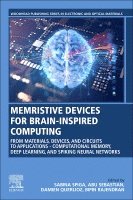
    Memristive Devices for Brain-Inspired Computing

    From Materials, Devices, and Circuits to Applications - Computational Memory, Deep Learning, and Spiking Neural Networks

    AvSabina Spiga,Abu Sebastian

    Häftad, Engelska, 2020

    Del i serien Woodhead Publishing Series in Electronic and Optical Materials

    2 430 kr

    Beställningsvara. Skickas inom 10-15 vardagar. Fri frakt över 249 kr.

    Beskrivning

    Memristive Devices for Brain-Inspired Computing: From Materials, Devices, and Circuits to Applications-Computational Memory, Deep Learning, and Spiking Neural Networks reviews the latest in material and devices engineering for optimizing memristive devices beyond storage applications and toward brain-inspired computing. The book provides readers with an understanding of four key concepts, including materials and device aspects with a view of current materials systems and their remaining barriers, algorithmic aspects comprising basic concepts of neuroscience as well as various computing concepts, the circuits and architectures implementing those algorithms based on memristive technologies, and target applications, including brain-inspired computing, computational memory, and deep learning.

    This comprehensive book is suitable for an interdisciplinary audience, including materials scientists, physicists, electrical engineers, and computer scientists.


    • Provides readers an overview of four key concepts in this emerging research topic including materials and device aspects, algorithmic aspects, circuits and architectures and target applications
    • Covers a broad range of applications, including brain-inspired computing, computational memory, deep learning and spiking neural networks
    • Includes perspectives from a wide range of disciplines, including materials science, electrical engineering and computing, providing a unique interdisciplinary look at the field

    Produktinformation

    • Utgivningsdatum:2020-06-12
    • Mått:152 x 229 x 29 mm
    • Vikt:910 g
    • Format:Häftad
    • Språk:Engelska
    • Serie:Woodhead Publishing Series in Electronic and Optical Materials
    • Antal sidor:564
    • Förlag:Elsevier Science
    • ISBN:9780081027820

    Utforska kategorier

    • Elektronik och kommunikationer inom Naturvetenskap och teknik
    • Maskinteknik och material inom Naturvetenskap och teknik

    Mer om författaren

    Sabina Spiga received the Degree in Physics from the Università di Bologna in 1995 and the PhD in Material Science in 2002 from Università di Milano. She is staff researcher at CNR-IMM–Unit of Agrate Brianza (Italy) since 2004, and she is currently leading a research team developing oxide-based resistive switching non-volatile memories and memristive devices for neuromorphic systems. She is currently principal Investigator for CNR of the project European project-Horizo2020 NeuRAM3-NEUral computing aRchitectures in Advanced Monolithic 3D-VLSI nano-technologies; and since 2014 she is also member of the Management Committee for Italy of the COST Action ICT 1401-“Memristors-Devices, Models, Circuits, Systems and Applications”. S. Spiga is co-author of more than 100 publications on peer reviewed journals and proceedings. She co-organized several symposia and workshops and national and international level, and in 2013/2014 she participated to the IEDM Memory Technology subcommittee. IBM Research – Zurich, SwitzerlandAbu Sebastian received a B. E. (Hons.) degree in Electrical and Electronics Engineering from BITS Pilani, India, in 1998 and M.S. and Ph.D. degrees in Electrical Engineering (minor in Mathematics) from Iowa State University in 1999 and 2004, respectively. Since 2006, he is a Research Staff Member at IBM Research - Zurich in Rüschlikon, Switzerland.He was a contributor to several key projects in the space of storage and memory technologies such as probe-based data storage, phase-change memory and carbon-based memory. Most recently, he is actively researching the area of non-von Neumann computing with the intent of connecting the technological elements with applications such as cognitive computing. He has published over 140 articles in journals and conference proceedings. He also holds over 30 granted patents. He is a co-recipient of the 2009 IEEE Control Systems Technology Award. In 2015 he was awarded the European Research Council (ERC) consolidator grant and in 2016 he was named an IBM Master Inventor.He served on the editorial board of the journal, Mechatronics from 2008 till 2015. He also served on the memory technologies committee of the IEDM from 2015-2016. Damien Querlioz is a CNRS researcher at the Centre for Nanoscience and Nanotechnology of Université Paris-Sud, Orsay. He received his predoctoral education at Ecole Normale Supérieure, Paris, his PhD at Université Paris-Sud in 2008, and was a postdoctoral scholar at Stanford University and CEA. He focuses on novel usages of emerging non-volatile memory, in particular relying on inspirations from biology and machine learning. He coordinates the INTEGNANO interdisciplinary research group. In 2016, he was the recipient of an ERC Starting Grant to develop the concept of natively intelligent memory. Bipin Rajendran received a B.Tech degree from I.I.T. Kharagpur, in 2000, and M.S. and Ph.D. degrees in Electrical Engineering from Stanford University, in 2003 and 2006, respectively. He was a Master Inventor and Research Staff Member at IBM T. J. Watson Research Center in New York during 2006-'12 and a faculty member in the Electrical Engineering Department at I.I.T. Bombay during 2012-'15. His research focuses on building algorithms, devices, and systems for brain-inspired computing. He has authored over 60 papers in peer-reviewed journals and conferences and has been issued 55 U.S. patents. His work has been recognized by Research Division Award and Technical Accomplishment Awards by IBM. He is a senior Member of IEEE and has served on the technical program committee of several IEEE conferences such as DRC, NVMW etc. His research in various aspects of Neuromorphic Computing has been funded by National Science Foundation, Semiconductor Research Corporation, IBM, Intel, and CISCO. He is currently an Associate Professor of Electrical and Computer Engineering at New Jersey Institute of Technology,USA.

    Innehållsförteckning

    • Part I Memristive devices for brain–inspired computing1. Role of resistive memory devices in brain-inspired computing 2. Resistive switching memories 3. Phase change memories4. Magnetic and Ferroelectric memories5. Selectors for resistive memory devicesPart II Computational Memory6. Memristive devices as computational memory 7. Logical operations8. Hyperdimensional Computing Nanosystem: In-memory Computing using Monolithic 3D Integration of RRAM and CNFET9. Matrix vector multiplications using memristive devices and applications thereof10. Computing with device dynamics 11. Exploiting stochasticity for computingPart III Deep learning12. Memristive devices for deep learning applications 13. PCM based co-processors for deep learning  14. RRAM based co-processors for deep learningPart IV Spiking neural networks15. Memristive devices for spiking neural networks 16. Neuronal realizations based on memristive devices17. Synaptic realizations based on memristive devices 18. Neuromorphic co-processors and experimental demonstrations 19. Recent theoretical developments and applications of spiking neural networks