• Fri frakt över 249 kr
  • •
  • Snabba leveranser
  • •
  • Billiga böcker
Kundservice

Du är på sajten för privatpersoner.

Företag, bibliotek eller offentlig verksamhet?

Du handlar på classic.bokus.com, där alla dina funktioner finns intakta.
Till classic.bokus.com
Bokus logotyp. Gå till startsidan.
  • Erbjudanden
  • Student
  • Topplistor
  • Barn & ungdom
  • Bokus Play
  • E-böcker
  • Ljudböcker
  • Pocketböcker
  • Spel och pussel

Upp till 25% på utvalda nyheter →

Sidfot

Mina sidor

    Hjälp

    • Kundservice
    • Vanliga frågor och svar
    • Frakt och leverans
    • Retur vid ångerrätt
    • Reklamera vara
    • Betalning
    • Köpvillkor
    • Allmänna villkor
    • Information om webbplatsens tillgänglighet

    Om Bokus

    • Om oss
    • Pressrum
    • För studenter
    • För företag
    • För bibliotek och offentlig verksamhet
    • För leverantörer
    • Hållbarhet

    Populärt

    • Aktuella erbjudanden
    • Presentkort
    • Studentlitteratur
    • Nya böcker
    • Topplistor
    • Signerade böcker
    • Engelska böcker

    Inspiration

    • Boktips
    • BookTok
    • Barnbokskaraktärer
    • Populära författare
    Logotyp för Bokus
    Följ oss på Facebook (extern länk)Följ oss på Instagram (extern länk)Följ oss på YouTube (extern länk)Följ oss på TikTok (extern länk)
    bokus @ CookiesAnpassa cookiesIntegritetspolicyKöpvillkor
    Till Citymail hemsida (extern länk)Till Budbee hemsida (extern länk)Till Postnord hemsida (extern länk)Till Schenker hemsida (extern länk)Till Early Bird hemsida (extern länk)Till Walleys hemsida (extern länk)
    1. Naturvetenskap och teknik
    2. Teknik och industri
    3. Maskinteknik och material

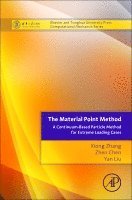
    The Material Point Method

    A Continuum-Based Particle Method for Extreme Loading Cases

    AvXiong Zhang,Zhen Chen

    Inbunden, Engelska, 2016

    1 378 kr

    Beställningsvara. Skickas inom 10-15 vardagar. Fri frakt över 249 kr.

    Beskrivning

    The Material Point Method: A Continuum-Based Particle Method for Extreme Loading Cases systematically introduces the theory, code design, and application of the material point method, covering subjects such as the spatial and temporal discretization of MPM, frequently-used strength models and equations of state of materials, contact algorithms in MPM, adaptive MPM, the hybrid/coupled material point finite element method, object-oriented programming of MPM, and the application of MPM in impact, explosion, and metal forming.

    Recent progresses are also stated in this monograph, including improvement of efficiency, memory storage, coupling/combination with the finite element method, the contact algorithm, and their application to problems.


    • Provides a user's guide and several numerical examples of the MPM3D-F90 code that can be downloaded from a website
    • Presents models that describe different types of material behaviors, with a focus on extreme events.
    • Includes applications of MPM and its extensions in extreme events, such as transient crack propagation, impact/penetration, blast, fluid-structure interaction, and biomechanical responses to extreme loading

    Produktinformation

    • Utgivningsdatum:2016-10-24
    • Mått:152 x 229 x 22 mm
    • Vikt:700 g
    • Format:Inbunden
    • Språk:Engelska
    • Antal sidor:300
    • Förlag:Elsevier Science
    • ISBN:9780124077164

    Utforska kategorier

    • Maskinteknik och material inom Naturvetenskap och teknik

    Mer om författaren

    Xiong Zhang received his Ph.D. in Computational Mechanics from the Dalian University of Technology in 1992. He is now a professor in the School of Aerospace Engineering at Tsinghua University, and the Associate Editor of the International Journal of Mechanics and Materials in Design. His selected honors include the New Century Excellent Talents in University (Ministry of Education of China, 2004), the First prize (2008) and Second prize (2009) for Natural Science from the Ministry of Education of China, the ICACM Fellows Award (2011), the Beijing Municipal Famous Teacher Award for Higher Education (2015) and the Qian Lingxi Computational Mechanics Award (Achievement Award, 2016). His current research interests focus on numerical modeling of extreme events, such as hypervelocity impact, blast, bird impact, penetration, perforation and fluid-structure interaction. He has published 3 monographs and 3 textbooks in Chinese. He was included in the list of Elsevier’s “Most Cited Chinese Researchers” in 2015. His research area is in Computation Mechanics with a recent focus on multiscale modeling and simulation of the multiphysical phenomena involved in structural failure subjected to extreme loading conditions. Before joining MU in 1995, he was a professional staff member at New Mexico Engineering Research Institute as well as in the Department for the Waste Isolation Pilot Project/Performance Analysis Code Development at Sandia National Laboratories.Among his honors and awards are the Fellow of ASME, the Fellow of the ICACM, the Yangtze visiting professor and Qianren-Plan visiting professor appointed by the Ministry of Education in China, the Faculty Research Award in the College of Engineering at MU, the Outstanding Youth Award (Oversea) from the National Natural Science Foundation of China, and the NSF-CAREER Award. He received his Ph.D. in solid and computational mechanics from the University of New Mexico in 1989. did his postdoctoral research at Northwestern University from 2008 to 2010. He has been a faculty member at Tsinghua University since 2010, and is now anassociate professor in the School of Aerospace Engineering.His research interests include multiscale simulation, meshfree particle methods and impact dynamics.He received the Natural Science Award from Chinese Ministry of Education in 2009, Du Qing-Hua Medal & Young Researcher Award of Computational Methods in Engineering in 2012, the ICACM Young Investigator Award in 2013.

    Innehållsförteckning

    • 1. Introduction2. Governing Equations3. The Material Point Method4. Computer Implementation of the MPM5. Coupling of the MPM with FEM6. Constitutive Models7. Multiscale MPM8. Applications of the MPM