• Fri frakt över 249 kr
  • •
  • Snabba leveranser
  • •
  • Billiga böcker
Kundservice

Du är på sajten för privatpersoner.

Företag, bibliotek eller offentlig verksamhet?

Du handlar på classic.bokus.com, där alla dina funktioner finns intakta.
Till classic.bokus.com
Bokus logotyp. Gå till startsidan.
  • Erbjudanden
  • Nyheter
  • Student
  • Topplistor
  • Barn & ungdom
  • Bokus Play
  • E-böcker
  • Pocketböcker
  • Spel & pussel

10% rabatt på allt med kod: NYSTART10 →

Sidfot

Mina sidor

    Hjälp

    • Kundservice
    • Vanliga frågor och svar
    • Frakt och leverans
    • Retur vid ångerrätt
    • Reklamera vara
    • Betalning
    • Köpvillkor
    • Allmänna villkor
    • Information om webbplatsens tillgänglighet

    Om Bokus

    • Om oss
    • Pressrum
    • För studenter
    • För företag
    • För bibliotek och offentlig verksamhet
    • För leverantörer
    • Hållbarhet

    Populärt

    • Aktuella erbjudanden
    • Presentkort
    • Studentlitteratur
    • Nya böcker
    • Topplistor
    • Signerade böcker
    • Engelska böcker

    Inspiration

    • Boktips
    • BookTok
    • Populära bokserier
    • Barnbokskaraktärer
    • Populära författare
    Logotyp för Bokus
    Följ oss på Facebook (extern länk)Följ oss på Instagram (extern länk)Följ oss på YouTube (extern länk)Följ oss på TikTok (extern länk)
    bokus @ CookiesAnpassa cookiesIntegritetspolicyKöpvillkor
    Till Citymail hemsida (extern länk)Till Budbee hemsida (extern länk)Till Postnord hemsida (extern länk)Till Schenker hemsida (extern länk)Till Early Bird hemsida (extern länk)Till Walleys hemsida (extern länk)
    1. Psykologi och pedagogik
    2. Psykologi
    3. Arbetspsykologi

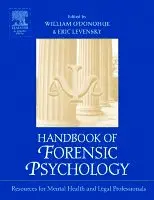
    Handbook of Forensic Psychology

    Resource for Mental Health and Legal Professionals

    AvWilliam O'Donohue,Eric R. Levensky

    Inbunden, Engelska, 2004

    2 065 kr

    Beställningsvara. Skickas inom 10-15 vardagar. Fri frakt över 249 kr.

    Beskrivning

    Forensic psychology has mushroomed into a diverse and increasingly complex field that is equal parts law and psychology. Psychologists act as expert witnesses in legal cases - sometimes without knowing much about the laws involved, and legal professionals rely on the assessment of psychologists sometimes without knowing much about how such assessments are made.

    The purpose of this handbook is to provide professionals with current, practical, and empirically based information to guide their work in forensic settings, or to better their understanding of the issues and debates in forensic psychology.

    Divided into four sections, the Handbook of Forensic Psychology covers basic issues, assessment, mental disorders and forensic psychology, and special topics. The basic issue chapters present a primer on law for the psychologist, a primer on psychology for attorneys, an overview of ethical issues relevant to forensic psychology, and a chapter on forensic report writing. The assessment section discusses factors and measures relevant for assessing a variety of behaviors, propensities, and capabilities, including dangerousness, violence, suicide, competency, substance abuse, PTSD and neuropsychological evaluations, as well as discussing interviewing children and child custody evaluations. Additional chapters discuss eyewitness testimony, recovered memory, polygraphs, sexual harassment, juror selection, and issues of ethnicity in forensic psychology.

    Produktinformation

    • Utgivningsdatum:2004-01-19
    • Mått:191 x 235 x 56 mm
    • Vikt:1 930 g
    • Format:Inbunden
    • Språk:Engelska
    • Antal sidor:1 104
    • Förlag:Elsevier Science
    • ISBN:9780125241960

    Utforska kategorier

    • Arbetspsykologi inom Psykologi och pedagogik

    Mer om författaren

    Dr. William O’Donohue is a licensed clinical psychologist and professor of clinical psychology at the University of Nevada, Reno. He obtained his B.S. in Psychology from University of Urbana-Champaign and his M.A. and Ph.D. in Clinical Psychology from SUNY at Stony Brook. Dr. O’Donohue’s research focuses on quality in mental health service delivery, integrated care, human sexuality, forensic psychology, cognitive behavioral therapy, and philosophy of psychology. For the last three decades, he has directed a free psychological treatment center for sexual assault victims. He has served on the American Psychiatric Association’s advisory committee to revise the diagnosis of pedophilia for the DSM5, and he has published more than 10 books with Elsevier, including Handbook of Cultural Competence in Applied Psychology and Forensic Interviews Regarding Child Sexual Abuse.

    Recensioner i media

    "O'Donohue and Levensky have put together a readable and truly comprehensive work that covers forensic topics (legal and ethical) intersecting with psychology. The editors divide the discussion into logical sections that include basic issues, assessment issues, mental disorders, and special topics. Chapters treat such key issues as forensic reports, eyewitness testimony, juries, and polygraphs. Included among the many other important topics are nonverbal detection of deception, and elder and child abuse. The list of contributors is impressive, and all information is current. This book will be a vital tool for forensic scientists and forensic psychologists as well as an invaluable resource for anyone who must write reports or give courtroom testimony. Summing Up: Essential. All collections supporting the study of forensics at the upper-division undergraduate level and above." --CHOICE

    Innehållsförteckning

    • Part I: Basic Issues.M.G. Brogdon, Sr., J.H. Adams, and R. Bahri, Psychology and the Law.W.T. O'Donohue, K. Beitz, and E.R. Levensky, An Introduction to Psychology for Attorneys.M. Lavin, Ethical Issues in Forensic Psychology.J.E. Hecker and R.J. Scoular, Forensic Report Writing.Part II: Assessment.L. Eccleston and T. Ward, Assessment of Dangerousness and Criminal Responsibility.R.J. Dempster, Issues in the Assessment, Communication, and Management of Risk for Violence.K. Strosahl, Forensic and Ethical Issues in the Assessment and Treatment of the Suicidal Patient.R. Roesch, J. Viljoen, and I. Hui, Assessing Intent and Criminal Responsibility.J. Skeem, S.L. Golding, and P. Emke-Francis, Assessing Adjudicative Competency: Using Legal and Empirical Principles to Inform Practice.C. Yury, R.A. Gentry, H. LeRoux, J.A. Buchanan, and J.E. Fisher, Assessing Mental Competency in the Elderly.A.R. Bradley, Child Custody Evaluations.M. Fanetti and R. Boles, Forensic Interviewing and Assessment Issues with Children.A. McLearen, C.A. Pietz, and R.L. Denney, Evaluation of Psychological Damages.K. Ferguson, Detecting Malingering in Forensic Neuropsychological Evaluations in Litigants with Mild Traumatic Brain Injury.E.V. Gifford, B.S. Kohlenberg, M.M. Piasecki, and E.J. Webber, The Forensic Assessment of Substance Abuse.K. Treadwell and E. Foa, Assessment of Post-Traumatic Stress Disorder.Part III: Mental Disorders and Forensic Psychology.S.G. Little, A. Akin-Little, and U.H. Mocniak, Conduct Disorders and Impulse Control in Children.E.M. Cale and S.O. Lilienfeld, What Every Forensic Psychologist Should Know About Psychopathic Personality.T.P. Sbraga, Sexual Deviance and Forensic Psychology: A Primer.S.J. Hucker, Disorders of Impulse Control.W.L. Williams, P.M. Ghezzi, and E. Burkeholder, Developmental Disabilities and Mental Retardation.Part IV: Special Topics.S. Ghetti, J.M. Schaaf, J. Qin, and G.S. Goodman, Issues in Eyewitness Testimony.A.C. Tsai, S. Morsbach, and E.F. Loftus, In Search of Recovered Memories.E. Martin, A Daubert Testing of Hypnotically Refreshed Testimony in the Criminal Courts.E.M. Oksol and W.T. O'Donohue, A Critical Analysis of the Polygraph.M. Frank and P. Ekman, Nonverbal Detection of Deception in Forensic Contexts.C. Avina, A. Bowers, and W.T. O'Donohue, Forensic Issues in Sexual Harassment.S.T. Azar and N. Olson, Legal Issues in Child Abuse and Neglect.E.R. Levensky and A.E. Fruzzetti, Partner Violence: Assessment, Prediction, and Intervention. D. Henderson, D. Varble, and J. Buchanan, Elder Abuse: Guidelines for Treatment.B.R. Johnson, Involuntary Commitment.D. Davis and W.C. Follette, Jurors Can Be Selected: Noninformation, Misinformation and Their Strategic Uses for Jury Selection.M. Mahaffey, Issues of Ethnicity in Forensic Psychology: A Model for Hispanics in the United States.K.A. Brunswig and R. Parham, Psychology in a Secure Setting.R. Otto, Evaluation of Youth in the Juvenile Justice System.D. Davis and W.T. O'Donohue, The Road to Perdition: Extreme Influence Tactics in the Interrogation Room.D. Davis and E.F. Loftus, What's Good for the Goose Cooks the Gander: Inconsistencies Between the Law and Psychology of Voluntary Intoxication and Sexual Assault.