• Fri frakt över 249 kr
  • •
  • Snabba leveranser
  • •
  • Billiga böcker
Kundservice

Du är på sajten för privatpersoner.

Företag, bibliotek eller offentlig verksamhet?

Du handlar på classic.bokus.com, där alla dina funktioner finns intakta.
Till classic.bokus.com
Bokus logotyp. Gå till startsidan.
  • Erbjudanden
  • Nyheter
  • Student
  • Topplistor
  • Barn & ungdom
  • Bokus Play
  • E-böcker
  • Pocketböcker
  • Spel & pussel

10% rabatt på allt med kod: NYSTART10 →

Sidfot

Mina sidor

    Hjälp

    • Kundservice
    • Vanliga frågor och svar
    • Frakt och leverans
    • Retur vid ångerrätt
    • Reklamera vara
    • Betalning
    • Köpvillkor
    • Allmänna villkor
    • Information om webbplatsens tillgänglighet

    Om Bokus

    • Om oss
    • Pressrum
    • För studenter
    • För företag
    • För bibliotek och offentlig verksamhet
    • För leverantörer
    • Hållbarhet

    Populärt

    • Aktuella erbjudanden
    • Presentkort
    • Studentlitteratur
    • Nya böcker
    • Topplistor
    • Signerade böcker
    • Engelska böcker

    Inspiration

    • Boktips
    • BookTok
    • Populära bokserier
    • Barnbokskaraktärer
    • Populära författare
    Logotyp för Bokus
    Följ oss på Facebook (extern länk)Följ oss på Instagram (extern länk)Följ oss på YouTube (extern länk)Följ oss på TikTok (extern länk)
    bokus @ CookiesAnpassa cookiesIntegritetspolicyKöpvillkor
    Till Citymail hemsida (extern länk)Till Budbee hemsida (extern länk)Till Postnord hemsida (extern länk)Till Schenker hemsida (extern länk)Till Early Bird hemsida (extern länk)Till Walleys hemsida (extern länk)
    1. Språk och ordböcker
    2. Språkvetenskap och lingvistik

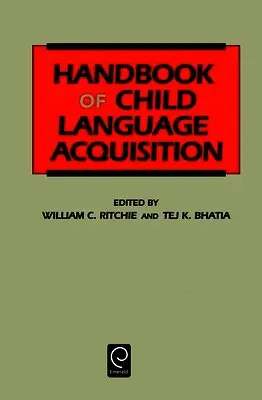
    Handbook of Child Language Acquisition

    AvTej K. Bhatia,William C. Ritchie

    Inbunden, Engelska, 1998

    Del i serien Brill

    2 228 kr

    Beställningsvara. Skickas inom 5-8 vardagar. Fri frakt över 249 kr.

    Beskrivning

    What allows children to acquire language so effortlessly, with such speed, and with such amazing accuracy? Capitalizing on the most recent developments in linguistics and cognitive psychology, this volume sheds new light on the what, why, and how of the child's ability to acquire one or more languages. The "Handbook" is one of a kind in a number of respects. It includes state-of-the-art treatments of acquisition from a variety of theoretical viewpoints ranging from functionalist approaches and the implications of the creolization of languages for the study of acquisition to the relevance of Chomsky's Minimalist Program. It contains overviews of the acquisition of all components of linguistic structure, treats the acquisition of the sign languages of the deaf, and discusses the specific problems of bilingual acquisition. This handbook addresses the following questions: 'Is the capacity for language acquisition constant throughout the career of the language learner (that is, is it 'continuous') or does that capacity change in significant ways as the learner matures?' ; 'Is the language capacity a separate module of the mind or does it follow from general, 'all-purpose' cognitive capacities?'; 'What is innate in language acquisition and what is acquired on the basis of experience?'; 'What research/methodological issues arise in the study of child language acquisition?'; 'How might input from the language (or languages) of the environment, including visual/gestural input in the case of the sign languages of the deaf, affect the process and result of acquisition?'; and, 'How are the facts of non-normal acquisition to be explained?'

    Produktinformation

    • Utgivningsdatum:1998-11-16
    • Mått:155 x 235 x 49 mm
    • Vikt:1 277 g
    • Format:Inbunden
    • Språk:Engelska
    • Serie:Brill
    • Antal sidor:742
    • Förlag:Elsevier Science Publishing Co Inc
    • ISBN:9780125890410

    Utforska kategorier

    • Språkvetenskap och lingvistik inom Språk och ordböcker
    • Barnpsykologi och utvecklingspsykologi inom Psykologi och pedagogik

    Recensioner i media

    "This volume benefits from the state-of-the-art contributions of prominent specialists, presents various approaches to SLA and covers most of the key issues in the field. I believe that it is a useful, comprehensive handbook for both students and researchers in the field." --Larisa Avram in INTERNATIONAL JOURNAL OF PSYCHOLINGUISTICS "...the book is an excellent collection of readings on selected aspects of human language development, particularly nativist points of view... if one is teaching a graduate course on language acquisition, and a collection of first-rate summaries of primarily nativist positions is desired, then this is certainly a book to consider." --CHILD LANGUAGE, Vol. 27, 2000 "...the Handbook of Child Language Acquisition provides a useful and unique view of the field... we have no reservations about recommending that you check it out of your local library and sample some of its valuable chapters." --CONTEMPORARY PSYCHOLOGY, Vol. 45, 2000

    Innehållsförteckning

    • Research and Theoretical Issues in Child Language Acquisition: W.C. Ritchie and T.K. Bhatia, Child Language Acquisition: Introduction, Foundations, and Overview. Issues of Innateness, Maturation, and Modularity in Child Language Acquisition: N. Chomsky, On the Nature, Use, and Acquisition of Language. K. Wexler, Maturation and Growth of Grammar. B. Lust, Universal Grammar: The Strong Continuity Hypothesis in First Language Acquisition. W. O'Grady, The Acquisition of Syntactic Representations: A General Nativist Approach. D. Bickerton, Creole Languages, the Language Bioprogram Hypothesis, and Language Acquisition. M. Rispoli, Functionalist Accounts of the Process of First Language Acquisition. Semantics and Syntax in Child Word Learning: P. Bloom, Theories of Word Learning: Rationalist Alternatives to Associationism. L.R. Gleitman and J. Gillette, The Role of Syntax in Verb Learning. The Child's Acquisition of Phonology and Pragmatics: B.E. Dresher, Child Phonology, Learnability, and Phonological Theory. A. Ninio and C.E. Snow, The Development of Pragmatics: Learning to Use Language Appropriately. Research Methodology and Applications: S. Crain and K. Wexler, Methodology in the Study of Language Acquisition: A Modular Approach. B. Lust, S. Flynn, C. Foley, and Y. Chien, How Do We Know What Children Know? Problems and Advances in Establishing Scientific Methods for the Study of Language Acquisition and Linguistic Theory. B. MacWhinney, The CHILDES System. Modality and the Linguistic Environment in Child Language: V. Valian, Input and Language Acquisition. D. Lillo-Martin, Modality Effects and Modularity in Language Acquisition: The Acquisition of American Sign Language. T.K. Bhatia and W.C. Ritchie, The Bilingual Child: Some Issues and Perspectives. Language Disorders and Impairments: Special Cases of Child Language Acquisition: D.A. Dinnsen, Some Empirical and Theoretical Issues in Disordered Child Phonology. H. Clahsen, Linguistic Perspectives on Specific Language Impairment. List of Abbreviations. Author Index. Subject Index.