• Fri frakt över 249 kr
  • •
  • Snabba leveranser
  • •
  • Billiga böcker
Kundservice

Du är på sajten för privatpersoner.

Företag, bibliotek eller offentlig verksamhet?

Du handlar på classic.bokus.com, där alla dina funktioner finns intakta.
Till classic.bokus.com
Bokus logotyp. Gå till startsidan.
  • Erbjudanden
  • Student
  • Topplistor
  • Barn & ungdom
  • Bokus Play
  • E-böcker
  • Ljudböcker
  • Pocketböcker
  • Spel & pussel

10% rabatt på allt med kod NYSTART10 →

Sidfot

Mina sidor

    Hjälp

    • Kundservice
    • Vanliga frågor och svar
    • Frakt och leverans
    • Retur vid ångerrätt
    • Reklamera vara
    • Betalning
    • Köpvillkor
    • Allmänna villkor
    • Information om webbplatsens tillgänglighet

    Om Bokus

    • Om oss
    • Pressrum
    • För studenter
    • För företag
    • För bibliotek och offentlig verksamhet
    • För leverantörer
    • Hållbarhet

    Populärt

    • Aktuella erbjudanden
    • Presentkort
    • Studentlitteratur
    • Nya böcker
    • Topplistor
    • Signerade böcker
    • Engelska böcker

    Inspiration

    • Boktips
    • BookTok
    • Populära bokserier
    • Barnbokskaraktärer
    • Populära författare
    Logotyp för Bokus
    Följ oss på Facebook (extern länk)Följ oss på Instagram (extern länk)Följ oss på YouTube (extern länk)Följ oss på TikTok (extern länk)
    bokus @ CookiesAnpassa cookiesIntegritetspolicyKöpvillkor
    Till Citymail hemsida (extern länk)Till Budbee hemsida (extern länk)Till Postnord hemsida (extern länk)Till Schenker hemsida (extern länk)Till Early Bird hemsida (extern länk)Till Walleys hemsida (extern länk)
    1. Data och IT
    2. Programmeringsböcker
    3. Webbprogrammering

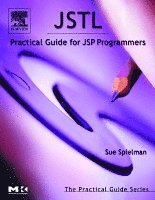
    JSTL

    Practical Guide for JSP Programmers

    AvSue Spielman

    Häftad, Engelska, 2003

    Del i serien Practical Guides

    289 kr

    Beställningsvara. Skickas inom 10-15 vardagar. Fri frakt över 249 kr.

    Fler format och utgåvor

    E-bok

    278 kr

    Beskrivning

    Web developers and page authors who use JavaServer Pages (JSP) know that it is much easier and efficient to implement web pages without reinventing the wheel each time. In order to shave valuable time from their development schedules, those who work with JSP have created, debugged, and used custom tags—a set of programmable actions that provide dynamic behavior to static pages—paving the way towards a more common, standard approach to using Java technology for web development. The biggest boost to this effort however has only recently arrived in the form of a standard set of tag libraries, known as the JSTL, which now provides a wide range of functionality and gives web page authors a much more simplified approach to implementing dynamic, Java-based web sites. JSTL: Practical Guide for JSP Programmers is a timely resource for anyone interested in doing large-scale J2EE application development. It sticks to the main features of the JSTL so that developers don't have to sift through unnecessary details to begin using the tags and working with the expression language. Sue Spielman's straight-forward, practical approach is enhanced with numerous code samples and insightful descriptions to make learning the JSTL a quickly and easily accomplished task.

    Produktinformation

    • Utgivningsdatum:2003-10-01
    • Mått:178 x 229 x 14 mm
    • Vikt:410 g
    • Format:Häftad
    • Språk:Engelska
    • Serie:Practical Guides
    • Antal sidor:229
    • Förlag:Elsevier Science & Technology
    • ISBN:9780126567557

    Utforska kategorier

    • Webbprogrammering inom Data och IT

    Mer om författaren

    Sue Spielman has over 15 years hands-on experience delivering leading edge technology products. She has been working with Java ever since it was born. Sue is the President and Senior Consulting Engineer of Switchback Software LLC (www.switchbacksoftware.com) a consulting firm that specializes in business and web application development and deployment using the latest in J2EE & J2ME technologies. She is the JSP/Servlet columnist for OnJava.com and a recognized Java expert appearing in industry magazines including JavaPro, XML, and Devx.com. Sue is a featured speaker on various Java technologies at conferences throughout the United States and abroad.

    Recensioner i media

    An invaluable reference for any JSP developer's library. Sue makes the complicated seem simple with her conversational writing style and well thought out examples and analogies. -Matt Houser, J2EE Developer with The Washington Post and former Sun Microsystems Java Instructor.

    Innehållsförteckning

    • Preface1 Introduction1.1 What Exactly Is the JSTL?1.2 Why a JSP Standard Tag Library?1.3 Why Now?1.4 Why You Really Want to Use the JSTL1.5 The Need for Encapsulation1.6 Functional Overview1.7 JSTL Tag Libraries1.8 Getting Ready to Use the JSTL1.9 The Road to the JSTL1.9.1 Dynamic vs. Static Content1.9.2 Using Dynamic Content1.9.3 Using Dynamic Web Features1.9.4 Server-Side Processing1.10 Servlets to the Rescue1.11 Hello My Friend Servlet1.12 JavaServer Pages1.13 When a JSP, When a Servlet?1.14 Evolving JSP1.15 Custom Actions in Action1.15.1 Why Use a Custom Action1.15.2 Hello My Friend Using Custom Actions1.15.3 The TLD File 1.15.4 The Tag Handler1.16 The Power of Tag Libraries1.16.1 Need for a Tag Library1.17 Making Life Easier, JSTL in Action2 JSTL Basics2.1 Environment Setup2.2 Using the Book Examples2.3 JSP Scopes2.4 JSTL Scoped Variables2.4.1 Var and Scope Attributes2.4.2 Variable Visibility2.5 Dynamic and Static Attributes2.6 Handling Errors and Exceptions2.7 Action Body Content2.8 Configuration Settings2.9 The Config Class2.10 Summary3 Using the Expression Language3.1 Implicit Objects Available in the EL3.2 Accessing Data Structures3.3 EL Operators 3.3.1 Relational Operators3.3.2 Other Operators3.3.3 Using Operators3.4 Automatic Type Conversion3.5 Default Values3.6 Summary4 Working with the Core Actions4.1 Writing Output to the JspWriter4.2 Setting Variables4.3 Removing Variables4.4 Using 4.4.1 Handling Exceptions4.5 Decisions, Decisions, Decisions—Conditional Actions4.5.1 Simple Conditional4.5.2 Mutually Exclusive Conditionals4.5.3 Creating Custom Logic Actions4.6 Handling Iterators4.6.1 4.6.2 Paging through a Large Collection4.6.3 Looping with a Collection4.6.4 Tokenizing Data Using 4.7 URL-Related Actions4.7.1 4.7.2 4.7.3 Creating and Using Dynamic Links4.7.4 4.7.5 4.8 Untangling the Web We Weave4.8.1 The Power of 4.8.2 and the Composite View Pattern4.8.3 Storing Imported Content4.8.4 Using Character Encoding4.9 Redirecting4.10 Summary5 Working with the XML Actions5.1 Overview of Supporting Technologies5.2 eXtensible Markup Language (XML)5.2.1 Using XML Files for Data Storage5.2.2 XML APIs5.3 eXtenstible Stylesheet Language (XSL)5.3.1 Allowing for Transformation5.3.2 XSL Languages5.4 XML Path Language (XPath)5.4.1 Library Functions5.5 Variable Mappings5.6 Using the Select Attribute5.7 Accessing Resources5.7.1 Node Types5.7.2 Node Functions5.8 eXtensible Stylesheet Language Transformation (XSLT)5.8.1 XSLT Namespace5.9 Parsing XML Documents5.9.1 Action5.9.2 Filtering5.9.3 Using the Advanced Attributes5.10 Using and 5.10.1 Action 5.10.2 Action5.11 and in Action 5.12 Using XML Documents to Determine Flow Control5.12.1 Action 5.12.2 Using 5.12.3 , , and Actions5.13 Going Loopy with 5.13.1 Nested forEach Loops5.14 XML Transformation Actions5.14.1 Action5.15 Transforming Content5.16 Providing Parameters to Transformations5.16.1 Action5.16.2 Performing Multiple Transformations5.17 Summary6 Working with the Internationalization and Formatting Actions6.1 Locales6.1.1 Internationalization vs. Localization6.2 Why be Language Independent?6.3 Localizing an Application Using Resource Bundles6.4 Types of I18N Architectures6.5 First, the Action6.6 Localization Context6.7 Localization Context Sample6.8 Preferred Locales6.8.1 Setting the Preferred Locales6.9 Formatting Locales6.10 How Resource Bundles are Decided6.10.1 Resource Bundle Lookup Differences6.11 Resource Bundle Lookup Samples6.12 Using the LocaleSupport Class6.13 Setting and Using Locales6.13.1 Action6.13.2 Having a Fallback Locale6.14 Using Messages and Resource Bundles6.14.1 Action6.14.2 Action6.14.3 Action6.14.4 Action6.15 Setting the Resource Bundle for 6.16 Adding a parameter to 6.17 Formatting Actions6.17.1 Determining the Time Zone6.17.2 Action6.17.3 Action 6.18 Setting and Using Time Zones6.19 Working with Timestamps6.20 Formatting and Parsing Timestamps6.20.1 Action6.20.2 6.20.3 Customizing the Format6.21 Using and Parsing Timestamps6.22 Working with Numbers6.22.1 Action6.22.2 Action6.22.3 Formatting Numbers6.22.4 Parsing Numbers6.23 Encoding the Client Response6.24 Summary7 SQL Tag Library Using the SQL Actions7.1 The Available Actions7.2 Working with the Data Source7.2.1 7.3 Configuring a Data Source7.4 Using a Data Source7.5 Maxrows Configuration Setting7.6 Configuring and Using a Data Source7.7 How to Modify Data7.7.1 Action7.7.2 How to Use var with 7.8 Interfaces and Classes7.8.1 Result Interface7.8.2 SQLExecutionTag Interface7.8.3 ResultSupport Class7.9 Finding What You Need with 7.9.1 Action7.10 Passing Parameters to SQL Statements7.10.1 Dealing with Date Parameters7.11 Working with Result Sets7.11.1 Accessing Rows and Columns7.11.2 Using Result Set Metadata7.12 Dealing with Transactions7.12.1 Words of Caution7.13 Action 7.14 How to Use 7.15 Summary7.16 Conclusion8 JSTL Quick Reference8.1 Expression Language Syntax8.1.1 Literals8.1.2 “[]” and “.” Operators8.1.3 Arithmetic Operators8.1.4 Relational Operators8.1.5 Logical Operators8.1.6 Empty Operator8.1.7 Operator Precedence8.1.8 Reserved Words8.1.9 Coercion Rules8.1.10 Accessing Named Variables8.1.11 Implicit Objects8.2 Configuration Settings8.3 Core Tag Library8.3.1 Tag Library URI8.3.2 General Purpose Actions8.3.3 Conditional Actions8.3.4 Iterator Actions8.3.5 URL Related Actions8.4 XML Tag Library8.4.1 Tag Library URI8.4.2 XML Core Actions8.4.3 XML Flow Control8.4.4 Iterator Actions8.4.5 Transformation Actions8.5 SQL Tag Library8.5.1 Tag Library URI8.5.2 Actions8.6 I18N Tag Library8.6.1 Tag Library URI8.6.2 Internationalization Actions8.6.3 Formatting ActionsIndex