• Fri frakt över 249 kr
  • •
  • Snabba leveranser
  • •
  • Billiga böcker
Kundservice

Du är på sajten för privatpersoner.

Företag, bibliotek eller offentlig verksamhet?

Du handlar på classic.bokus.com, där alla dina funktioner finns intakta.
Till classic.bokus.com
Bokus logotyp. Gå till startsidan.
  • Erbjudanden
  • Nyheter
  • Student
  • Topplistor
  • Barn & ungdom
  • Bokus Play
  • E-böcker
  • Pocketböcker
  • Spel & pussel

10% rabatt på allt med kod: NYSTART10 →

Sidfot

Mina sidor

    Hjälp

    • Kundservice
    • Vanliga frågor och svar
    • Frakt och leverans
    • Retur vid ångerrätt
    • Reklamera vara
    • Betalning
    • Köpvillkor
    • Allmänna villkor
    • Information om webbplatsens tillgänglighet

    Om Bokus

    • Om oss
    • Pressrum
    • För studenter
    • För företag
    • För bibliotek och offentlig verksamhet
    • För leverantörer
    • Hållbarhet

    Populärt

    • Aktuella erbjudanden
    • Presentkort
    • Studentlitteratur
    • Nya böcker
    • Topplistor
    • Signerade böcker
    • Engelska böcker

    Inspiration

    • Boktips
    • BookTok
    • Populära bokserier
    • Barnbokskaraktärer
    • Populära författare
    Logotyp för Bokus
    Följ oss på Facebook (extern länk)Följ oss på Instagram (extern länk)Följ oss på YouTube (extern länk)Följ oss på TikTok (extern länk)
    bokus @ CookiesAnpassa cookiesIntegritetspolicyKöpvillkor
    Till Citymail hemsida (extern länk)Till Budbee hemsida (extern länk)Till Postnord hemsida (extern länk)Till Schenker hemsida (extern länk)Till Early Bird hemsida (extern länk)Till Walleys hemsida (extern länk)
    1. Psykologi och pedagogik
    2. Psykologi
    3. Kognitiv psykologi

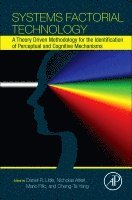
    Systems Factorial Technology

    A Theory Driven Methodology for the Identification of Perceptual and Cognitive Mechanisms

    AvDaniel Little,Nicholas Altieri

    Inbunden, Engelska, 2017

    960 kr

    Beställningsvara. Skickas inom 10-15 vardagar. Fri frakt över 249 kr.

    Beskrivning

    Systems Factorial Technology: A Theory Driven Methodology for the Identification of Perceptual and Cognitive Mechanisms explores the theoretical and methodological tools used to investigate fundamental questions central to basic psychological and perceptual processes. Such processes include detection, identification, classification, recognition, and decision-making.

    This book collects the tools that allow researchers to deal with the pervasive model mimicry problems which exist in standard experimental and theoretical paradigms and includes novel applications to not only basic psychological questions, but also clinical diagnosis and links to neuroscience.

    Researchers can use this book to begin using the methodology behind SFT and to get an overview of current uses and future directions. The collected developments and applications of SFT allow us to peer inside the human mind and provide strong constraints on psychological theory.


    • Provides a thorough introduction to the diagnostic tools offered by SFT
    • Includes a tutorial on applying the method to reaction time data from a variety of different situations
    • Introduces novel advances for testing the significance of SFT results
    • Incorporates new measures that allow for the relaxation of the high accuracy criterion
    • Examines tools to expand the scope of SFT analyses
    • Applies SFT to a spectrum of different cognitive domains across different sensory modalities

    Produktinformation

    • Utgivningsdatum:2017-04-07
    • Mått:152 x 229 x 28 mm
    • Vikt:810 g
    • Format:Inbunden
    • Språk:Engelska
    • Antal sidor:428
    • Förlag:Elsevier Science
    • ISBN:9780128043158

    Utforska kategorier

    • Kognitiv psykologi inom Psykologi och pedagogik

    Mer om författaren

    Daniel R. Little is a Senior Lecturer at the University of Melbourne. He directs the Knowledge, Information & Learning Laboratory in the Melbourne School of Psychological Sciences. His research focuses on the mathematical modeling of complex perceptual decisions in categorization and recognition. Daniel received his PhD in 2009 from the University of Western Australia. Nicholas Altieri, MS PhD, is an Assistant Professor of Speech Language Pathology at Idaho State University. He currently co-directs the EEG laboratory in the Department of Communication Sciences and Disorders. His research specializes in multi-sensory perception, cognitive neuroscience, speech recognition, and statistical modeling of psychological processes. Nicholas studied as a graduate student for five years in James Townsend's laboratory where he began working with SFT, and continues to apply its theoretical fundamentals across a wide range of research topics. Mario Fifić is an associate Professor of Department of Psychology at Grand Valley State University, Michigan. He directs the Cognitive Science and Decision-Making Laboratory. His research focuses on the development of a highly diagnostic and sophisticated methodology for uncovering mental architecture, known as systems factorial technology (SFT). SFT allows for precise determination of the fundamental properties of mental processes underlying cognitive operations in categorization, face detection, reading and visual/memory search. Prof. Cheng-Ta Yang is an Associate Professor of Department of Psychology, National Cheng Kung University. He got his PHD degree at Department of Psychology, National Taiwan University in 2009. His primary research interests include attention, visual short-term memory, perceptual decision-making, and cognitive modeling. He has spent more than 10 years on studying Systems Factorial Technology and its application. Recently, he received several awards such as Ta-You Wu Memorial Award from National Science Council (2013), The Outstanding Young Persons (2015), and Academia Sinica Research Award for Junior Research Investigators (2016).

    Innehållsförteckning

    • I. Introduction to Systems Factorial Technology1. Historical Foundations and a Tutorial Introduction to Systems Factorial TechnologyNicholas Altieri, Mario Fific, Daniel Little and Cheng-Ta Yang 2. Stretching Mental Processes: An Overview of and Guide for SFT ApplicationsMario Fific and Daniel Little II. Recent Advances in Systems Factorial Technology3. Statistical analyses for Systems Factorial TechnologyJoseph Houpt and Devin Michael Burns 4. Development and Applications of the Capacity-Function that Measures AccuracyNicholas Altieri5. Selective Influence And Categorical Separability (Perceptual Separability) In Perception And Cognition: Similarities And DistinctionsJames T. Townsend, Yanjun Liu and Jennifer Lentz 6. Bridge-Building: SFT Interrogation of Major Cognitive PhenomenaDaniel Algom, Daniel Fitousi and Ami Eidels 7. An Examination of Task Demands on the Elicited Processing CapacityLeslie Blaha8. An Information Processing Perspective to Understanding Conflicting InformationXue Jun Cheng, Sarah Moneer, Nicole Elise Christie and Daniel Little III. Applications of Systems Factorial Technology9. Applying the Double Factorial Paradigm to Detection and Categorization Tasks: An Example Using Audiovisual Speech PerceptionNicholas Altieri10. Attention and Perceptual Decision MakingCheng-Ta Yang11. Are Two Ears Always Better than One? The Capacity Function Says NoYuan He, Jennifer Lentz and James T. Townsend 12. Logical-rule Based Models of Categorization: Using Systems Factorial Technology to Understand Feature and Dimensional ProcessingDavid william Griffiths, Anthea Grace Blunden and Daniel Little 13. Applying Systems Factorial Technology to Discrete Accumulators with Varying ThresholdsBradley Harding, Vincent LeBlanc, Marc-Andre Goulet and Denis Cousineau 14. Can Confusion-Data Inform Systems Factorial Technology-Like Inference? A Comparison of SFT and Accuracy-Based Measures in Comparable ExperimentsZachary L. Howard, Ami Eidels, Noah H. Silbert, and Daniel R. Little15. The Advantages of Combining the Simultaneous-Sequential Paradigm with Systems Factorial TechnologyPiers Douglas Howe and Adam Ferguson IV. Bridging Levels of Explanation16. The Continuing Evolution of Systems Factorial Theory: Connecting Theory with Behavioral and Neural DataMichael Wenger, Erin Ingvalson and Stephanie Rhoten 17. Using Systems Factorial Technology to Elucidate the "f" of Clinical fMRS (functional Magnetic SpectroscopyReggie Taylor, Jean Theberge, Peter Williamson, Maria Densmore and Richard Neufeld 18. Applications of Capacity Analysis into Social Cognition DomainAlla Yankouskaya, Jie Sui, Zahra Moradi, Pia Rotshtein, and Glyn W. Humphreys