• Fri frakt över 249 kr
  • •
  • Snabba leveranser
  • •
  • Billiga böcker
Kundservice

Du är på sajten för privatpersoner.

Företag, bibliotek eller offentlig verksamhet?

Du handlar på classic.bokus.com, där alla dina funktioner finns intakta.
Till classic.bokus.com
Bokus logotyp. Gå till startsidan.
  • Erbjudanden
  • Nyheter
  • Student
  • Topplistor
  • Barn & ungdom
  • Bokus Play
  • E-böcker
  • Pocketböcker
  • Spel & pussel

10% rabatt på allt med kod NYSTART10 →

Sidfot

Mina sidor

    Hjälp

    • Kundservice
    • Vanliga frågor och svar
    • Frakt och leverans
    • Retur vid ångerrätt
    • Reklamera vara
    • Betalning
    • Köpvillkor
    • Allmänna villkor
    • Information om webbplatsens tillgänglighet

    Om Bokus

    • Om oss
    • Pressrum
    • För studenter
    • För företag
    • För bibliotek och offentlig verksamhet
    • För leverantörer
    • Hållbarhet

    Populärt

    • Aktuella erbjudanden
    • Presentkort
    • Studentlitteratur
    • Nya böcker
    • Topplistor
    • Signerade böcker
    • Engelska böcker

    Inspiration

    • Boktips
    • BookTok
    • Populära bokserier
    • Barnbokskaraktärer
    • Populära författare
    Logotyp för Bokus
    Följ oss på Facebook (extern länk)Följ oss på Instagram (extern länk)Följ oss på YouTube (extern länk)Följ oss på TikTok (extern länk)
    bokus @ CookiesAnpassa cookiesIntegritetspolicyKöpvillkor
    Till Citymail hemsida (extern länk)Till Budbee hemsida (extern länk)Till Postnord hemsida (extern länk)Till Schenker hemsida (extern länk)Till Early Bird hemsida (extern länk)Till Walleys hemsida (extern länk)
    1. Naturvetenskap och teknik
    2. Teknik och industri
    3. Maskinteknik och material

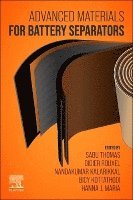
    Advanced Materials for Battery Separators

    AvSabu Thomas,Didier Rouxel

    Häftad, Engelska, 2024

    2 250 kr

    Beställningsvara. Skickas inom 10-15 vardagar. Fri frakt över 249 kr.

    Beskrivning

    Advanced Materials for Battery Separators focuses solely on battery separators and their significance, providing the reader with a detailed description of their use in both aqueous and non-aqueous batteries. Topics include separator requirements and classifications, as well as discussions of the different methods for the fabrication of separators, experimental techniques used for the characterization of separators, and their physical and chemical properties. It concludes with a look at the challenges and new technologies developed to improve the performance of separators.

    This book is a valuable reference for engineers, research scholars, and for graduates and post graduates primarily in the field of material science, electrochemistry, and polymer chemistry. It can also be useful for engineers and technologists working in both industry and the energy field.

    • Provides a detailed discussion of separators used in battery applications
    • Discusses the influence of nanofillers on separator performance and the analytical techniques used for the characterization of separators
    • Explores the challenges and new technologies to improve the performance of separators

    Produktinformation

    • Utgivningsdatum:2024-06-25
    • Mått:152 x 229 x undefined mm
    • Vikt:730 g
    • Format:Häftad
    • Språk:Engelska
    • Antal sidor:442
    • Förlag:Elsevier Science
    • ISBN:9780128175071

    Utforska kategorier

    • Maskinteknik och material inom Naturvetenskap och teknik

    Mer om författaren

    Professor Sabu Thomas is currently an Emeritus Professor of Mahatma Gandhi University, Kottayam, Kerala, India. He was the former Vice Chancellor of Mahatma Gandhi University. He is a Senior Professor of Christ University, Bangalore, India. He is also a visiting Professor at the Department of Chemical Sciences, University of Johannesburg, Johannesburg, South Africa, Department of Chemical Engineering, Faculty of Engineering, Chulalongkorn University, Bangkok, Thailand, and an Adjunct Faculty in the Department of Polymer and Process Engineering, IIT Roorkee, India. He is the Chairman of the TrEST Research Park, Trivandrum, Kerala, India. The H index of Professor Thomas is 163 and he has more than 133,000 citationsDr. Didier Rouxel is a full Professor at the University of Lorraine, France, and researcher in the Institut Jean Lamour of Nancy, France. He received the Engineer degree from the École Supérieure des Sciences et Techniques de l’Ingénieur de Nancy, in 1989, and the Ph.D. degree in material sciences and engineering from the University of Nancy I in 1993. He was the Leader of the “Micro and NanoSystems” Group of the Institut Jean Lamour, Nancy, France (2013-2018). He was also the Leader of the C’NANO French Grand Est network for the theme “Nanosciences and Materials for Health” (2009-2015), Expert of the European Interreg project NANO4M – Nano For Market, Theme “Nano & Microsensors and Implants (HEALTH)” (2009-2010), Expert from the French national agency ANSES, “Nanomaterials and Health” Working Group (2012-2015). Prof. Rouxel has been involved in the spectroscopic analysis of inorganics and is vastly experienced in the analysis of polymer nanocomposite systems by almost all spectroscopic techniques. His major areas of interest include elastic properties of polymeric materials studied by Brillouin spectroscopy, development of polymer nanocomposite materials, development of micro-devices based on electro-active polymers, piezoelectric nanocrystals, microsensor development for surgery, etc. Since 2011, he has co-directed numerous Franco-Indian collaborative projects. He is Doctor Honoris Causa from Mahatma Gandhi University, Kerala, India (2022).Dr. Nandakumar Kalarikkal is an Associate Professor at the School of Pure and Applied Physics and Joint Director of the International and Inter University Centre for Nanoscience and Nanotechnology of Mahatma Gandhi University, Kottayam, Kerala, India. His research activities involve applications of nanostructured materials, laser plasma, and phase transitions. He is the recipient of research fellowships and associateships from prestigious government organizations such as the Department of Science and Technology and Council of Scientific and Industrial Research of the Government of India. He has active collaborations with national and international scientific institutions in India, South Africa, Slovenia, Canada, France, Germany, Malaysia, Australia, and the United States. He has more than 130 publications in peer-reviewed journals. He also co-edited nine books of scientific interest and co-authored many book chapters. Ms.BICY K is a CSIR-SRF doctoral Fellow. Her area of interest is fabrication of microporous polymeric separators for Lithium ion batteries. The topic of her research is polymer based nanocomposite membranes for lithium ion battery separator, at IIUCNN, Mahatma Gandhi University .Kottayam. In addition, her research includes the preparation of microporous polymer membranes and nanocomposites by different techniques like Electrospinning, Solution casting, melt mixing etc. and their applications in lithium ion battery separator. Hanna J. Maria is a Senior Researcher at the School of Energy Materials and the International and Inter University Centre for Nanoscience and Nanotechnology, Mahatma Gandhi University, India. Her research focusses on natural rubber composites and their blends, thermoplastic composites, lignin, nanocellulose, bionanocomposites, nanocellulose, rubber-based composites and nanocomposites.

    Innehållsförteckning

    • 1. Battery energy storage systems: A methodical enabler of reliable power2. Separators: an essential barrier between electrodesPart I: Separators for Non-Aqueous Batteries3. Introduction to Separators for Non-Aqueous Batteries4. Separators for Lithium Ion Batteries5. Advanced Separators for Lithium Sulfur Batteries6. Lithium Ion Conducting Membranes in Lithium-Air Batteries7. Designing of Ion Transport Pathways in Separator for Lithium Ion BatteriesPart II: Separators for Aqueous Batteries8. Introduction to Separators for Aqueous Batteries9. Lead Acid Battery Separators10. Alkaline Zn-MnO2 Battery Separators11. Redox Flow BatteriesPart III: Theoretical Predictions and Future Challenges12. Theoretical Simulations of Lithium-Ion Batteries13. New Challenges of Battery Separators