• Fri frakt över 249 kr
  • •
  • Snabba leveranser
  • •
  • Billiga böcker
Kundservice

Du är på sajten för privatpersoner.

Företag, bibliotek eller offentlig verksamhet?

Du handlar på classic.bokus.com, där alla dina funktioner finns intakta.
Till classic.bokus.com
Bokus logotyp. Gå till startsidan.
  • Erbjudanden
  • Nyheter
  • Student
  • Topplistor
  • Barn & ungdom
  • Bokus Play
  • E-böcker
  • Pocketböcker
  • Spel & pussel

10% rabatt på allt med kod NYSTART10 →

Sidfot

Mina sidor

    Hjälp

    • Kundservice
    • Vanliga frågor och svar
    • Frakt och leverans
    • Retur vid ångerrätt
    • Reklamera vara
    • Betalning
    • Köpvillkor
    • Allmänna villkor
    • Information om webbplatsens tillgänglighet

    Om Bokus

    • Om oss
    • Pressrum
    • För studenter
    • För företag
    • För bibliotek och offentlig verksamhet
    • För leverantörer
    • Hållbarhet

    Populärt

    • Aktuella erbjudanden
    • Presentkort
    • Studentlitteratur
    • Nya böcker
    • Topplistor
    • Signerade böcker
    • Engelska böcker

    Inspiration

    • Boktips
    • BookTok
    • Populära bokserier
    • Barnbokskaraktärer
    • Populära författare
    Logotyp för Bokus
    Följ oss på Facebook (extern länk)Följ oss på Instagram (extern länk)Följ oss på YouTube (extern länk)Följ oss på TikTok (extern länk)
    bokus @ CookiesAnpassa cookiesIntegritetspolicyKöpvillkor
    Till Citymail hemsida (extern länk)Till Budbee hemsida (extern länk)Till Postnord hemsida (extern länk)Till Schenker hemsida (extern länk)Till Early Bird hemsida (extern länk)Till Walleys hemsida (extern länk)
    1. Data och IT
    2. Informationsteknik: allmänt

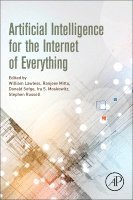
    Artificial Intelligence for the Internet of Everything

    AvWilliam Lawless,Ranjeev Mittu

    Häftad, Engelska, 2019

    1 261 kr

    Beställningsvara. Skickas inom 10-15 vardagar. Fri frakt över 249 kr.

    Beskrivning

    Artificial Intelligence for the Internet of Everything considers the foundations, metrics and applications of IoE systems. It covers whether devices and IoE systems should speak only to each other, to humans or to both. Further, the book explores how IoE systems affect targeted audiences (researchers, machines, robots, users) and society, as well as future ecosystems. It examines the meaning, value and effect that IoT has had and may have on ordinary life, in business, on the battlefield, and with the rise of intelligent and autonomous systems. Based on an artificial intelligence (AI) perspective, this book addresses how IoE affects sensing, perception, cognition and behavior.

    Each chapter addresses practical, measurement, theoretical and research questions about how these "things� may affect individuals, teams, society or each other. Of particular focus is what may happen when these "things� begin to reason, communicate and act autonomously on their own, whether independently or interdependently with other "things�.


    • Considers the foundations, metrics and applications of IoE systems
    • Debates whether IoE systems should speak to humans and each other
    • Explores how IoE systems affect targeted audiences and society
    • Discusses theoretical IoT ecosystem models

    Produktinformation

    • Utgivningsdatum:2019-02-25
    • Mått:152 x 229 x 15 mm
    • Vikt:430 g
    • Format:Häftad
    • Språk:Engelska
    • Antal sidor:303
    • Förlag:Elsevier Science
    • ISBN:9780128176368

    Utforska kategorier

    • Informationsteknik: allmänt inom Data och IT
    • Artificiell intelligens inom Data och IT

    Mer om författaren

    William Lawless is professor of mathematics and psychology at Paine College, GA. For his PhD topic on group dynamics, he theorized about the causes of tragic mistakes made by large organizations with world-class scientists and engineers. After his PhD in 1992, DOE invited him to join its citizens advisory board (CAB) at DOE’s Savannah River Site (SRS), Aiken, SC. As a founding member, he coauthored numerous recommendations on environmental remediation from radioactive wastes (e.g., the regulated closure in 1997 of the first two high-level radioactive waste tanks in the USA). He is a member of INCOSE, IEEE, AAAI and AAAS. His research today is on autonomous human-machine teams (A-HMT). He is the lead editor of seven published books on artificial intelligence. He was lead organizer of a special issue on “human-machine teams and explainable AI” by AI Magazine (2019). He has authored over 85 articles and book chapters, and over 175 peer-reviewed proceedings. He was the lead organizer of twelve AAAI symposia at Stanford (2020). Since 2018, he has also been serving on the Office of Naval Research's Advisory Boards for the Science of Artificial Intelligence and Command Decision Making. Ranjeev Mittu is the Branch Head for the Information and Decision Sciences Branch within the Information Technology Division at the U.S. Naval Research Laboratory (NRL). He leads a multidisciplinary group of scientists and engineers conducting research and advanced development in visual analytics, human performance assessment, decision support systems, and enterprise systems. Mr. Mittu’s research expertise is in multi-agent systems, human-systems integration, artificial intelligence (AI), machine learning, data mining and pattern recognition; and he has authored and/or coedited eleven books on the topic of AI in collaboration with the national and international scientific communities spanning academia and defense. Mr. Mittu received a Master of Science Degree in Electrical Engineering in 1995 from The Johns Hopkins University in Baltimore, MD.The views expressed in this Work do not necessarily represent the views of the Department of the Navy, the Department of Defense, or the United States.Don Sofge is a computer scientist and roboticist at the Naval Research Laboratory (NRL) with 36 years of experience in artificial intelligence, machine learning, and control systems R&D, the last 23 years at NRL. He leads the Distributed Autonomous Systems Section in the Navy Center for Applied Research in Artificial Intelligence (NCARAI), where he develops nature-inspired computing paradigms to challenging problems in sensing, artificial intelligence, and control of autonomous robotic systems. He has more than 200 refereed publications including 12 edited books in robotics, artificial intelligence, machine learning, planning, sensing, control, and related disciplines.The views expressed in this Work do not necessarily represent the views of the Department of the Navy, the Department of Defense, or the United States.Dr. Moskowitz has been a mathematician at the Naval Research Laboratory (NRL) for 29 years; presently, he is in the Information Management and Decision Architectures Branch within NRL’s Information Technology Division. Prior to his work at NRL, he was a mathematics professor. His PhD was in Differential Topology from Stony Brook University, Stony Brook, New York. His research areas are information theory and information hiding. His major contributions have been to the area of covert channel analysis. He has over 120 publications and three patents. In particular he is the co-inventor of the NRL Network Pump ®. Dr. Russell is currently the Battlefield Information Processing Branch Chief at the Army Research Laboratory. Dr. Russell received a B.Sc. in Computer Science and M.S. and Ph.D. degrees in Information Systems from the University of Maryland. His primary research interests are in the area of decision support systems, machine learning, systems architectures, and intelligent systems. His published research articles appear in Expert Systems with Applications, Decision Support Systems Journal, the Encyclopedia of Decision Making and Decision Support Technologies, and Frontiers in Bioscience, amongst others.

    Innehållsförteckning

    • 1. Introduction2. Uncertainty Quantification in Internet of Battlefield Things3. Intelligent Autonomous Things on the Battlefield4. Active Inference in Multi-agent Systems: Context-driven Collaboration and Decentralized Purpose-driven Team Adaptation5. Policy Issues Regarding Implementations of Cyber Attack. Resilience Solutions for Cyber Physical Systems6. Trust and Human-Machine Teaming: A Qualitative Study7. The Web of Smart Entities – Aspects of a Theory of the Next Generation of the Internet of Things8. Raising Them Right: AI and the Internet of Big Things9. Valuable Information and the Internet of Things10. Would IOET Make Economics More Neoclassical or More Behavioral? Richard Thaler’s Prediction, A Revisit11. Accessing Validity of Argumentation of Agents of the Internet of Everything12. Distributed Autonomous Energy Organizations: Next Generation Blockchain Applications for Energy Infrastructure13. Compositional Models for Complex Systems14. Meta-agents: Using Multi-Agent Networks to Manage Dynamic Changes in the Internet of Things (IoT)