• Fri frakt över 249 kr
  • •
  • Snabba leveranser
  • •
  • Billiga böcker
Kundservice

Du är på sajten för privatpersoner.

Företag, bibliotek eller offentlig verksamhet?

Du handlar på classic.bokus.com, där alla dina funktioner finns intakta.
Till classic.bokus.com
Bokus logotyp. Gå till startsidan.
  • Erbjudanden
  • Nyheter
  • Student
  • Topplistor
  • Barn & ungdom
  • Bokus Play
  • E-böcker
  • Pocketböcker
  • Spel & pussel

10% studentrabatt med kod TERM26

Sidfot

Mina sidor

    Hjälp

    • Kundservice
    • Vanliga frågor och svar
    • Frakt och leverans
    • Retur vid ångerrätt
    • Reklamera vara
    • Betalning
    • Köpvillkor
    • Allmänna villkor
    • Information om webbplatsens tillgänglighet

    Om Bokus

    • Om oss
    • Pressrum
    • För studenter
    • För företag
    • För bibliotek och offentlig verksamhet
    • För leverantörer
    • Hållbarhet

    Populärt

    • Aktuella erbjudanden
    • Presentkort
    • Studentlitteratur
    • Nya böcker
    • Topplistor
    • Signerade böcker
    • Engelska böcker

    Inspiration

    • Boktips
    • BookTok
    • Populära bokserier
    • Barnbokskaraktärer
    • Populära författare
    Logotyp för Bokus
    Följ oss på Facebook (extern länk)Följ oss på Instagram (extern länk)Följ oss på YouTube (extern länk)Följ oss på TikTok (extern länk)
    bokus @ CookiesAnpassa cookiesIntegritetspolicyKöpvillkor
    Till Citymail hemsida (extern länk)Till Budbee hemsida (extern länk)Till Postnord hemsida (extern länk)Till Schenker hemsida (extern länk)Till Early Bird hemsida (extern länk)Till Walleys hemsida (extern länk)
    1. Naturvetenskap och teknik
    2. Teknik och industri
    3. Biokemisk teknik

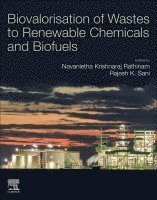
    Biovalorisation of Wastes to Renewable Chemicals and Biofuels

    AvNavanietha Krishnaraj Rathinam,Rajesh Sani

    Häftad, Engelska, 2019

    1 938 kr

    Beställningsvara. Skickas inom 10-15 vardagar. Fri frakt över 249 kr.

    Beskrivning

    Biovalorisation of Wastes to Renewable Chemicals and Biofuels addresses advanced technologies for converting waste to biofuels and value-added products. Biovalorisation has several advantages over conventional bioremediation processes as it helps reduce the costs of bioprocesses. Examples are provided of several successfully commercialized technologies, giving insight into developing, potential processes for biovalorisation of different wastes. Different bioprocess strategies are discussed for valorising the wastes coming from the leather industry, olive oil industry, pulp and paper, winery, textile, and food industries, as well as aquaculture.� A section on biorefinery for hydrocarbons and emerging contaminants is included to cover concepts on biodesulfurization of petroleum wastes, leaching of heavy metals from E - waste, and bioelectrochemical processes for CO2.� Chapters on algal biorefinery are also included to focus on the technologies for conversion of CO2 sequestration and wastewater utilization.

    Biovalorisation of Wastes to Renewable Chemicals and Biofuels can be used as course material for graduate students in chemical engineering, chemistry, and biotechnology, and as a reference for industrial professionals and researchers who want to gain a basic understanding on the subject.


    • Covers a wide range of topics, from the conversion of wastes to organic acids, biofuels, biopolymers and industrially relevant products
    • Bridges the gap between academics and industry
    • Written in a lucid and self-explanatory style
    • Includes activities/quiz/critical questions

    Produktinformation

    • Utgivningsdatum:2019-10-15
    • Mått:216 x 276 x undefined mm
    • Vikt:1 060 g
    • Format:Häftad
    • Språk:Engelska
    • Antal sidor:422
    • Förlag:Elsevier Science
    • ISBN:9780128179512

    Utforska kategorier

    • Biokemisk teknik inom Naturvetenskap och teknik
    • Tillverkningsteknik inom Naturvetenskap och teknik

    Mer om författaren

    Navanietha Rathinam is a Research Professor in the Department of Chemical and Biological Engineering, South Dakota School of Mines and Technology, South Dakota. His research interests include bioelectrochemical systems for converting wastes to biofuels and value-added products, biofuels from lignocellulosic biomass, extremophilic bioprocessing, and space biology. He is a recipient of prestigious awards including Bioenergy - Award for Cutting Edge Research, Australian Overseas Research Award, and Young Faculty Award in Engineering. He has published over 30 research articles, 10 book chapters, edited 3 books, 1 patent, and PI/Co-I for 4 research grants. He also serves as a panelist for federal agencies such as NASA and NSF. He is selected as a US Ambassador for American Society for Microbiology. Dr. Sani is a Professor in the Departments of Chemical and Biological Engineering and Chemistry, Biology, and Health Sciences at South Dakota School of Mines and Technology, Rapid City, SD. In the past 16 years, Dr. Sani has taught 15 different courses (e.g., Biochemical Engineering, Extremophilic Bioprocessing, Biochemistry, and Applied Biological Sciences courses) to undergraduate and graduate students at the South Dakota School of Mines and Technology and Washington State University, Pullman WA, and tried to integrate Engineering Sciences with Biological Sciences. His research expertise includes Rules of Life in Biofilms grown on 2D materials, Extremophilic Bioprocessing of Solid Wastes to Biofuels and Value-added Products, Space Biology, Genome Editing, Biocatalysis, and Biopolymers. He has one patent, eleven invention disclosures, published over 100 peer-reviewed articles in high impact factor journals, and has contributed to 34 book chapters. In addition, he has edited 10 books, and has been leading a research consortium funded by the NSF with the aid of 48 scientists and engineers.

    Innehållsförteckning

    • Part 1: Biovalorisation of Industrial Wastes1. Anaerobic biovalorisation of leather industry solid waste and production of high value-added biomolecules and biofuels2. Valorization of olive oil industry wastes and production of ethanol and high value-added biomolecules3. Anerobic treatment of pulp and paper industry waste4. Biovolarisation of winery industry waste to produce value added products5. Conversion of Textile effluent waste water to fertilizer using cyanobacteria6. Anaerobic bioconversion of poultry industry-derived wastes for the production of biofuels and other value-added products7. The Intertwined Facets of Membrane Technology for Industrial Effluents8. Biovalorisation of food industry wastes (cheese whey and molasses) to galactosidases by recombinant Part 2: Biorefinery for Hydrocarbons and Emerging Contaminants9. Biodesulfurisation of petroleum wastes10. Microbial leaching of heavy metals from E - waste : opportunities and challengesPart 3: Biovalorisation of agricultural biomass11. Recent trends in biorefinery based valorization of lignocellulosic biomass 12. Protein Engineering Approaches for Lignocellulosic Ethanol Biorefinery13. Biovalorisation potential of Agro-forestry/industry biomass to Lactic acid: Opportunities and Challenges14. Vermicomposting of organic wastes and the production of vermicompost15. Microbial Electrolysis cells for converting wastes to Biohydrogen16. Agro-Based Sugarcane Industry Wastes For Production Of High Value BioproductsPart 4: Algal Biorefinary17. Microalgal Biovalorisation: Conventional and Non-Conventional Approach18. Integration of wastewater valorization with microalgae for biofuel production19. Microalgae in Bioelectrochemical Systems: Technological Interventions20. Bioleaching21. Membrane separation technologies for downstream processing