• Fri frakt över 249 kr
  • •
  • Snabba leveranser
  • •
  • Billiga böcker
Kundservice

Du är på sajten för privatpersoner.

Företag, bibliotek eller offentlig verksamhet?

Du handlar på classic.bokus.com, där alla dina funktioner finns intakta.
Till classic.bokus.com
Bokus logotyp. Gå till startsidan.
  • Erbjudanden
  • Student
  • Topplistor
  • Barn & ungdom
  • Bokus Play
  • E-böcker
  • Ljudböcker
  • Pocketböcker
  • Spel & pussel

Upp till 25% på utvalda nyheter →

Sidfot

Mina sidor

    Hjälp

    • Kundservice
    • Vanliga frågor och svar
    • Frakt och leverans
    • Retur vid ångerrätt
    • Reklamera vara
    • Betalning
    • Köpvillkor
    • Allmänna villkor
    • Information om webbplatsens tillgänglighet

    Om Bokus

    • Om oss
    • Pressrum
    • För studenter
    • För företag
    • För bibliotek och offentlig verksamhet
    • För leverantörer
    • Hållbarhet

    Populärt

    • Aktuella erbjudanden
    • Presentkort
    • Studentlitteratur
    • Nya böcker
    • Topplistor
    • Signerade böcker
    • Engelska böcker

    Inspiration

    • Boktips
    • BookTok
    • Populära bokserier
    • Barnbokskaraktärer
    • Populära författare
    Logotyp för Bokus
    Följ oss på Facebook (extern länk)Följ oss på Instagram (extern länk)Följ oss på YouTube (extern länk)Följ oss på TikTok (extern länk)
    bokus @ CookiesAnpassa cookiesIntegritetspolicyKöpvillkor
    Till Citymail hemsida (extern länk)Till Budbee hemsida (extern länk)Till Postnord hemsida (extern länk)Till Schenker hemsida (extern länk)Till Early Bird hemsida (extern länk)Till Walleys hemsida (extern länk)
    1. Naturvetenskap och teknik
    2. Matematik och naturvetenskap
    3. Matematik

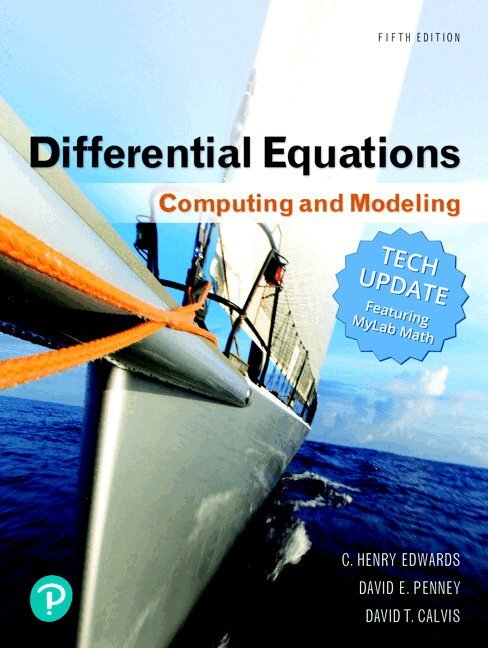
    Differential Equations

    Computing and Modeling, Tech Update

    AvC. Edwards,David Penney

    Inbunden, Engelska, 2018

    2 667 kr

    Tillfälligt slut

    Beskrivning

    For one-semester sophomore- or junior-level courses in Differential Equations.


    Fosters the conceptual development and geometric visualization students need–now available with MyLab Math

    Differential Equations: Computing and Modeling blends traditional algebra problem-solving skills with the conceptual development and geometric visualization of a modern differential equations course that is essential to science and engineering students. It balances traditional manual methods with the new, computer-based methods that illuminate qualitative phenomena–a comprehensive approach that makes accessible a wider range of more realistic applications.


    The book starts and ends with discussions of mathematical modeling of real-world phenomena, evident in figures, examples, problems, and applications throughout. For the first time, MyLab™ Math is available for the 5th Edition, providing online homework with immediate feedback, the complete eText, and more. Additionally, new presentation slides created by author David Calvis are now live in MyLab Math, available in Beamer (LaTeX) and PDF formats. The slides are ideal for both classroom lectures and student review, and combined with Calvis’ superlative videos offer a level of support not found in any other Differential Equations course.


    Also available with MyLab Math

    MyLab™ Math is the teaching and learning platform that empowers instructors to reach every student. By combining trusted author content with digital tools and a flexible platform, MyLab Math personalizes the learning experience and improves results for each student.


    Note: You are purchasing a standalone product; MyLab Math does not come packaged with this content. Students, if interested in purchasing this title with MyLab Math, ask your instructor to confirm the correct package ISBN and Course ID. Instructors, contact your Pearson representative for more information.


    If you would like to purchase both the physical text and MyLab Math, search for:


    0134996003 / 9780134996004   Differential Equations: Computing and Modeling Media Update and MyLab Math with Pearson eText -- Title-Specific Access Card Package, 5/e

    Package consists of:

    • 0134850475 / 9780134850474  Differential Equations: Computing and Modeling Media Update

    • 0134873084 / 9780134873084  MyLab Math plus Pearson eText — Standalone Access Card - for Differential Equations: Computing and Modeling Media Update

    Produktinformation

    • Utgivningsdatum:2018-01-31
    • Mått:206 x 251 x 25 mm
    • Vikt:1 093 g
    • Format:Inbunden
    • Språk:Engelska
    • Antal sidor:576
    • Upplaga:5
    • Förlag:Pearson Education
    • ISBN:9780134850474

    Utforska kategorier

    • Matematik inom Naturvetenskap och teknik

    Mer om författaren

    About our authors C. Henry Edwards is emeritus professor of mathematics at the University of Georgia. He earned his Ph.D. at the University of Tennessee in 1960, and retired after 40 years of classroom teaching (including calculus or differential equations almost every term) at the universities of Tennessee, Wisconsin, and Georgia, with a brief interlude at the Institute for Advanced Study (Princeton) as an Alfred P. Sloan Research Fellow. He has received numerous teaching awards, including the University of Georgia's honoratus medal in 1983 (for sustained excellence in honors teaching), its Josiah Meigs award in 1991 (the institution's highest award for teaching), and the 1997 statewide Georgia Regents award for research university faculty teaching excellence. His scholarly career has ranged from research and dissertation direction in topology to the history of mathematics to computing and technology in the teaching and applications of mathematics. In addition to being author or co-author of calculus, advanced calculus, linear algebra, and differential equations textbooks, he is well-known to calculus instructors as author of The Historical Development of the Calculus (Springer-Verlag, 1979). During the 1990s he served as a principal investigator on three NSF-supported projects: (1) A school mathematics project including Maple for beginning algebra students; (2) A Calculus-with-Mathematica program; and (3) A MATLAB-based computer lab project for numerical analysis and differential equations students. In 2013 Prof. Edwards was named a Fellow of the American Mathematical Society.The late David E. Penney, University of Georgia, completed his Ph.D. at Tulane University in 1965 (under the direction of Prof. L. Bruce Treybig) while teaching at the University of New Orleans. Earlier he had worked in experimental biophysics at Tulane University and the Veteran's Administration Hospital in New Orleans under the direction of Robert Dixon McAfee, where Dr. McAfee's research team's primary focus was on the active transport of sodium ions by biological membranes. Penney's primary contribution here was the development of a mathematical model (using simultaneous ordinary differential equations) for the metabolic phenomena regulating such transport, with potential future applications in kidney physiology, management of hypertension, and treatment of congestive heart failure. He also designed and constructed servomechanisms for the accurate monitoring of ion transport, a phenomenon involving the measurement of potentials in microvolts at impedances of millions of megohms. Penney began teaching calculus at Tulane in 1957 and taught that course almost every term with enthusiasm and distinction until his retirement at the end of the last millennium. During his tenure at the University of Georgia he received numerous University-wide teaching awards as well as directing several doctoral dissertations and seven undergraduate research projects. He is the author of research papers in number theory and topology, and is the author or co-author of textbooks on calculus, computer programming, differential equations, linear algebra, and liberal arts mathematics.David T. Calvis is Professor of Mathematics at Baldwin Wallace University near Cleveland, Ohio. He completed a Ph.D. in complex analysis from the University of Michigan in 1988 under the direction of Fred Gehring. While at Michigan he also received a Master's degree in Computer, Information, and Control Engineering. Having initially served at Hillsdale College in Michigan, he has been at Baldwin Wallace since 1990, most recently assisting with the creation of an Applied Mathematics program there. He has received a number of teaching awards, including BWU's Strosacker Award for Excellence in Teaching and Student Senate Teaching Award. He is the author of a number of materials dealing with the use of computer algebra systems in mathematics instruction, and has extensive classroom experience teaching differential equations and related topics.

    Innehållsförteckning

    • Table of Contents First-Order Differential Equations 1.1 Differential Equations and Mathematical Models1.2 Integrals as General and Particular Solutions1.3 Slope Fields and Solution Curves1.4 Separable Equations and Applications1.5 Linear First-Order Equations1.6 Substitution Methods and Exact EquationsMathematical Models and Numerical Methods 2.1 Population Models2.2 Equilibrium Solutions and Stability2.3 Acceleration—Velocity Models2.4 Numerical Approximation: Euler’s Method2.5 A Closer Look at the Euler Method2.6 The Runge—Kutta MethodLinear Equations of Higher Order 3.1 Introduction: Second-Order Linear Equations3.2 General Solutions of Linear Equations3.3 Homogeneous Equations with Constant Coefficients3.4 Mechanical Vibrations3.5 Nonhomogeneous Equations and Undetermined Coefficients3.6 Forced Oscillations and Resonance3.7 Electrical Circuits3.8 Endpoint Problems and EigenvaluesIntroduction to Systems of Differential Equations 4.1 First-Order Systems and Applications4.2 The Method of Elimination4.3 Numerical Methods for SystemsLinear Systems of Differential Equations 5.1 Matrices and Linear Systems5.2 The Eigenvalue Method for Homogeneous Systems5.3 A Gallery of Solution Curves of Linear Systems5.4 Second-Order Systems and Mechanical Applications5.5 Multiple Eigenvalue Solutions5.6 Matrix Exponentials and Linear Systems5.7 Nonhomogeneous Linear SystemsNonlinear Systems and Phenomena 6.1 Stability and the Phase Plane6.2 Linear and Almost Linear Systems6.3 Ecological Models: Predators and Competitors6.4 Nonlinear Mechanical Systems6.5 Chaos in Dynamical SystemsLaplace Transform Methods 7.1 Laplace Transforms and Inverse Transforms7.2 Transformation of Initial Value Problems7.3 Translation and Partial Fractions7.4 Derivatives, Integrals, and Products of Transforms7.5 Periodic and Piecewise Continuous Input Functions7.6 Impulses and Delta Functions